Determine the necessary mass, volume, or concentration for preparing a solution.
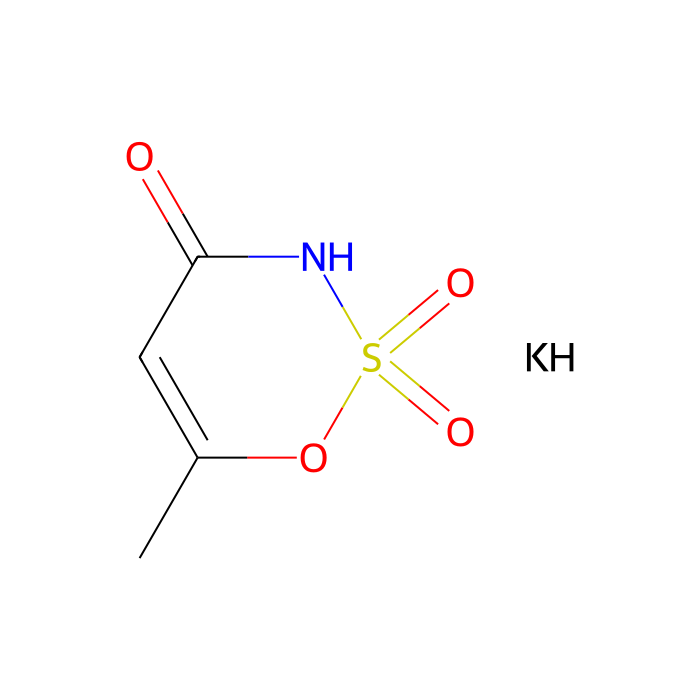
Acesulfame Potassium , CAS No.A412808
Disponible para pedir
Storage
Room temperature

for sensitive chromatographic and analytical workflows requiring minimal baseline interference.
Room temperature Ships Check lot-specific COA for exact specifications.
SDS, COA, datasheet, and spec sheet available for download. Lot-specific COA accessible via lot number lookup.
Cited in 0 peer-reviewed publications across chromatography, organic synthesis, and cross-coupling reactions.
Information
Acesulfame potassium is a non-nutritive sweetener.
In vitro
Acesulfame potassium activates two members of the human TAS2R family (hTAS2R43 and hTAS2R44) to stimulate bitter taste. Acesulfame potassium elicited robust elevation of cytosolic Ca2+ in hTAS2R44-expressing cells, with a threshold value of activation of 0.25 mM and an EC50 value of 2.5 mM. Acesulfame potassium elicited response of hTAS2R43-expressing cells with a threshold value of 3.1 mM and an estimated EC50 value ﹥10 mM\nAcesulfame potassium acts directly on the pancreatic islets and potentiates glucose-induced insulin release. Acesulfame potassium (1.0-15.0 mM) augmented insulin release from islets incubated in the presence of 7.0 mM d-glucose. [2]\nAcesulfame Potassium enhanced glucose absorption via activating sweet taste receptors in the enterocyte to translocate GLUT2 to the apical membrane through the PLC βII. In Caco-2 and RIE-1 cells, Acesulfame potassium (10 mM) increased glucose uptake by 20-30 % when incubated for 10 min with glucose >25 mM.\nAcesulfame potassium increased the contractile response of isolated rat detrusor muscle strips via increased extracellular Ca2+ influx. Acesulfame potassium (10-7 M to 10-2 M) enhanced the contractile response to 10 Hz EFS compared to control. The atropine-resistant response to EFS is marginally increased by Acesulfame potassium (10-6 M). Acesulfame potassium (10-6 M) increased the maximum contractile response to α, β methylene ATP by 35% and to KCl by 12%. Acesulfame potassium (10-6 M) increased the log EC50 from -2.7 to -3.03.
In vivo
Acesulfame potassium acts on two members of the TAS1R family of G-protein-coupled receptors (TAS1R2 and TAS1R3) to stimulate sweet taste. Selective elimination of T1R-subunits differentially abolishes de tection and perception of these two taste modalities. \nAcesulfame potassium can also induce insulin secretion in rats. Injection of Acesulfame potassium (150 mg/kg body weight) increased the plasma insulin concentration at 5 min from 27.3 mU/mL to 58.6 mU/mL. Infusion of Acesulfame potassium (20 mg/kg body weight/min) for one hour maintained the insulin concentration at a high level (about 85-100 mU/mL). When using different amounts of Acesulfame potassium, the insulin secretion is stimulated in a dose-dependent fashion. \nOral administration of Acesulfame potassium (60, 450, 1500 and 2250 mg/kg body weight) induced a significant increase in the frequency of cellular damage and chromosome aberrations in the Bone marrow cells isolated from mice femora. Oral administration of Acesulfame potassium at the concentration of 150, 300, and 600 mg/kg body weight is found to induce DNA damage in bone marrow cells of mice with a minimum effective concentration (MEC) value of 150 mg/kg in the comet assay. \n
| ALogP | -0.858 |
|---|---|
| hba_count | 2 |
| Recuento HBD | 1 |
| Sonrisas canónicas | [KH].CC1=CC(=O)N[S](=O)(=O)O1 |
|---|---|
| Reaxy-Rn | 24254301 |
| Reaxys-RN_link_address | https://www.reaxys.com/reaxys/secured/hopinto.do?context=S&query=IDE.XRN=24254301&ln= |
Comprehensive hazard, handling, storage, and regulatory compliance document.
Download SDS →Lot-specific quality data. Enter your lot number to retrieve the exact COA.
Look up COA →Full quality attributes and acceptance criteria for this grade.
View spec sheet →| DMSO (mg/ml) Solubilidad máxima | 40 |
|---|---|
| DMSO (mM) Solubilidad máxima | 197.7750309 |
| Agua (mg/ml) Solubilidad máxima | 40 |
| Agua (mM) Solubilidad máxima | 197.7750309 |