GRADE & PURITYMoligand™?Moligand™ — Aladdin's line of ligands and bioactive small molecules. Use for receptor, pathway, and binding studies needing defined small-molecule tools.≥98%(HPLC)
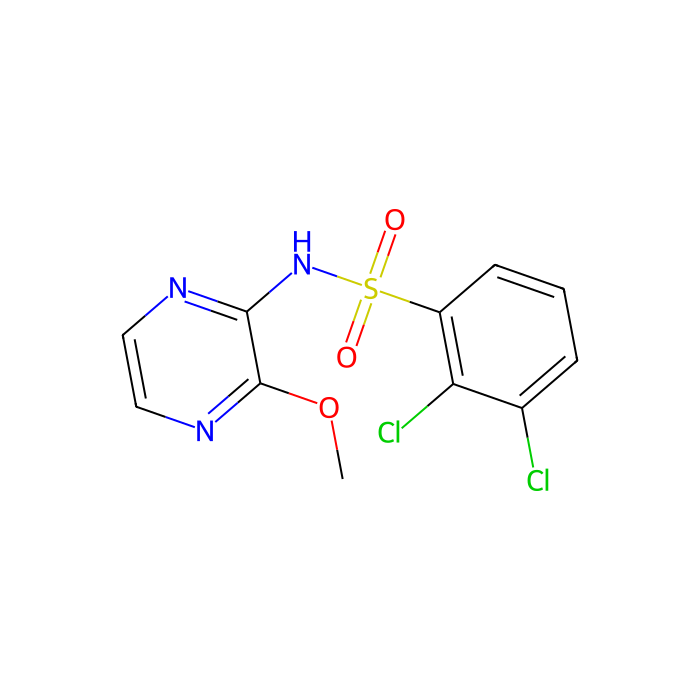
AZD-2098 is an orally active, potent and selective CCR4 antagonist (pIC50 = 7.8/8.0/8.0/7.6 against CCL22 binding to human/mouse/rat/dog CCR4; inactive toward CXCR1/2 & CCR1/2b/5/7/8 at 10 μM) with little or no activity toward a panel of ∼120 receptors/en
Condiciones de almacenamiento de almacenamiento
Store at -20°C
Enviado en
Ice chest + Ice pads
Este producto requiere envío en cadena de frío. Los servicios terrestres y otros servicios económicos no están disponibles.
This compound belongs to the class of organic compounds known as benzenesulfonamides. These are organic compounds containing a sulfonamide group that is S-linked to a benzene ring.
External Descriptors
Not available
1. Djoumbou Feunang Y, Eisner R, Knox C, Chepelev L, Hastings J, Owen G, Fahy E, Steinbeck C, Subramanian S, Bolton E, Greiner R, and Wishart DS. ClassyFire: Automated Chemical Classification With A Comprehensive, Computable Taxonomy. Journal of Cheminformatics, 2016, 8:61.
Solvent:DMSO, Max Conc. mg/mL: 33.42, Max Conc. mM: 100; Solvent:ethanol, Max Conc. mg/mL: 3.34, Max Conc. mM: 10
Peso molecular
334.200 g/mol
XLogP3
2.600
Hydrogen Bond Donor Count
1
Hydrogen Bond Acceptor Count
6
Rotatable Bond Count
4
Exact Mass
332.974 Da
Monoisotopic Mass
332.974 Da
Topological Polar Surface Area
89.600 Ų
Heavy Atom Count
20
Formal Charge
0
Complexity
418.000
Isotope Atom Count
0
Defined Atom Stereocenter Count
0
Undefined Atom Stereocenter Count
0
Defined Bond Stereocenter Count
0
Undefined Bond Stereocenter Count
0
The total count of all stereochemical bonds
0
Covalently-Bonded Unit Count
1
Calculadoras de soluciones
Molarity Calculator
Determine the necessary mass, volume, or concentration for preparing a solution.
Dilution Calculator
Determine the dilution needed to prepare a stock solution.
Reconstitution Calculator
Reseñas
Reseñas de cliente
Application Protocols
No vendor-validated protocols are provided for this item. The following are general, non-item-specific practices for small-molecule ligands in screening and mechanistic assays.
Stock preparation (general): Dissolve in anhydrous DMSO to prepare a 10–50 mM master stock. Vortex and sonicate briefly if needed. Filter through 0.2 µm PTFE if particulates persist and filtration is compatible.
Plate setup: Perform serial dilutions in DMSO, then back-dilute into assay buffer to the desired final solvent percentage (commonly ≤0.5–1% v/v). Include vehicle controls at matched solvent.
Stability checks: Incubate a test aliquot under assay conditions and analyze by LC-MS or UPLC to confirm stability over the assay window.
Adsorption mitigation: Use low-bind tubes/plates; consider 0.01–0.05% nonionic surfactant when assay-compatible to reduce loss to plastics and aggregation.
Data quality: Incorporate positive/negative controls appropriate to the assay platform; employ replicates and Z′-factor assessment in high-throughput screens.
Not specified for this item; refer to CoA/Spec Sheet:
Any supplier-tested assay formats, recommended concentrations, or control compounds for AZD 2098.
Biological Roles
Item-specific biological target(s) and roles for AZD 2098 are not provided in this listing. The following notes are general to small-molecule ligands used in discovery research.
Role in research: Screening ligands are used to probe protein function, validate targets, map signaling pathways, and establish preliminary structure–activity relationships (SAR).
Selectivity profiling: Without a declared target, broad profiling across a panel (e.g., kinases, GPCRs, ion channels—depending on hypothesis) may be informative to identify primary/secondary activities.
ADME considerations (general): Solubility, permeability, and microsomal stability strongly influence cellular readouts. Record vehicle % and preincubation conditions; consider equilibrium times in binding assays.
Caveats:
Off-target effects and assay interference (fluorescence quenching, redox activity, colloidal aggregation) can mislead interpretation. Employ counter-screens and detergent controls where appropriate.
No therapeutic or clinical claims are made or implied. This product is for research use only.
Action items for users:
If your project depends on a defined molecular target or MoA for AZD 2098, obtain the full structure and target annotation from the CoA, SDS, or primary literature associated with CAS 566203-88-1 / CID 10308720.
Buffer Applications
AZD 2098 is a small-molecule ligand, not a buffering agent. As such, it is not used to establish or maintain pH. However, buffers are central to its assay use.
Practical guidance (general):
Select buffer based on the biological system (e.g., HEPES or PBS for cell assays; Tris or phosphate for enzymology), ensuring compatibility with the detection method.
Include low levels of nonionic surfactant (0.01–0.05%) to mitigate nonspecific binding/aggregation when validated for the assay.
Filter and degas buffers to reduce particulates and bubbles that can affect optical or microfluidic readouts.
Not provided for this item:
pKa values or ionization state of AZD 2098, which would inform buffer pH selection for stability/solubility. Refer to CoA/Spec Sheet or perform an empirical pH–solubility profile if needed.
Green Alternatives
Because AZD 2098 is supplied as a small-molecule research ligand rather than a process solvent or bulk reagent, “green alternatives” primarily relate to solvent systems used for stock preparation and assay compatibility rather than substitution of the compound itself.
Prefer aqueous systems with minimal organic content when biologically compatible. Use the lowest feasible DMSO or EtOH percentage that maintains solubility and compound stability.
Consider propylene carbonate or glycerol/propylene glycol blends in specific biophysical assays if they maintain activity and are compatible with detection methods.
Replace acetonitrile with ethanol or isopropanol for cleanup and instrument rinsing when possible.
Example comparison (general, not item-specific):
DMSO vs 2‑pyrrolidone: DMSO offers broad solubility and is widely validated in bioassays; 2‑pyrrolidone can dissolve very lipophilic compounds but may affect biocompatibility and viscosity.
MeCN vs EtOH/H2O: EtOH/H2O blends reduce waste hazard but can impact solubility; verify assay tolerance.
Operational green tips:
Prepare higher-concentration master stocks to reduce solvent volume per data point, then dilute immediately before use.
Use micro-scale plate setups to minimize chemical use and waste. Consolidate wash/rinse steps and implement solvent recycling where facility SOPs allow.
Note: Any solvent change can alter apparent potency/solubility; re-verify activity after switching vehicles.
Pharmaceutical Uses
This item is supplied strictly for research use and is not intended for human or veterinary use. No pharmacopeial or excipient status is provided in this listing.
Context for discovery use (general):
Compounds in the Moligand™ class are often employed in early discovery workflows such as target validation, hit confirmation, SAR development, and mechanism-of-action studies.
Formulation-oriented activities (e.g., enabling solutions, suspension vehicles) may be explored in preclinical research to support in vitro/in vivo studies; such work is outside the scope of this product listing and requires project-specific validation.
Not specified for this item; refer to CoA/Spec Sheet:
Any excipient role or compliance with pharmacopeial monographs.
Salt form, polymorph, or solvate information relevant to developability.
Reminder:
Do not use this product for clinical applications, diagnostic procedures, or in manufacturing of drug products. For regulatory or GLP/GMP contexts, source material with appropriate certification and documentation.
Physical Properties
Item-specific physicochemical data are not provided in this listing. Do not treat any typical values as specifications.
Appearance: Not specified for this item; refer to CoA/Spec Sheet.
Molecular weight: Not specified for this item; refer to CoA/Spec Sheet.
Molecular formula: Not specified for this item; refer to CoA/Spec Sheet.
Melting point: Not specified for this item; refer to CoA/Spec Sheet.
Boiling point: Not specified for this item; refer to CoA/Spec Sheet.
Density: Not specified for this item; refer to CoA/Spec Sheet.
Refractive index: Not applicable for solids; if liquid, not specified for this item; refer to CoA/Spec Sheet.
Aqueous solubility: Not specified for this item; refer to CoA/Spec Sheet.
LogP/LogD: Not specified for this item; refer to CoA/Spec Sheet.
pKa(s): Not specified for this item; refer to CoA/Spec Sheet.
General chemistry guidance (literature/practice, not item-specific):
Small-molecule screening ligands are commonly handled as DMSO stock solutions (e.g., 10–50 mM) due to broad solubilizing capacity of DMSO; confirm solubility experimentally.
If ionizable, apparent solubility may improve upon salt formation or pH adjustment in aqueous co-solvent systems (DMSO–water, DMSO–buffer, or EtOH/PEG400 blends). Always perform a small-scale solubility screen before assay plate preparation.
Critical reminder:
Treat any computed/literature property pulled from external databases as non-specification. For regulated or tightly controlled workflows, use the lot-specific CoA to define acceptance criteria.
Quality and Grades
Grade/Purity: Moligand™
What Moligand™ means in practice:
Moligand™ denotes compounds curated for small‑molecule discovery workflows (e.g., target validation, screening, mechanistic studies). Emphasis is on identity and purity suitable for research assays rather than synthetic reagent grade claims.
Typical attributes of such grade offerings (general explanation; not specification for this lot):
High HPLC/UPLC purity suitable for biochemical and cell-based assays.
Identity confirmation by MS and/or NMR.
Packaged to support plate-friendly dissolutions (e.g., DMSO stocks).
Item-specific quality details:
Purity percentage, residual solvent limits, counterion/salt form, water content, and metal limits: Not specified for this item; refer to CoA/Spec Sheet.
UV cutoff and LC baseline suitability: Not specified for this item; refer to CoA/Spec Sheet.
Implications for assay use:
For quantitative biology, verify purity and identity via the provided CoA and consider in-house orthogonal QC (e.g., HRMS, 1H/13C NMR, quantitative NMR, additional LC methods) if your application is highly sensitive to impurities.
If the material is a salt or solvate, normalize dosing to free‑base/acid equivalents using the lot-specific molecular weight.
Reaction and Applications
Reactivity-focused synthetic applications are not typically the primary use for AZD 2098 as listed in a discovery compound collection. Instead, it is intended for biological screening and mechanistic studies.
Intended application class: Small-molecule research ligand for in vitro or ex vivo studies, target validation, and SAR exploration. No target or mechanism is specified in this listing; consult primary literature or the CoA if available.
Chemical reactivity: Not characterized here; use standard caution when mixing with strong oxidants/reductants or extremes of pH.
Assay-focused tips (general practice):
Prepare a concentrated DMSO master stock (e.g., 10 mM) and generate serial dilutions to define potency ranges. Confirm compound stability in assay media over the experimental timeframe.
Adsorption/aggregation: Some hydrophobic molecules exhibit nonspecific binding to plastics or aggregate in aqueous media. Consider adding non-ionic surfactant at low levels (e.g., 0.01–0.05% Tween-20/Pluronic) where compatible, and use low-bind plastics.
Light/oxidation: If chromophoric, protect from light; include antioxidants only if compatible with the readout.
Controls:
Include vehicle controls at the highest solvent percentage used. If a reported reference standard for AZD 2098 exists in your lab records, cross-validate potency to confirm identity and activity consistency across lots.
Note: For any chemical transformation or derivatization of AZD 2098, first obtain the full structure and functional group profile to assess compatibility and risk.
Reaction Conditions
Not typically applicable. AZD 2098 is supplied for use as a screening ligand, not as a reagent or catalyst in synthetic transformations. No item-specific reaction condition data are provided.
If chemical modification is planned (general guidance only):
Solvents: Choose based on functional groups once structure is verified; common media include DMF/DMAc, DCM, MeCN, MeOH/EtOH, toluene, and mixed aqueous-organic systems.
Temperatures: Start at ambient; escalate cautiously while monitoring by LC-MS to identify decomposition.
Catalysts: Select per transformation (e.g., Pd for cross-coupling, EDCI/HATU for amidation) only after confirming compatible handles.
Workup: Favor mild quench and rapid purification (flash chromatography, preparative HPLC) to minimize degradation.
Reminder:
None of the above constitutes item-specific specifications. Verify structural identity and stability of AZD 2098 before attempting any transformation.
Safety and Handling
Safety data for this item are not fully specified in this listing. Always consult the SDS for authoritative guidance before use.
GHS classification: Not specified for this item; refer to SDS.
Pictograms / Signal word / H-statements: Not specified for this item; refer to SDS.
Potential hazards (general for research ligands): May cause irritation upon contact or inhalation; avoid dust/airborne particles; unknown chronic toxicity—handle as a material of unknown hazard.
Best-practice PPE and engineering controls:
Wear lab coat, safety glasses, and appropriate chemically resistant gloves (e.g., nitrile). Work in a fume hood when weighing or dissolving powders. Avoid inhalation of dust/aerosols.
Use clean tools and closed containers to minimize environmental exposure and cross-contamination.
Handling tips for plate-based screening:
Prepare stocks in a chemical fume hood; cap promptly to limit moisture/oxygen ingress and evaporation. Use low-retention tips/vials for hydrophobic compounds.
Filter solutions through 0.2 µm PTFE/RC filters if particulate is observed and filtration is compatible with the compound.
Incompatibilities and stability (general):
Avoid strong oxidizers and strong acids/bases unless compatibility is known. Protect from light if the structure is chromophoric or suspected photosensitive.
First-aid overview (general):
Skin/eye contact: Rinse with water for several minutes; remove contaminated clothing. Inhalation: Move to fresh air. Ingestion: Rinse mouth. Seek medical attention in all cases. Defer to SDS for detailed measures.
Solvent Selection
Item-specific solubility parameters are not provided. The following guidance reflects common practice for small-molecule screening compounds and should be verified experimentally.
Primary stock solvent (typical): DMSO due to broad solubilizing power and assay compatibility at ≤0.5–1% v/v in many systems.
Secondary solvents/co-solvents (general): Ethanol (EtOH), methanol, acetonitrile (MeCN), and PEG400 or 20–50% PEG400 in water for poorly soluble, lipophilic compounds.
Aqueous buffers: Use with co-solvent; pre-wet containers with DMSO to minimize adsorption for sticky compounds.
Quick comparison (general, not item-specific):
DMSO: Highest solvency; can affect some bioassays at >1–2% v/v.
EtOH: Volatile, widely compatible; may lyse cells at higher %.
MeCN: Useful for LC-MS and chemical manipulations; lower biocompatibility.
PEG400: Enhances apparent solubility in water; viscous, can interfere with optical readouts.
Practical tips:
Start with a small-scale solubility test across DMSO, DMSO:water (1:3 to 1:9), and EtOH:water (1:9). Sonication and gentle warming (≤37 °C) can aid dissolution; avoid prolonged heating.
Filter if needed through 0.2 µm PTFE or hydrophilic membranes compatible with your vehicle.
Record exact vehicle composition on assay plates to track solvent effects.
Storage and Reconstitution
Storage conditions (item-specific): Store at −20 °C.
Shipping (item-specific): Shipped in ice chest with ice pads to maintain a cool chain during transit.
Appearance: Not specified for this item; refer to CoA/Spec Sheet.
For initial use, allow the container to equilibrate to room temperature in a desiccator before opening to prevent moisture condensation.
Prepare a concentrated DMSO stock (e.g., 10–50 mM) if compatible. Record exact concentration gravimetrically or by quantitative NMR if high accuracy is required.
If aqueous working solutions are needed, dilute the DMSO stock into buffer immediately before use, keeping final DMSO at assay-tolerated levels (often ≤0.5–1% v/v). Inspect for precipitation; if observed, adjust vehicle or concentration.
Aliquoting and stability (general):
Aliquot stocks into single-use vials to minimize freeze–thaw cycles. Store sealed aliquots at −20 °C (or per CoA) protected from light and moisture.
Avoid repeated freeze–thaw; thaw on ice or at room temperature, mix gently, and use promptly. Discard aliquots showing discoloration or precipitate that does not redissolve under gentle warming/sonication.
Not specified for this item; refer to CoA/Spec Sheet:
Exact solubility, long-term stability, hygroscopicity, photosensitivity, or recommended shelf life after opening.
Structure and Identity
Overview: AZD 2098 is an AstraZeneca-derived small molecule listed in our Moligand™ collection for discovery research and screening. Item-specific structural identifiers are not fully provided in this listing.
Product name: AZD 2098 (SKU: A288638)
CAS: 566203-88-1
CID: 10308720 (PubChem)
InChIKey: Not specified for this item; refer to CoA/Spec Sheet. (Provided value appears truncated in this listing.)
SMILES: Not specified for this item; refer to CoA/Spec Sheet.
Molecular formula: Not specified for this item; refer to CoA/Spec Sheet.
Molecular weight: Not specified for this item; refer to CoA/Spec Sheet.
Structural features (general, literature-style guidance):
Specific ring systems, heteroatoms, stereocenters, and functional groups are not disclosed in this record. Users should consult the supplier CoA/SDS or the cited PubChem CID for the authoritative 2D structure and identifiers.
Describing the 2D structure in words:
Without the SMILES/InChI or a verified 2D depiction, an accurate textual description of rings, linkers, and substituents cannot be provided. If your workflow requires cheminformatics import (SMILES/InChI), please request the latest CoA/Spec Sheet for this exact lot.
Notes on identity control:
For screening compounds, best practice includes cross-checking CAS–InChIKey–SMILES concordance, verifying high-resolution MS against the theoretical exact mass (when known), and confirming purity by HPLC/UPLC with orthogonal detection (UV/ELS/MS).
Synthetic Utility
AZD 2098 is offered as a bioactive research compound rather than a synthetic building block. Without a disclosed structure in this listing, specific functional-group reactivity and named-reaction participation cannot be detailed.
General notes if derivatization is contemplated:
Obtain the exact structure and assess functional handles (e.g., aryl halides for cross-coupling, amines/acids for amide coupling, heteroatoms for SNAr) before planning analog synthesis.
Evaluate stability under common conditions (acid/base, redox, heat, photolysis) prior to route scouting. Run micro-scale stress tests and LC-MS monitoring.
If preparing labeled analogs (e.g., biotinylated or fluorophore-tagged probes), map SAR to avoid perturbing pharmacophores; consider linkers placed at solvent-exposed positions.
Applications more aligned with this listing:
Use as a reference ligand or tool compound in biochemical assays, with optional immobilization onto affinity matrices if the structure supports a handle away from the binding motif.
Caution:
Do not infer reactive behavior or protection/deprotection strategies without verified structural information for AZD 2098. Consult the CoA/SDS or primary references associated with CAS 566203-88-1.
Target Specificity
No target, pathway, or selectivity profile is provided for AZD 2098 in this listing.
Declared target(s): Not specified for this item; refer to CoA/Spec Sheet or primary literature associated with CAS 566203-88-1 / CID 10308720.
Species reactivity, binding constants, enzyme class, or pathway annotations: Not specified.
Guidance for users (general):
If AZD 2098 is being used as a putative tool compound, confirm activity in orthogonal assays and against off-target panels relevant to your biology area.
Record and report the exact lot, vehicle composition, and assay conditions when comparing to literature values, as these can significantly influence apparent potency.
Research use only: No diagnostic, therapeutic, or clinical claims are made or implied.
Need help choosing the grade?
Our grade selection guide covers purity, stabilizer status, and application suitability for all variants in our catalog.
We use cookies to ensure the website functions properly and, where permitted, to improve your experience. You can manage your preferences at any time in Settings. Learn more in our Cookie Policy.
Shall we send you a message when we have discounts available?
Remind me later
Thank you! Please check your email inbox to confirm.
Products are supplied to verified businesses, institutions, and qualified professionals for research and development use only. Not for use in humans, animals, diagnosis, or therapy.

 L2420400