
Determine the necessary mass, volume, or concentration for preparing a solution.
| Activity Type | Relation | Activity value | Units | Action Type | Journal | PubMed Id | doi | Assay Aladdin ID |
|---|
Moligand™, ≥98% Moligand™ for sensitive chromatographic and analytical workflows requiring minimal baseline interference.
Store at -20°C Ships Ice chest + Ice pads Check lot-specific COA for exact specifications.
SDS, COA, datasheet, and spec sheet available for download. Lot-specific COA accessible via lot number lookup.
Cited in 0 peer-reviewed publications across chromatography, organic synthesis, and cross-coupling reactions.
BNTA, a potent extracellular matrix (ECM) modulator, facilitates cartilage structural molecule synthesis on chondrocytes by activating superoxide dismutase 3 (SOD3). BNTA shows a promising potential for osteoarthritis alleviation by modulating cartilage generation.
In Vitro
BNTA (0.01-10 μM; 1-7 d) does not decrease cell viability of human osteoarthritis chondrocytes and rat primary chondrocytes. BNTA (0.1 μM; 2 d) increases SOX9 protein markedly. BNTA (0.1 μM; 2 d) remarkably increases the COL2A1 and SOX9 protein levels in IL1β-induced rat OA chondrocytes. BNTA (10 μM; 5 d) increases proteoglycan staining in ATDC5 cells. BNTA (0.01-10 μM; 6 h) upregulates the expression levels of ECM-related genes COL2A1 , ACAN , proteoglycan 4 ( PRG4 ), and SRY-box 9 ( SOX9 ) in human OA chondrocytes. BNTA (0.01-10 μM; 6 h) increases Col2a1 , Acan , Prg4 , and Sox9 mRNA levels, with maximum effects around 0.1 μM in IL1β-induced rat OA chondrocytes. BNTA (0.01-1 μM; 2 or 3 w) enhances anabolism and inhibited inflammatory response in osteoarthritis cartilage explants. MCE has not independently confirmed the accuracy of these methods. They are for reference only. Cell Viability AssayCell Line: Human OA chondrocytes Concentration: 0.01, 0.1, 1, 10 μM Incubation Time: 1, 3, 5, 7 d Result: No toxicity was observed. Western Blot AnalysisCell Line: Human OA chondrocytes Concentration: 0.1 μM Incubation Time: 2 d Result: Elevated SOX9 protein compared with vehicle.
In Vivo
BNTA (0.015-1.5 mg/kg; intra-articular injection; twice a week for 4 and 8 weeks) could attenuate OA progression developed after anterior cruciate ligament transection (ACLT) in rats . MCE has not independently confirmed the accuracy of these methods. They are for reference only. Animal Model: Male SD rats weighing 80 g are induced by ACLT Dosage: 0.015, 0.15, 1.5 mg/kg Administration: Intra-articular injection; twice a week for 4 and 8 weeks Result: Attenuated post-traumatic osteoarthritis development after intra-articular injection for 4 and 8 weeks and was well tolerated.
Form:Solid
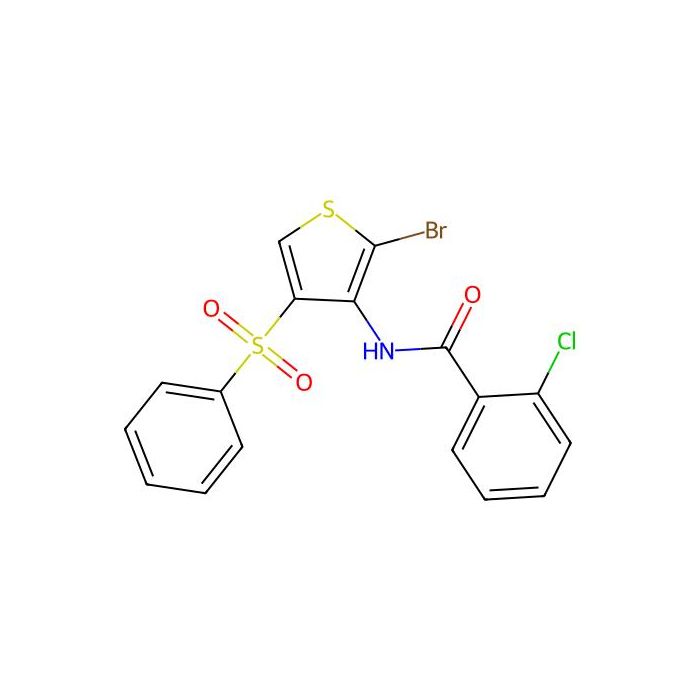
| Sonrisas canónicas | C1=CC=C(C=C1)S(=O)(=O)C2=CSC(=C2NC(=O)C3=CC=CC=C3Cl)Br |
|---|---|
| IUPAC Name | N-[4-(benzenesulfonyl)-2-bromothiophen-3-yl]-2-chlorobenzamide |
| InChIKey | OCNJYMSNHNAZON-UHFFFAOYSA-N |
| INCHI | 1S/C17H11BrClNO3S2/c18-16-15(20-17(21)12-8-4-5-9-13(12)19)14(10-24-16)25(22,23)11-6-2-1-3-7-11/h1-10H,(H,20,21) |
| Isómeros SMILES | C1=CC=C(C=C1)S(=O)(=O)C2=CSC(=C2NC(=O)C3=CC=CC=C3Cl)Br |
| PubChem CID | 2819453 |
| Peso molecular | 456.76 |
Comprehensive hazard, handling, storage, and regulatory compliance document.
Download SDS →Lot-specific quality data. Enter your lot number to retrieve the exact COA.
Look up COA →Full quality attributes and acceptance criteria for this grade.
View spec sheet →Taxonomy Tree
| Kingdom | Organic compounds |
|---|---|
| Superclass | Benzenoids |
| Clase | Benzene and substituted derivatives |
| Subclass | Benzoic acids and derivatives |
| Intermediate Tree Nodes | Halobenzoic acids and derivatives |
| Direct Parent | 2-halobenzoic acids and derivatives |
| Alternative Parents | Benzamides Benzenesulfonyl compounds Benzoyl derivatives Chlorobenzenes Aryl bromides Aryl chlorides Vinylogous halides Thiophenes Sulfones Heteroaromatic compounds Secondary carboxylic acid amides Hydrocarbon derivatives Organic oxides Organobromides Organochlorides Organonitrogen compounds Organooxygen compounds Organopnictogen compounds |
| Molecular Framework | Aromatic heteromonocyclic compounds |
| Substituents | 2-halobenzoic acid or derivatives - Benzamide - Benzenesulfonyl group - Benzoyl - Chlorobenzene - Halobenzene - Aryl bromide - Aryl chloride - Aryl halide - Heteroaromatic compound - Vinylogous halide - Thiophene - Sulfonyl - Sulfone - Carboxamide group - Secondary carboxylic acid amide - Organoheterocyclic compound - Carboxylic acid derivative - Organobromide - Organohalogen compound - Organooxygen compound - Organosulfur compound - Organic nitrogen compound - Hydrocarbon derivative - Organic oxide - Organopnictogen compound - Organic oxygen compound - Organochloride - Organonitrogen compound - Aromatic heteromonocyclic compound |
| Descripción | This compound belongs to the class of organic compounds known as 2-halobenzoic acids and derivatives. These are benzoic acids or derivatives carrying a halogen atom at the 2-position of the benzene ring. |
| External Descriptors | Not available |
| Activity Type | Relation | Activity value | Units | Action Type | Journal | PubMed Id | doi | Assay Aladdin ID |
|---|
| Solubilidad | DMSO : 100 mg/mL (218.93 mM; Need ultrasonic) |
|---|---|
| Peso molecular | 456.800 g/mol |
| XLogP3 | 5.400 |
| Hydrogen Bond Donor Count | 1 |
| Hydrogen Bond Acceptor Count | 4 |
| Rotatable Bond Count | 4 |
| Exact Mass | 454.905 Da |
| Monoisotopic Mass | 454.905 Da |
| Topological Polar Surface Area | 99.900 Ų |
| Heavy Atom Count | 25 |
| Formal Charge | 0 |
| Complexity | 577.000 |
| Isotope Atom Count | 0 |
| Defined Atom Stereocenter Count | 0 |
| Undefined Atom Stereocenter Count | 0 |
| Defined Bond Stereocenter Count | 0 |
| Undefined Bond Stereocenter Count | 0 |
| The total count of all stereochemical bonds | 0 |
| Covalently-Bonded Unit Count | 1 |
Our grade selection guide covers purity, stabilizer status, and application suitability for all variants in our catalog.
View Moligand™ grade guide →