
Determine the necessary mass, volume, or concentration for preparing a solution.
| Activity Type | Activity Value -log(M) | Mechanism of Action | Activity Reference | Publications (PubMed IDs) |
|---|
Moligand™, 10mM in DMSO Moligand™ for sensitive chromatographic and analytical workflows requiring minimal baseline interference.
Store at -80°C Ships Dry ice packs + Cold packs Check lot-specific COA for exact specifications.
SDS, COA, datasheet, and spec sheet available for download. Lot-specific COA accessible via lot number lookup.
Cited in 4 peer-reviewed publications across chromatography, organic synthesis, and cross-coupling reactions.
Information
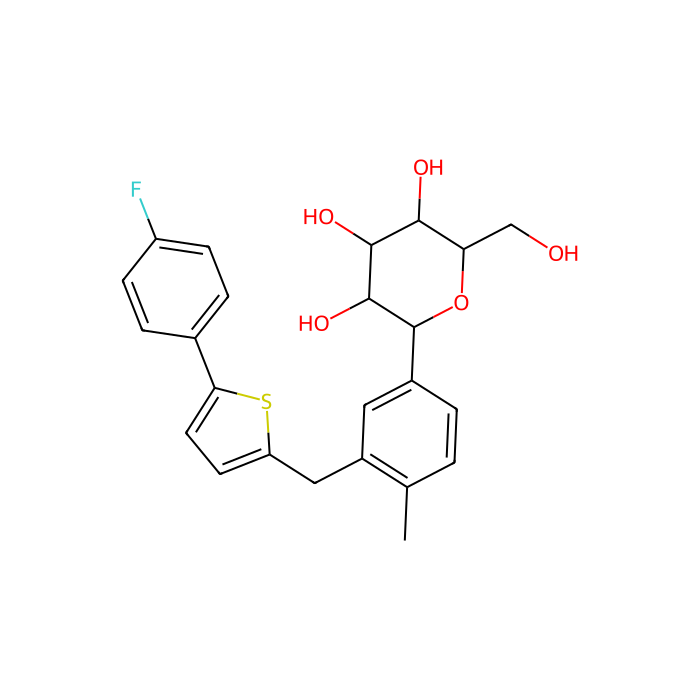
Canagliflozin (TA 7284, JNJ 28431754) is a highly potent and selective SGLT2 inhibitor forhSGLT2withIC50of 2.2 nM in a cell-free assay, exhibits 413-fold selectivity over hSGLT1.
In vitro
Canagliflozin is a novel C-glucoside with thiophene ring. Canagliflozin inhibits Na+-dependent 14C-AMG uptake in a concentration-dependent fashion. Canagliflozin inhibits 14C-AMG uptake in CHO-hSGLT1 and mSGLT1 cells with IC50 of 0.7 μM and >1 μM, respectively. Canagliflozin inhibits the facilitative (non-Na+-linked) GLUT-mediated 2H-2-DG uptake in L6 myoblasts by less than 50%. In sham-injected oocytes, Canagliflozin (10 μM) or phlorizin (3 mM) alone in the presence of 50 μM DNJ does not affect currents. In SGLT3-injected oocytes, DMSO and Canagliflozin 10 μM inhibits DNJ-induced currents by 15.6% and 23.4%, respectively.
In vivo
Canagliflozin shows pronounced anti-hyperglycemic effects in high-fat diet fed KK (HF-KK) mice. Oral administration at 30 mg/kg of Canagliflozin to male SD rats induces glucose excretion over 24 hours by 3,696 mg per 200 g body weight. Pharmacokinetic studies reveals a much higher exposure of Canagliflozin following oral administration. Following intravenous and oral doses of 3 and 10 mg/kg, respectively, to male SD rats, AUC0−inf, po, t1/2 and oral bioavailability are determined to be 35,980 ng·h/mL, 5.2 hours, and 85%, respectively. Thus, inhibition of SGLT2 in renal tubules after oral dosing of Canagliflozin is likely to continuously suppress reabsorption of glucose. The extensive UGE would reflect excellent pharmacokinetic properties of Canagliflozin in vivo as well as high potency of SGLT2 inhibition. Since most of the filtered glucose is reabsorbed by SGLT2 in the renal tubules, the novel compound would be useful for an anti-diabetic agent. Single oral administration of Canagliflozin at 3 mg/kg remarkably reduced blood glucose levels without influencing food intake in hyperglycemic high-fat diet fed KK (HF-KK) mice. There is a 48% reduction in blood glucose level versus vehicle at 6 hours. In contrast, Canagliflozin only slightly affects blood glucose levels in normoglycemic mice. Therefore, Canagliflozin would control hyperglycemia in the therapy of T2DM with low risk of hypoglycemia.
Cell Data
cell lines:HCT-116, U2OS, H-460, HL-60, HT-29, SiHa, MCF-7, Colo-205, SW-480, PC-3, Caco2, T-24
Concentrations:0-10 μM
Incubation Time:24 hours
Powder Purity:≥99%
| Isomeric SMILES | CC1=C(C=C(C=C1)[C@H]2[C@@H]([C@H]([C@@H]([C@H](O2)CO)O)O)O)CC3=CC=C(S3)C4=CC=C(C=C4)F |
|---|---|
| Molecular Weight | 444.52 |
| Reaxy-Rn | 29634568 |
| Reaxys-RN_link_address | https://www.reaxys.com/reaxys/secured/hopinto.do?context=S&query=IDE.XRN=29634568&ln= |
Comprehensive hazard, handling, storage, and regulatory compliance document.
Download SDS →Lot-specific quality data. Enter your lot number to retrieve the exact COA.
Look up COA →Full quality attributes and acceptance criteria for this grade.
View spec sheet →| Activity Type | Activity Value -log(M) | Mechanism of Action | Activity Reference | Publications (PubMed IDs) |
|---|
| Activity Type | Activity Value -log(M) | Mechanism of Action | Activity Reference | Publications (PubMed IDs) |
|---|
| Solubility | Solubility (25°C) In vitro DMSO: 30 mg/mL (199.88 mM); Water: 30 mg/mL (199.88 mM); Ethanol: 30 mg/mL |
|---|
| 1. Lulu Peng, Zhengwei Zou, Lin Zhou, Lincai Li, Wenming Lu, Cixiang Chen, Yan Xu, Yuyue Liu, Jing Lin, Junsong Ye. (2025) Canagliflozin inhibits hepatic stellate cells activation and proliferation by inhibiting PP2A-mediated β-catenin dephosphorylation to attenuate hepatic fibrosis. INTERNATIONAL IMMUNOPHARMACOLOGY, [PMID:40818181] [10.1016/j.intimp.2025.115347] |
| 2. Xueru He, Ying Li, Yajing Li, Caihui Guo, Yuhao Fu, Xuejiao Xun, Zhi Wang, Zhanjun Dong. (2023) In vivo assessment of the pharmacokinetic interactions between donafenib and dapagliflozin, donafenib and canagliflozin in rats. BIOMEDICINE & PHARMACOTHERAPY, [PMID:37027985] [10.1016/j.biopha.2023.114663] |
| 3. Shuqin Du, Hanqiang Shi, Lie Xiong, Ping Wang, Yanbo Shi. (2022) Canagliflozin mitigates ferroptosis and improves myocardial oxidative stress in mice with diabetic cardiomyopathy. Frontiers in Endocrinology, [PMID:36313744] [10.3389/fendo.2022.1011669] |
| 4. Jinsheng Li, Xueli Hou, Jinlong Xiao, Li Zhu, Yujie Deng, Ziyi Li, Zijian Zhao, Zhenghong Luo, Hao Wei. (2024) Synthesis of New Derivatives of Berberine Canagliflozin and Study of Their Antibacterial Activity and Mechanism. MOLECULES, 29 (1): (273). [PMID:38202855] [10.3390/molecules29010273] |
Our grade selection guide covers purity, stabilizer status, and application suitability for all variants in our catalog.
View Moligand™ grade guide →