
Determine the necessary mass, volume, or concentration for preparing a solution.
| Activity Type | Activity Value -log(M) | Mechanism of Action | Activity Reference | Publications (PubMed IDs) |
|---|
10mM in DMSO for sensitive chromatographic and analytical workflows requiring minimal baseline interference.
Store at -80°C Ships Dry ice packs + Cold packs Check lot-specific COA for exact specifications.
SDS, COA, datasheet, and spec sheet available for download. Lot-specific COA accessible via lot number lookup.
Cited in 0 peer-reviewed publications across chromatography, organic synthesis, and cross-coupling reactions.
Information
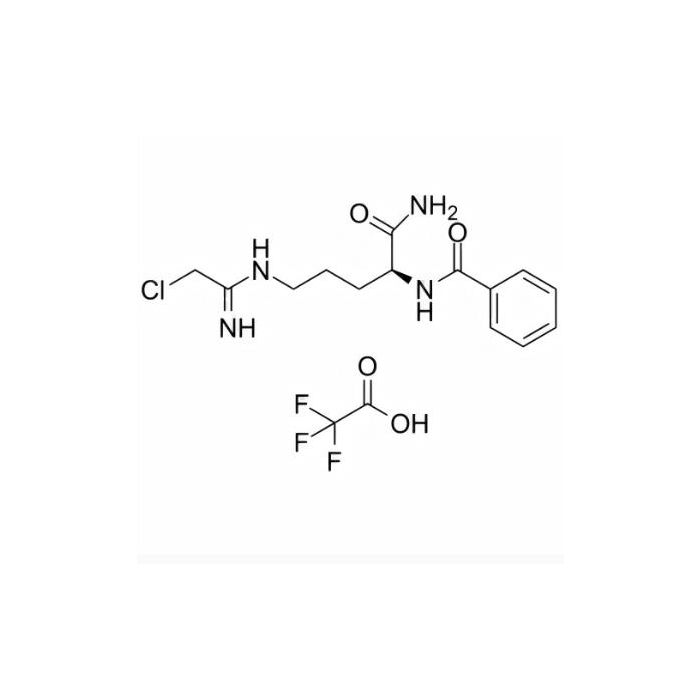
Cl-amidine Cl-amidine is an irreversible pan- peptidylarginine deiminase (PAD) inhibitor with IC50 values of 5.9 ± 0.3 μM, 0.8 ± 0.3 μM, 6.2 ± 1.0 μM for PAD4, PAD1 and PAD3, respectively. Cl-amidine induces apoptosis .
In vitro
Cl-amidine antagonizes the PAD4-mediated enhancement of the the p300GBD-GRIP1 interaction in a dose-dependent manner. The inhibitory effect of this compound is not a nonspecific one but is targeted at the active PAD4 enzyme. Cl-amidine increases p53 expression in CD45 positive immune cells. It triggers the differentiation and apoptosis of multiple cancer cell lines that are p53+/+ and p53−/− (e.g., HL60, HT29, TK6, and U2-OS cells). Cl-amidine induces the expression of p53 and several downstream target genes including the cyclin dependent kinase inhibitor p21, GADD45, and the proapoptotic protein PUMA in U2-OS osteosarcoma cells.
In vivo
Cl-amidine treatment inhibits NZM(New Zealand mixed 2328) NET(neutrophil extracellular trap) formation in vivo and significantly alters circulating autoantibody profiles and complement levels while reducing glomerular IgG deposition. Further, Cl-amidine increases the differentiation capacity of bone marrow endothelial progenitor cells, improves endothelium-dependent vasorelaxation, and markedly delays time to arterial thrombosis induced by photochemical injury. Cl-amidine delays thrombosis development in NZM mice. It inhibits PADs in mice without significant toxicity and improves disease phenotypes in animal models of inflammatory arthritis and inflammatory bowel disease. And It is shown to reduce disease severity in mouse models of ulcerative colitis and RA.
Cell Data
cell lines:
Concentrations:0-200 μM
Incubation Time:40 h
Powder Purity:≥97%
| ALogP | 1.333 |
|---|---|
| hba_count | 3 |
| HBD Count | 3 |
| Rotatable Bond | 10 |
| Isomeric SMILES | C1=CC=C(C=C1)C(=O)N[C@@H](CCCN=C(CCl)N)C(=O)N.C(=O)(C(F)(F)F)O |
|---|---|
| Alternate CAS | 1373232-26-8;913723-61-2 |
| Molecular Weight | 424.80 |
Comprehensive hazard, handling, storage, and regulatory compliance document.
Download SDS →Lot-specific quality data. Enter your lot number to retrieve the exact COA.
Look up COA →Full quality attributes and acceptance criteria for this grade.
View spec sheet →| Activity Type | Activity Value -log(M) | Mechanism of Action | Activity Reference | Publications (PubMed IDs) |
|---|
| DMSO(mg / mL) Max Solubility | 84 |
|---|---|
| DMSO(mM) Max Solubility | 197.740113 |
| Water(mg / mL) Max Solubility | 70 |
| Water(mM) Max Solubility | 164.7834275 |