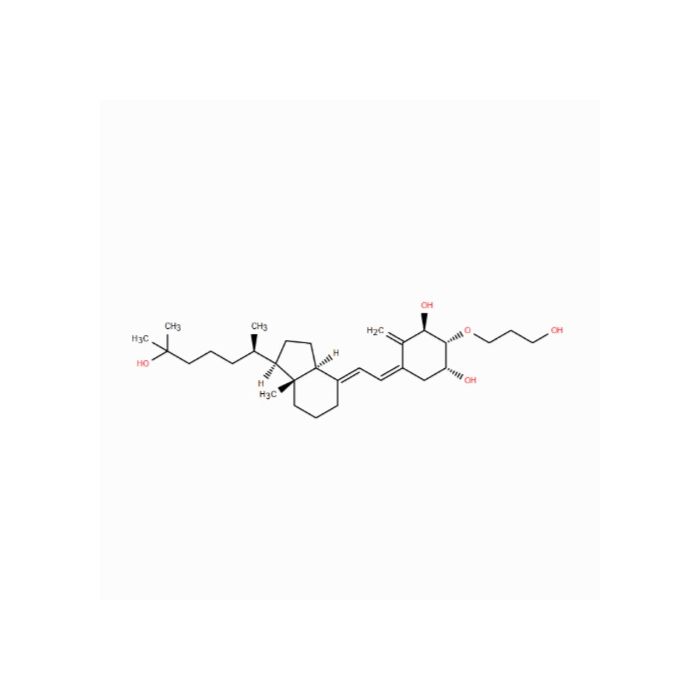
 G2613509
Determine the necessary mass, volume, or concentration for preparing a solution.
| Activity Type | Activity Value -log(M) | Mechanism of Action | Activity Reference | Publications (PubMed IDs) |
|---|

Taxonomy Tree
| Kingdom | Organic compounds |
|---|---|
| Superclass | Lipids and lipid-like molecules |
| Clase | Steroids and steroid derivatives |
| Subclass | Vitamin D and derivatives |
| Intermediate Tree Nodes | Not available |
| Direct Parent | Vitamin D and derivatives |
| Alternative Parents | Triterpenoids Cyclitols and derivatives Tertiary alcohols Secondary alcohols Dialkyl ethers Primary alcohols Hydrocarbon derivatives |
| Molecular Framework | Aliphatic homopolycyclic compounds |
| Substituents | Triterpenoid - Cyclitol or derivatives - Tertiary alcohol - Cyclic alcohol - Secondary alcohol - Ether - Dialkyl ether - Organic oxygen compound - Hydrocarbon derivative - Primary alcohol - Organooxygen compound - Alcohol - Aliphatic homopolycyclic compound |
| Descripción | This compound belongs to the class of organic compounds known as vitamin d and derivatives. These are compounds containing a secosteroid backbone, usually secoergostane or secocholestane. |
| External Descriptors | Vitamin D3 and derivatives |
| Activity Type | Activity Value -log(M) | Mechanism of Action | Activity Reference | Publications (PubMed IDs) |
|---|
| Solubilidad | DMSO |
|---|---|
| Sensibilidad | Light sensitive |
| Peso molecular | 490.7 |
| XLogP3 | 4.300 |
| Hydrogen Bond Donor Count | 4 |
| Hydrogen Bond Acceptor Count | 5 |
| Rotatable Bond Count | 10 |
| Exact Mass | 490.366 Da |
| Monoisotopic Mass | 490.366 Da |
| Topological Polar Surface Area | 90.200 Ų |
| Heavy Atom Count | 35 |
| Formal Charge | 0 |
| Complexity | 784.000 |
| Isotope Atom Count | 0 |
| Defined Atom Stereocenter Count | 7 |
| Undefined Atom Stereocenter Count | 0 |
| Defined Bond Stereocenter Count | 2 |
| Undefined Bond Stereocenter Count | 0 |
| The total count of all stereochemical bonds | 2 |
| Covalently-Bonded Unit Count | 1 |
No tested applications or protocols were provided for this catalog item.
General research-use guidance (non-validated; for planning only):
Users should validate conditions for their specific models and endpoints and consult peer-reviewed literature for assay-specific parameters.
General literature context (for research use only; not a therapeutic claim):
Target class: Eldecalcitol is a synthetic analog of vitamin D3 that functions as a high-affinity agonist of the nuclear vitamin D receptor (VDR). Upon binding, the VDR–RXR heterodimer regulates transcription of genes involved in calcium/phosphate handling, differentiation, and other metabolic pathways.
Structural pharmacology highlights:
Biochemical behavior in vitro:
Research applications:
Note: No target specificity data unique to this catalog item were provided; the above reflects general vitamin D receptor biology to aid experimental design.
This compound is not a buffering agent and is not used to maintain solution pH.
Practical handling in buffered systems (general guidance):
Buffer compatibility notes:
As Eldecalcitol is a specific bioactive small molecule (not a commodity solvent or reagent), “green replacement” typically refers to greener solvent and handling choices during its use and analysis.
Greener handling strategies (general guidance):
Comparison of common choices (general):
Trade-offs:
No clinical or therapeutic claims are made for this catalog item. The following refers to non-clinical laboratory and quality control contexts.
Typical research/formulation roles (general):
Pharmacopeial status: Not specified for this item; refer to CoA/Spec Sheet and relevant compendia.
Packaging and stability considerations relevant to formulation work:
Regulatory note:
Item-specific specifications (this lot):
Literature/general properties (for reference; not item specifications):
Practical tips:
Catalog grade: Moligand™.
Item-specific notes from Product Data:
Unspecified attributes for this item:
Practical QA recommendations to users:
Scope for Eldecalcitol in bench chemistry is primarily as a bioactive ligand standard rather than as a general reagent.
Research applications (general, literature-based):
Chemical manipulation (if derivatization is desired):
Practical handling tips:
Note: No manufacturer-specific application claims were provided beyond research-use; the above reflects general literature practices for vitamin D analogs.
General conditions for typical transformations of vitamin D analogs like Eldecalcitol (literature guidance; not item specifications):
Esterification of hydroxyl groups:
Carbonate/Carbamate formation (for prodrugs/tags):
Etherification at terminal primary alcohol on the 2β‑substituent:
Silyl protection/deprotection:
Purification and analysis:
Expected outcomes: Yields and selectivities vary with protection strategies; plan for small-scale scouting due to sensitivity of the triene and multiple hydroxyls.
Authoritative safety information resides in the SDS; always consult the SDS prior to use.
Solvent strategy is driven by Eldecalcitol’s high lipophilicity and photosensitivity.
Polarity/miscibility (general, literature-based):
Recommended stock solution choices:
Handling considerations:
When to choose alternatives:
Small comparison (general):
Item-specific storage/shipping from Product Data:
Reconstitution and handling (general guidance; not item specifications):
Unspecified parameters for this item:
Always dispose of expired or degraded material following institutional chemical waste procedures.
Brief overview: Eldecalcitol (ED-71) is a synthetic vitamin D3 analog (secosteroid) bearing a 1α,25-dihydroxylated A-ring and an additional 2β-(3‑hydroxypropoxy) substituent that modulates VDR binding and metabolic stability.
Item-specific registry data:
Literature identity (for reference only; not a specification):
2D structural description (verbal):
While Eldecalcitol is generally used as a finished, bioactive ligand rather than a building block, chemists may derivatize it for probe development or SAR studies. General synthetic considerations (literature-based):
Reactive handles:
Protection strategy:
Key cautions:
Analytical support:
No target specificity, clone, isotype, or species reactivity data were provided for this catalog item. This section typically applies to biologicals (e.g., antibodies, proteins). For Eldecalcitol, please refer to the Biological Roles tab for general, literature-based context on vitamin D receptor engagement in research settings.
Nuestra guía de selección de calidades cubre la pureza, el estado del estabilizador y la idoneidad de la aplicación para todas las variantes de nuestro catálogo.
Ver la guía de calidades Moligand™ →