
From Nitroarenes to Pharmaceutically Relevant Pyridines: A Photochemically Induced Aryl Nitrene-Mediated Skeletal Editing Strategy
From Nitroarenes to Pharmaceutically Relevant Pyridines: A Photochemically Induced Aryl Nitrene-Mediated Skeletal Editing Strategy
1 Research Source and Core Problem
1.1 Research Object
The study reported by Saha, Pan, Ghosh, Pal, Guin, Redhu, Gota, and Maiti, titled A General Strategy to Access Pharmaceutically Relevant Pyridines from Nitroarenes, proposes a synthetic strategy for directly accessing pharmaceutically relevant pyridine heterocycles from nitroarenes. The study was published in Angewandte Chemie International Edition, with the DOI 10.1002/anie.202517867.
The core of this study is the conversion of nitroarenes into pyridine frameworks through photochemically induced nitrene formation, aromatic-ring rearrangement, and selective carbon deletion. In essence, this transformation belongs to aromatic skeletal editing: rather than installing functional groups at the periphery of an aromatic ring, it alters the atomic composition and connectivity within the aromatic framework itself.
1.2 The Synthetic Problem
Pyridine is a nitrogen-containing aromatic heterocycle that appears frequently in drug molecules. Compared with a benzene ring, the nitrogen atom in a pyridine ring can alter a molecule’s electronic distribution, hydrogen-bond-accepting ability, polarity, solubility, and metabolic properties. In medicinal chemistry, replacing a benzene ring with pyridine is commonly used to modulate molecular properties and explore structure–activity relationships, abbreviated as SAR.
Traditional pyridine synthesis generally relies on the condensation of nitrogen-containing building blocks, cyclization, or multistep heterocycle construction. For simple molecules, these methods are mature and effective. However, for complex drug molecules or late-stage analogue modification, rebuilding a pyridine ring often increases route length and limits substrate scope.
The problem addressed by this study is therefore: Can stable and readily available nitroarenes be used directly to remodel an existing aromatic ring into a pyridine framework, thereby rapidly providing pharmaceutically relevant pyridine analogues?
2 Key Structures and Overall Reaction Design
2.1 Representative Structures
Structure name | Structural representation | Molecular formula | Description |
Nitroarene | Ar–NO₂ | Depends on Ar | Reaction starting material; the nitro group serves both as an activatable functional group and as the nitrogen source incorporated into the pyridine framework |
Nitrobenzene | Ph–NO₂ | C₆H₅NO₂ | Parent structure of nitroarenes |
Pyridine | C₅H₅N | C₅H₅N | Six-membered nitrogen-containing aromatic heterocycle; a common drug scaffold |
2-Aminopyridine | H₂N–C₅H₄N | C₅H₆N₂ | An important medicinal-chemistry building block that can serve as both a hydrogen-bond donor and a hydrogen-bond acceptor structural unit |
2.2 Reaction Design Schematic
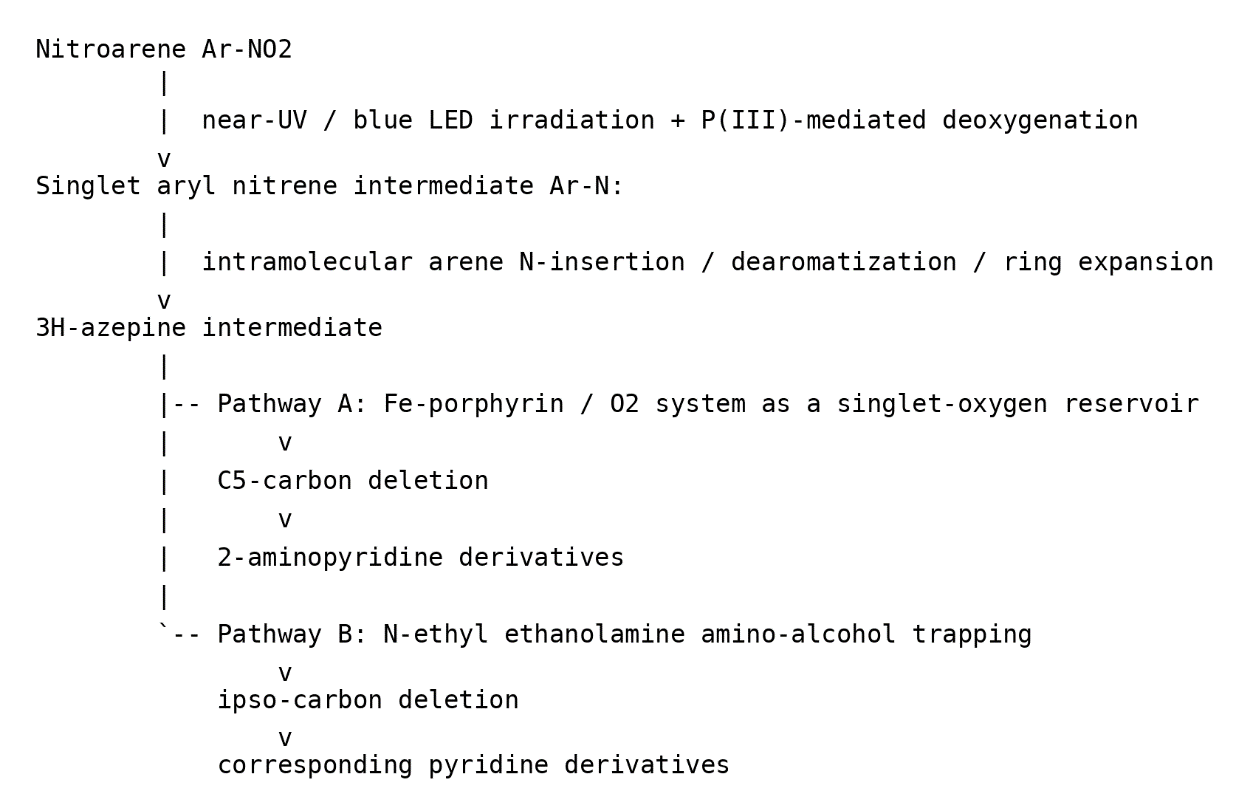
This reaction can be summarized as the following cascade process:
3 Division of Roles Between Photochemistry and the Iron–Porphyrin Catalyst
3.1 Photochemistry Generates the Key Singlet Nitrene
Nitroarenes are relatively stable and readily available aromatic compounds. To rewrite their aromatic skeletons into pyridines, it is first necessary to divert nitroarenes away from conventional reduction, substitution, or coupling pathways and into a highly reactive intermediate pathway capable of nitrogen-atom insertion and ring expansion.
This study uses near-UV/blue LED irradiation to photoexcite nitroarenes, which then undergo intersystem crossing, abbreviated as ISC, to form triplet excited states. These excited nitroarenes possess electrophilic O-radical character and subsequently undergo selective deoxygenation with an electron-rich trivalent phosphorus reagent, generating the key singlet aryl nitrene intermediate.
Singlet aryl nitrenes are highly reactive and can insert into the aromatic ring to form dearomatized intermediates. These intermediates then undergo 6π electrocyclic ring opening to generate seven-membered ketimine species, which, after amine trapping and isomerization, form 3H-azepine intermediates. The 3H-azepine intermediate is the key branching intermediate for the subsequent formation of either 2-aminopyridines or unsubstituted pyridines.
The role of photochemistry in this system is not simply to provide reaction energy. Rather, it converts stable nitroarenes into singlet nitrenes, thereby shifting the reaction from an ordinary functional-group transformation into an aromatic skeletal editing process.
3.2 The Iron–Porphyrin Catalyst Regulates the Oxygen-Participating C5-Carbon-Deletion Process
This study uses an iron–porphyrin catalytic system to regulate the participation of singlet oxygen, ¹O₂, in the subsequent ring-editing process. The structural and functional design of this catalyst is inspired by the iron–porphyrin active centers found in natural heme enzymes. Natural heme systems can bind and activate molecular oxygen through cooperative action between the iron center and the porphyrin ligand.
In this reaction, the main role of the iron–porphyrin catalyst is to regulate the participation of singlet oxygen after formation of the azepine intermediate, enabling subsequent oxidative rearrangement and ring contraction so that the reaction proceeds through a C5-carbon-deletion pathway to afford 2-aminopyridine derivatives. The value of this catalytic system lies in its ability to control the oxygen-involved C5-carbon-deletion cascade, thereby improving the conversion efficiency and selectivity of the 2-aminopyridine pathway.
Step/component | Main role | Effect on the outcome |
Light irradiation | Generates the nitrene intermediate | Initiates aromatic skeletal editing |
Trivalent phosphorus reagent | Promotes deoxygenation of the nitro group | Drives nitrene formation |
Iron–porphyrin catalyst | Regulates singlet oxygen | Improves the efficiency of the C5-carbon-deletion pathway |
Singlet oxygen | Participates in ring contraction and oxidative rearrangement | Promotes formation of 2-aminopyridines |
4 Core Logic of the Reaction Mechanism
4.1 From Nitro Group to Nitrene: The Nitro Group Becomes an Embedded Nitrogen Source
Common reaction pathways of nitroarenes traditionally include reduction to anilines, participation in coupling reactions, or use as electron-withdrawing substituents that influence aromatic-ring reactivity. What distinguishes this study is that the nitro group is not simply converted into a peripheral functional group. Instead, it is transformed into a nitrene and then incorporated into the heteroaromatic framework.
This changes the synthetic significance of nitroarenes:
Traditional understanding: nitroarene = a transformable functional group on an aromatic ring
Understanding in this study: nitroarene = a nitrogen-containing aromatic precursor that can be reconstructed into a pyridine framework
This also explains the retrosynthetic value of the method. When faced with a target pyridine structure, researchers can consider whether a corresponding nitroarene precursor exists and then complete the arene-to-pyridine conversion through skeletal editing.
4.2 From Nitrene to Azepine: The Aromatic Ring Enters an Editable State
After formation of the singlet nitrene, it undergoes an intramolecular reaction with the aromatic ring to form a dearomatized intermediate. This is followed by 6π electrocyclic ring opening to generate a seven-membered aza-ring intermediate, namely 3H-azepine. This intermediate is the key branching point in the reaction. It retains part of the carbon skeleton of the original aromatic ring while also possessing the reactivity required for further rearrangement and contraction.
4.3 From a Seven-Membered Ring to Pyridine: Selective Carbon Deletion Determines the Product Type
Pyridine consists of five carbon atoms and one nitrogen atom, whereas benzene contains six carbon atoms. The conversion of a nitroarene into a pyridine therefore requires two essential changes:
① introducing nitrogen into the aromatic-ring skeleton;
② selectively deleting one carbon atom from the original carbon framework.
Two main pathways are present in this study:
Pathway | Key participants | Mode of carbon deletion | Main product |
Pathway A | Amine nucleophiles + iron–porphyrin/oxygen-participating system | C5-carbon deletion | 2-Aminopyridines |
Pathway B | Aminoalcohol trapping system, such as N-ethylethanolamine | Ipso-carbon deletion; that is, deletion of the carbon in the original aromatic ring that bears the nitro group | Corresponding pyridine derivatives |
The importance of these two pathways lies in the fact that they do not generate the same pyridine product. Instead, they access pyridine structures with different substitution patterns through different carbon-deletion modes. For medicinal chemistry, this product-divergent capability is useful for rapidly preparing structurally related pyridine analogues with different properties.
5 Synthetic Value: From Arene Libraries to Pyridine Libraries
5.1 The Starting-Material Source Has Practical Significance
Nitroarenes are widely available, and many aromatic compounds can be converted into the corresponding nitroarenes through nitration or precursor transformation. Compared with unstable azides or specialized nitrogen-containing precursors, nitroarenes are generally more stable and easier to store and handle. The synthetic value of this strategy lies in converting existing nitroarene resources into potential pyridine-product resources.
5.2 The Products Cover Pharmaceutically Relevant Pyridine Structures
The study reports a variety of 2-aminopyridine derivatives as well as pyridine derivatives obtained through ipso-carbon deletion, including 2-aminopyridines with different substitution patterns, fused pyridines, and pyridines derived from complex molecules. Some substrates are derived from drugs or bioactive molecules, indicating that this method can be used for late-stage skeletal modification. In the drug-discovery stage, the value of this method is reflected in three aspects:
Medicinal-chemistry need | Corresponding value of this method |
Rapid preparation of pyridine analogues | Directly obtains pyridine frameworks from nitroarenes, reducing the need to redesign synthetic routes |
Exploration of benzene-to-pyridine replacement | Uses the pyridine nitrogen to modulate electronic properties, polarity, and hydrogen-bonding interactions |
Late-stage structural modification | Introduces pyridine frameworks into complex molecules for SAR studies |
6 Significance for Drug Design
6.1 Pyridine Nitrogen Alters Molecular Properties
The replacement of benzene with pyridine is often regarded as a bioisosteric replacement. The lone pair of the pyridine nitrogen does not participate in the aromatic six-π-electron system and can act as a hydrogen-bond acceptor in interactions with protein targets. At the same time, the pyridine nitrogen lowers the electron density of the aromatic ring, increases molecular polarity, and may alter metabolic sites. This structural change can lead to the following effects:
Structural change | Possible effect |
Introduction of a nitrogen atom into the aromatic ring | Changes electronic distribution and dipole moment |
Formation of a hydrogen-bond acceptor site | Alters the target-binding mode |
Increased molecular polarity | Affects aqueous solubility and membrane permeability |
Altered aromatic-ring metabolic tendency | Affects metabolic stability |
These effects do not necessarily lead to improved activity, but they provide clearly defined variables for medicinal-chemistry optimization. The value of this method is precisely that it enables rapid access to compounds corresponding to these variables.
6.2 Significance of the Nimesulide Case
The study uses a nimesulide-related structure as an application case. Nimesulide contains a nitroaromatic structure, and the nitro group is associated with potential safety risks. By converting the nitroaromatic fragment into a pyridine-related framework, new analogues can be obtained for comparing changes in target binding and molecular properties.
This method is applicable not only to simple model substrates but also to the structural modification of drug-relevant molecules. The study evaluates the interactions between the modified molecules and the target through molecular docking and COX-2 binding-related assays, indicating that this strategy has potential medicinal-chemistry applications. It should be noted, however, that these results represent a methodological application validation. Molecular docking and in vitro binding data can show that structural modification may improve target interactions, but they cannot be directly equated with a comprehensive improvement in efficacy, safety, or clinical value.
7 Key Considerations for Method Applicability
This reaction is clearly innovative, but in practical use its applicability should be evaluated according to the substrate and the research objective.
Evaluation item | Key question | Impact on application |
Substrate structure | Whether the nitro position, substituent electronic effects, and steric hindrance of the nitroarene favor photodeoxygenation to form the nitrene, aromatic-ring insertion, ring expansion, and selective carbon deletion | Affects nitrene-formation efficiency, the ring-expansion process, conversion, and regioselectivity |
Substitution pattern and regioselectivity | Whether ortho-, meta-, or para-substitution may lead to different carbon-deletion sites or isomer formation | Determines whether the target pyridine product is single and whether it can be easily separated |
Product type | Whether the target product is a 2-aminopyridine derivative or a pyridine derivative obtained through ipso-carbon deletion | Determines whether the C5-carbon-deletion pathway or the ipso-carbon-deletion pathway should be selected |
Nucleophile selection | Whether an amine nucleophile or an aminoalcohol trapping system such as N-ethylethanolamine is used | Affects the mode of trapping of the 3H-azepine intermediate and determines product divergence |
Photochemical conditions | Whether the light-source wavelength, light intensity, reactor configuration, reaction concentration, and irradiation time can be reliably reproduced | Affects nitroarene excitation, deoxygenation, and nitrene-formation efficiency |
Oxygen-participating process | Whether the target is the 2-aminopyridine pathway and whether effective singlet-oxygen participation in C5-carbon deletion is required | Affects the efficiency of C5-carbon deletion and the yield of 2-aminopyridines |
Catalytic system | Whether the type, loading, purity, and availability of the iron–porphyrin catalyst meet the reaction requirements | Affects singlet-oxygen utilization efficiency, reaction selectivity, and experimental reproducibility |
Functional-group compatibility | Whether the substrate contains functional groups that may be affected by light, oxygen, phosphorus reagents, or reactive intermediates | Determines whether complex substrates, drug molecules, or late-stage modification substrates are suitable |
Scalability | Whether the reaction objective is milligram-scale medicinal-chemistry screening or gram-scale and larger route development | Determines the requirements for yield, light transmission, oxygen control, purification, and safety |
8 Product Classification Tables Related to the Skeletal Editing Strategy from Nitroarenes to Pharmaceutically Relevant Pyridines
Table 1. Nitroarene Substrates and Nitroarene Derivatives
Category | CAS No. | Aladdin Catalog No. | Name | Specification or Purity | Product Features and Applications |
Parent nitroarene | 98-95-3 | Nitrobenzene | ACS, ≥99% (GC) | Basic nitroarene substrate, used for model studies on photodeoxygenation to generate aryl nitrenes and on aromatic-ring skeletal editing | |
Alkyl-substituted nitroarene | 88-72-2 | o-Nitrotoluene | ≥99% | Ortho-alkyl-substituted substrate, used to examine the influence of steric hindrance on nitrene insertion, ring expansion, and regioselectivity | |
Alkyl-substituted nitroarene | 99-08-1 | m-Nitrotoluene | Chemically pure (CP) | Meta-alkyl-substituted substrate, used to study the influence of substitution position on the direction of carbon deletion and the formation of pyridine isomers | |
Alkyl-substituted nitroarene | 99-99-0 | p-Nitrotoluene | ≥99% | Para-alkyl-substituted substrate, used for studies of aryl nitrene generation, substituent effects, and pyridine-framework transformation | |
Methoxy-substituted nitroarene | 91-23-6 | 2-Nitroanisole | ≥98% | Ortho-methoxy-substituted substrate, used to study the effects of electron-donating substituents and ortho effects on the skeletal editing pathway | |
Methoxy-substituted nitroarene | 555-03-3 | N159810 | 3-Nitroanisole | — | Meta-methoxy-substituted substrate, used to study the regioselectivity and product distribution of meta-substituted nitroarenes |
Methoxy-substituted nitroarene | 100-17-4 | p-Nitroanisole | ≥98% | Para-methoxy-substituted substrate, used to study the influence of electron-donating substituents on photodeoxygenation and aryl nitrene reactivity | |
Carboxylic acid-substituted nitroarene | 62-23-7 | 4-Nitrobenzoic acid | Suitable for synthesis | Carboxylic acid-substituted nitroarene, used for studies on carboxyl functional-group tolerance and precursors to pyridine carboxylic acid-type structures | |
Ester-substituted nitroarene | 619-50-1 | Methyl 4-nitrobenzoate | ≥99% | Ester-substituted nitroarene, used for studies on the construction of pharmaceutically relevant pyridine carboxylate frameworks | |
Aldehyde-substituted nitroarene | 555-16-8 | p-Nitrobenzaldehyde | AR, ≥97% (GC) | Aldehyde-substituted nitroarene, used for studies on carbonyl functional-group compatibility and the design of aldehyde-containing pyridine precursors | |
Cyano-substituted nitroarene | 619-72-7 | p-Nitrobenzonitrile | ≥97% | Cyano-substituted nitroarene, used to study the influence of strongly electron-withdrawing substituents on photodeoxygenation, ring expansion, and product selectivity | |
Amino-substituted nitroarene | 100-01-6 | p-Nitroaniline | AR, ≥99% | Amino-substituted nitroarene, used for studies on nitrogen-containing functional-group compatibility and multifunctional aromatic substrates | |
Nitrophenol analytical standard | 100-02-7 | p-Nitrophenol standard solution | 2000 μg/mL in methanol | Analytical standard for nitrophenols, used for nitroarene detection, method validation, and quantitative analysis | |
Halogenated nitroarene | 350-46-9 | 1-Fluoro-4-nitrobenzene | ≥98% | Fluorinated nitroarene, used for studies on the compatibility of halogen-substituted substrates and subsequent functional-group transformations | |
Halogenated nitroarene | 586-78-7 | 1-Bromo-4-nitrobenzene | ≥99% (GC) | Brominated nitroarene, used for substrate design studies linking skeletal editing with coupling reactions | |
Halogenated nitroarene | 636-98-6 | 1-Iodo-4-nitrobenzene | ≥98% | Iodinated nitroarene, used for highly reactive halogenated arene substrates and the design of subsequent cross-coupling sites | |
Fused-ring nitroarene | 86-57-7 | 1-Nitronaphthalene | ≥99% | Fused-ring nitroarene substrate, used for studies on fused pyridine frameworks and skeletal editing of polycyclic aromatic systems | |
Fused-ring nitroarene | 581-89-5 | 2-Nitronaphthalene | ≥98% | Fused-ring nitroarene isomer, used for studies on the regioselectivity of fused-ring substrates and isomer formation |
Table 2. Photodeoxygenation Reagents, Nucleophilic Trapping Reagents, and Reaction Solvents
Category | CAS No. | Aladdin Catalog No. | Name | Specification or Purity | Product Features and Applications |
Trivalent phosphorus deoxygenation reagent | 121-45-9 | Trimethyl phosphite | Chemically pure (CP), ≥95% | Photodeoxygenation reagent for nitroarenes, used for aryl nitrene generation and reaction-condition optimization | |
Trivalent phosphorus deoxygenation reagent | 122-52-1 | Triethyl phosphite | ≥98% | Trivalent phosphorus deoxygenation reagent, used for nitro-group deoxygenation, nitrene generation, and phosphorus-reagent screening | |
Organophosphine control reagent | 603-35-0 | Triphenylphosphine | ≥99% (GC) | Organophosphine reducing reagent, used for deoxygenation-reaction controls, phosphine-reagent screening, and mechanistic studies | |
Amine nucleophile | 109-89-7 | Diethylamine | Rectified grade, ≥99.5% | Amine nucleophilic trapping reagent, used for the formation of azepine intermediates and studies of the 2-aminopyridine pathway | |
Aminoalcohol nucleophile | 141-43-5 | Ethanolamine | Rectified grade, ≥99.5% | Aminoalcohol reference reagent, applicable as a reference for aminoalcohol trapping-system design and condition screening | |
Anhydrous ether solvent | 109-99-9 | T1491789 | Tetrahydrofuran (THF) | Anhydrous grade, ≥99.9%, stabilizer-free, H₂O ≤30 ppm | Common anhydrous solvent for photochemical deoxygenation and water-sensitive systems, used for nitrene-generation reactions and condition screening |
Anhydrous polar solvent | 75-05-8 | Anhydrous acetonitrile (ACN) | Anhydrous grade, ≥99.8%, H₂O ≤0.003% | Polar anhydrous solvent, used for photochemical reactions, oxygen-participating reactions, and reaction-system screening | |
Halogenated hydrocarbon solvent | 75-09-2 | D433567 | Dichloromethane | Suitable for analysis, ACS | Halogenated hydrocarbon solvent, used for porphyrin-complex dissolution, reaction screening, extraction, and analytical sample pretreatment |
Table 3. Porphyrin Ligands, Metalloporphyrin Catalysts, and Iron-Source Reagents
Category | CAS No. | Aladdin Catalog No. | Name | Specification or Purity | Product Features and Applications |
Porphyrin ligand | 917-23-7 | meso-Tetraphenylporphine (TPP) | ≥99%, chlorin-free | Porphyrin ligand, used for the preparation of metalloporphyrin catalysts, oxygen-activation models, and photooxidation studies | |
Iron–porphyrin catalyst | 16456-81-8 | meso-Tetraphenylporphine iron(III) chloride | ≥95% | Iron–porphyrin catalyst, used for studies on singlet-oxygen-participating C5-carbon deletion and 2-aminopyridine formation | |
Manganese–porphyrin catalyst | 32195-55-4 | Manganese(III) tetraphenylporphyrin chloride | ≥95% | Manganese–porphyrin complex, used for metalloporphyrin catalyst screening and control studies of oxygen-participating reactions | |
Cobalt–porphyrin catalyst | 14172-90-8 | Cobalt(II) tetraphenylporphyrin | ≥95% | Cobalt–porphyrin complex, used for comparing metal-center effects and studying oxygen-activation-related reactions | |
Iron-source reagent | 7705-08-0 | Anhydrous iron(III) chloride | ≥99.9% metals basis | High-purity iron-source reagent, used for iron-complex preparation, metal-impurity control experiments, and catalytic-system controls |
Table 4. Pyridine Parent Core, Aminopyridines, and Functionalized Pyridine Building Blocks
Category | CAS No. | Aladdin Catalog No. | Name | Specification or Purity | Product Features and Applications |
Pyridine parent core | 110-86-1 | Pyridine | Anhydrous grade, ≥99.8% | Basic pyridine structural unit, used for comparison of pyridine-framework properties, derivatization reactions, and medicinal-chemistry studies | |
Aminopyridine building block | 504-29-0 | 2-Aminopyridine (2-AP) | Chemically pure (CP) | Representative 2-aminopyridine product, used for aminopyridine framework construction, derivatization, and target-binding studies | |
Aminopyridine building block | 462-08-8 | 3-Aminopyridine | ≥99% | Aminopyridine isomer, used for studies on amino-substitution position effects and as a pyridine-analogue control | |
Aminopyridine building block | 504-24-5 | 4-Aminopyridine | ≥98% | Aminopyridine isomer, used for studies on pyridine amino-position effects, hydrogen-bonding interactions, and structure–activity relationships | |
Halopyridine building block | 109-09-1 | 2-Chloropyridine | ≥98% | Chloropyridine building block, used for nucleophilic substitution, coupling reactions, and pyridine-analogue synthesis | |
Halopyridine building block | 109-04-6 | 2-Bromopyridine | ≥98% | Bromopyridine building block, used for cross-coupling, functional-group extension, and pyridine-framework derivatization | |
Cyanopyridine building block | 100-70-9 | 2-Cyanopyridine | ≥98% | Cyanopyridine building block, used for the synthesis of pyridine carboxylic acids, pyridine amides, and nitrogen-containing heterocyclic derivatives | |
Pyridine carboxylic acid building block | 59-67-6 | Nicotinic acid | Suitable for synthesis, Moligand™ | 3-Pyridinecarboxylic acid building block, used for nicotinic acid derivatives, amidation reactions, and pharmaceutically relevant pyridine-structure studies | |
Pyridine carboxylic acid building block | 55-22-1 | Isonicotinic acid (IN) | AR, Moligand™, ≥99% | 4-Pyridinecarboxylic acid building block, used for the synthesis of isonicotinamide, isoniazid, and pyridine carboxylic acid derivatives | |
Pyridine carboxylate building block | 93-60-7 | Methyl nicotinate | ≥99% | 3-Pyridinecarboxylate building block, used for ester hydrolysis, amidation, and synthesis of nicotinic acid derivatives | |
Pyridine carboxylate building block | 2459-09-8 | Methyl isonicotinate | ≥98% | 4-Pyridinecarboxylate building block, used for the synthesis of isonicotinic acid derivatives and pharmaceutical intermediates | |
Drug-relevant pyridine molecule | 54-85-3 | Isoniazid | ≥99% | Pyridine hydrazide drug molecule, used as a control for pharmaceutically relevant pyridine products and for acylhydrazide-structure derivatization studies | |
Drug-relevant pyridine molecule | 535-83-1 | Trigonelline | Moligand™, ≥98% | Nicotinic acid quaternary ammonium salt derivative, used for studies on pyridine-nitrogen quaternization structures, bioactive molecules, and reference standards |
Table 5. Drug-Relevant Complex Molecules, Potential Derivatization Parent Structures, and Reference Compounds for Late-Stage Modification
Category | CAS No. | Aladdin Catalog No. | Name | Specification or Purity | Product Features and Applications |
Complex steroid molecule | 57-88-5 | Cholesterol, plant-derived | ≥98% | Complex steroidal scaffold molecule, used for complex-molecule derivatization, late-stage modification, and design of nitroarene-derived substrates | |
Arylpropionic acid drug | 15687-27-1 | Ibuprofen | Moligand™, ≥98% (GC) | Arylpropionic acid drug molecule, used for the design of drug-derived nitroarene substrates and pyridine analogues | |
p-Aminobenzoate drug | 94-09-7 | Ethyl 4-aminobenzoate | ≥99% | Aromatic ester drug molecule, used for aromatic-drug-scaffold derivatization and late-stage functionalization studies | |
Nitroaromatic drug | 51803-78-2 | Nimesulide | Moligand™, ≥98% (HPLC) | Nitroaromatic drug molecule, used for nitroarene skeletal editing, nitro-group replacement, and pyridine-analogue studies | |
Heterocycle-containing drug molecule | 113665-84-2 | Clopidogrel | Moligand™, ≥97% | Complex heterocycle-containing drug molecule, used for late-stage modification of drug scaffolds and as a control for pyridine analogues | |
Aryloxy arylamine drug | 56296-78-7 | Fluoxetine hydrochloride | ≥98% (HPLC) | Aryloxy arylamine drug molecule, used for late-stage functionalization of complex drug scaffolds and nitrogen-containing heterocycle replacement studies | |
Aryloxy arylamine drug | 82248-59-7 | Atomoxetine hydrochloride | ≥98% | Aryloxy arylamine drug molecule, used for drug-analogue design, aromatic-framework replacement, and late-stage modification studies |
Note: The products listed above are representative Aladdin products related to scientific research and formulation research. For additional product specifications, grades, and COA information, please search by product name/CAS/catalog number on the Aladdin official website.
References
[1] Saha, A.; Pan, A.; Ghosh, D.; Pal, A.; Guin, S.; Redhu, A. K.; Gota, V.; Maiti, D. A General Strategy to Access Pharmaceutically Relevant Pyridines from Nitroarenes. Angew. Chem. Int. Ed. 2025, e17867; final issue: 2026, 65, e17867. DOI: 10.1002/anie.202517867.
[2] Dwivedi, A. R.; Jaiswal, S.; Kukkar, D.; Kumar, R.; Singh, T. G.; Singh, M. P.; Gaidhane, A. M.; Lakhanpal, S.; Prasad, K. N.; Kumar, B. A decade of pyridine-containing heterocycles in US FDA approved drugs: a medicinal chemistry-based analysis. RSC Med. Chem. 2025, 16, 12–36. DOI: 10.1039/D4MD00632A.
[3] Sharma, R.; Arisawa, M.; Takizawa, S.; Salem, M. S. H. Remodelling molecular frameworks via atom-level surgery: recent advances in skeletal editing of (hetero)cycles. Org. Chem. Front. 2025, 12, 1633–1670. DOI: 10.1039/D4QO02157F.
For more related articles, please see below: