
Benzimidazole Building-Block Selection Guide: How Three “Knobs” (N Position / C2 Position / Benzene Ring) Drive Properties and Use Cases (Tables 1–4B)
Benzimidazole Building-Block Selection Guide: How Three “Knobs” (N Position / C2 Position / Benzene Ring) Drive Properties and Use Cases (Tables 1–4B)
1.The practical problem: why “a small heterocycle” can determine whether a molecule is truly usable
In drug discovery, agrochemical R&D, and functional materials development, you often face the same kind of choice:
a) You need a fragment that is small enough, yet can deliver predictable molecular interactions (hydrogen bonding / coordination / π interactions), while remaining usable in real environments with workable stability and tunability (acid–base state, solubility, morphology / processing window).
b) Many heterocyclic systems either lack “predictable interaction handles” (H-bond donors/acceptors or coordination sites are unclear, or hard to present reliably), or offer only a narrow window for tuning physicochemical properties (acid–base behavior, polarity, and solubility are difficult to balance; morphology tends to drift across conditions and batches). The common outcome is: activity/performance looks valid at first, but problems show up during formulation, film formation, or scale-up—for example, salt form/solubility cannot be stabilized, thin-film morphology is unstable, or batch-to-batch variability grows after process scaling.
Benzimidazole keeps reappearing because it compresses three key capabilities into a very small scaffold:
①. A two-nitrogen motif that, in the neutral state, often presents a “one donor + one acceptor” hydrogen-bonding template: one N more often acts as an acceptor, while the other provides an N–H donor. Tautomerism and protonation can switch “which N plays which role,” enabling interaction-mode switching when needed; it can also participate in metal coordination/complexation in some contexts.
②. Protonatability, enabling switching among “charge ↔ solubility ↔ interaction mode” across environments (the pKa of its conjugate acid is commonly around ~5.4–5.6, with shifts depending on substitution and medium).
③. A fused aromatic framework that provides structural stability and π-system rigidity, making it easier—both in drug-like systems and in materials—to maintain relatively predictable conformations and packing tendencies.
2.Definitions and core concepts
2.1 What is benzimidazole?
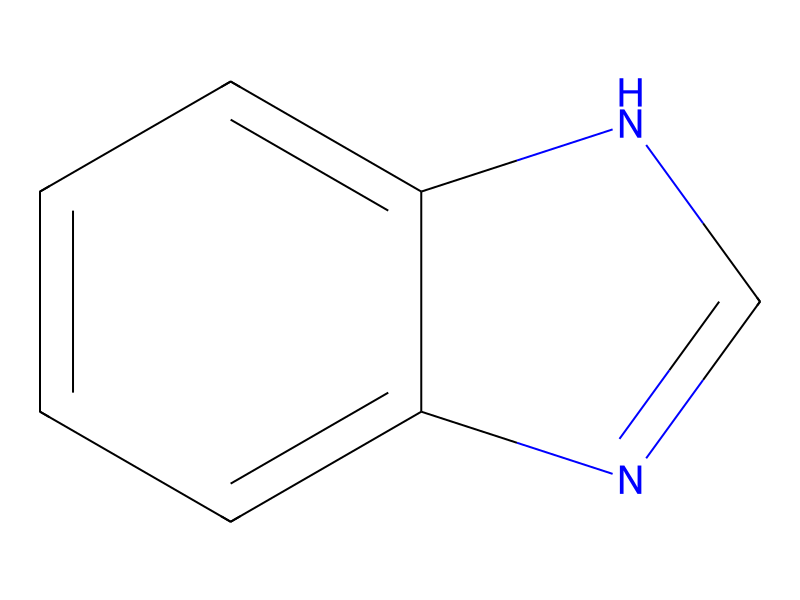
Benzimidazole is a fused aromatic heterocycle: it can be viewed as a bicyclic system formed by “a benzene ring fused to an imidazole ring.” The most common parent is 1H-benzimidazole, with molecular formula C₇H₆N₂.
2.2 What does “heterocyclic building block” mean?
In R&D and synthesis contexts, “heterocyclic building block” emphasizes its role:
1. As a reusable starting fragment (building block / fragment);
2. Extending outward from specific positions (commonly the N position or the 2-position) to attach “functional arms” (pharmacophores, coordination arms, conjugated segments, side chains, etc.);
3. Achieving clear control of properties and interactions with a small structural cost.
2.3 Tautomerism and protonation
The N–H position in benzimidazole can undergo prototropic tautomerism: within the same scaffold, the proton can redistribute between different nitrogens under different environments. In addition, it can be protonated to form a benzimidazolium species. These “state switches” directly change:
①. Which nitrogen behaves more like an H-bond acceptor, and whether N–H serves as a donor;
②. Solubility and the strength of ionic interactions;
③. How it binds to targets/acids/ions/polymer segments.
3.Structural features: three key modification sites determine how properties change
As a building block, benzimidazole is most useful when you treat three sites as adjustable “knobs”: the N position, the 2-position, and benzene-ring substitution. They map respectively to interaction mode, tunable charge, and expandable interfaces.
3.1 Three modification sites (“structural knobs”): what properties they change and what you can observe
Structural knob | Primary properties changed | Observable outcomes |
N position (retain N–H vs N-substitution) | H-bond donor/acceptor pattern, tautomeric behavior; tendency toward protonation and salt formation | Binding mode changes; solubility/salt form becomes tunable; the system’s “state” becomes more single-defined or more switchable |
2-position (most-used “interface position”) | Electronic effects and sterics; geometry at the linkage point; whether a stronger coordination/recognition “handle” is formed | Convenient for attaching pharmacophores/coordination arms/conjugated segments; more efficient SAR or property tuning in materials |
Benzene-ring substitution (electron-donating/withdrawing + sterics) | pKa and polarity/hydrophobicity; π-stacking and morphology tendencies | Tunable activity/selectivity and ADMET; tunable film morphology and processing window (materials) |
4.Classification: four types defined by the “structural knobs”
Category | Structural features | Advantages | Typical scenarios |
A. N–H retained (tautomeric, salt-forming) | Retains ring N–H (proton can potentially migrate between the two nitrogens); readily protonated by acids to form salts | Switchable interaction modes; salt forms can tune solubility and binding mode | Salt-form tuning for solubility and SAR optimization in drug/agrochem scaffolds; binding designs requiring H-bond networks; also commonly used as a starting point for further N- or C2-modification |
B. N-substituted neutral (no N–H; more stable/controllable) | Introduces alkyl/aryl at N; no N–H (so N–H tautomerism no longer occurs); reduced H-bond donor capability, often more hydrophobic | Fewer “state changes,” less uncertainty from strong H-bond donation, easier to stabilize properties | Prefer predominantly neutral behavior; reduce solubility/polymorph variability driven by strong H-bond donation; materials systems needing a more stable neutral fragment; or cases where overly strong interactions with metals/ions could cause side reactions (still system-dependent) |
C. C2-functionalized linkage type (interface building block) | Adds substituents at the 2-position, treating it as a “connection port” to attach pharmacophores, coordination arms, conjugated segments, side chains, etc. | Turns benzimidazole from a “scaffold” into an “expandable interface” | Pharmacophore assembly and SAR expansion; building coordination/chelating fragments; extending conjugation and side-chain engineering in materials; construction where a clearly defined linkage site is needed |
D. Ionic derivatives (a positively charged toolbox) | Achieves cationization via reversible protonation (salt formation) or further N-alkylation to form benzimidazolium salts (azolium; commonly N,N′-disubstituted) for more persistent cationic character; can serve as a starting point toward NHC precursors | Directly rewrites solubility, ionic interactions, and interfacial behavior through “charge state” | Systems needing ionic interactions or interfacial/phase-transfer capability; ionic liquids/electrolytes or ionic-polymer design; and N,N′-substituted benzimidazolium salts can be used as starting points to generate NHC (carbene ligands) for metal coordination/catalysis ligand construction |
5.Quick overview of typical applications: three benzimidazole “application tracks” × common modification patterns (mapped to Section 4, A–D)
Application track | The “real-world problem” it addresses | Common modification approach (Section 4) | Key points |
Medicinal chemistry: small scaffold for molecular recognition + property tuning | You need predictable binding features, while being able to tune solubility/charge state/polarity into a “usable window.” | Often start from A (N–H retained) and/or C (C2 interface); move to B (N-substituted) when a more stable neutral state is needed. | The literature often treats benzimidazole as a privileged scaffold: a small core that can simultaneously encode designable interactions (H-bonding, aromatic stacking, etc.) while enabling rapid SAR expansion. |
Fungicides (agrochemicals): clear target → high efficacy, but also resistance pressure | Concentrated, target-specific action can be strong, but can be “bypassed” by target mutations. | Frequently benzimidazole derivatives with specific substitution patterns (can be understood as combined use of A/B/C, where substitution governs distribution/stability/affinity). | Representative benzimidazole fungicides (e.g., carbendazim, benomyl, thiabendazole) interact with β-tubulin and inhibit microtubule polymerization—an important mechanistic basis. Because this is site-specific action, practice typically emphasizes rotation or mixing with agents of different modes of action to reduce resistance risk. |
Materials: PBI (polybenzimidazole) tackles harsh conditions with “high thermal stability + proton conduction” | You want membrane stability and sustained proton conduction under high temperature/low humidity conditions. | When benzimidazole is incorporated into the polymer backbone to form PBI, it essentially corresponds to “writing the protonatable capability of A/D into the materials system.” | The IUPAC Gold Book explicitly notes that polybenzimidazoles have high thermal stability and are proton-conducting polymers, suitable for fuel-cell membranes, etc. Engineering practice often uses acid doping (e.g., phosphoric acid) for high-temperature proton conduction, but this introduces trade-offs such as acid migration and mechanical balance—requiring co-optimization of structure and formulation. |
6.Work backward from your goal: which benzimidazole type should you choose?
R&D need | Structural knob to prioritize | Typical starting type |
Need a clear H-bond network / want salt formation to tune solubility | N position (N–H / protonation) | A. N–H retained type |
Want a more single-defined state; reduce uncertainty from tautomerism and shifts in “donor/acceptor/coordination ability” | N position (N-substitution) | B. N-substituted neutral type |
Want to use it as a “platform interface” to attach pharmacophores / coordination arms / conjugated segments | C2 position (interface site) | C. C2-functionalized linkage type |
Need charge/ion pairing to drive solubility, interfacial behavior, or electrostatics; or want an NHC (carbene ligand) route | Charge state (azolium salt) | D. Benzimidazolium salts / ionic type |
7.Benzimidazole-related chemicals: choose the right table quickly by research task (Tables 1–4B)
Research/experimental need | Which table to consult first | Selection logic | Representative products in the table |
PPI (proton pump inhibitor) work: methods, impurity profiling, stability and process comparison, scaffold benchmarking | Table 1: Pharmaceutical APIs | PPIs are the most concentrated and mainstream benzimidazole drug line; Table 1 provides commonly used PPI APIs directly, making it a good starting point for analytical and reference standards. | Esomeprazole, omeprazole, lansoprazole, pantoprazole, rabeprazole |
Benzimidazole anthelmintics: API reference, efficacy/analytical validation | Table 1: Pharmaceutical APIs | Anthelmintics are another classic “benzimidazole scaffold landing into medicines” use case; starting from API-grade samples makes it easier to build analytical and reference systems. | Albendazole |
Benzimidazole fungicides/preservatives: agricultural activity screening, resistance/residue analysis references | Table 2: Agrochemicals / Preservatives | The core need is “active reference + analytical method/residue work”; Table 2 focuses on representative fungicides and commonly used standards, matching the experimental entry point. | Thiabendazole, carbendazim, (benomyl / related carbamate types) |
Sunscreen / UV absorption & photostability: formulation screening, photoaging evaluation, UVB absorber benchmarking | Table 3: Personal care / Optical | UV work typically needs two material types: “chromophore scaffold” + “water solubility/formulation compatibility”; Table 3 provides benzimidazole UV scaffolds and sulfonated water-soluble UVB absorbers. | 2-phenylbenzimidazole; 2-phenyl-5-benzimidazolesulfonic acid |
Need a parent core / simple substitutions for structure controls: test how H-bonding/acid–base/hydrophobic tuning impacts properties | Table 4A: Building blocks (core / N-position / C2-alkyl & electronic tuning) | Table 4A is characterized by “minimal structures, most controllable variables,” ideal for initial structure–property/structure–activity comparisons (set direction first, then move to complex intermediates). | Benzimidazole (BZI), 1-methylbenzimidazole, 2-methyl/ethyl/propyl benzimidazole, 2-(trifluoromethyl)benzimidazole |
Metal complexation / corrosion inhibition / metal capture, etc.: need stronger metal-binding ability (incl. sulfur coordination) | Table 4A: Building blocks | Sulfur-containing motifs (thiol/thio-) are among the most direct “coordination handles”; if the goal is metal interaction/corrosion inhibition/additive benchmarking, start from these building blocks first. | 2-mercaptobenzimidazole |
Ionic derivatives / NHC ligand precursors: build benzimidazolium salts; explore metal complexes/catalytic systems | Table 4A: Building blocks | Benzimidazolium salts = positively charged benzimidazole salts: commonly used in “ionic properties/ionic interactions” studies and often as starting points for preparing NHC ligands for metal complexes/catalysis; for such work, consult Table 4A first. | 1,3-dimethyl-1H-benzimidazolium iodide |
Rapid library expansion: C2 nucleophilic substitution/coupling/side-chain introduction (most common “handle position”) | Table 4B: C2 handles + benzene-ring functionalization | C2 is one of the most frequent derivatization entry points (alongside N-substitution and ring functionalization); Table 4B covers common C2 and ring “handles” (halides, chloromethyl, hydroxymethyl, aldehyde, carboxylic acid, 2-amino, etc.) for fast library build-out and positional controls. | 2-chloro/2-bromobenzimidazole; 2-(chloromethyl)benzimidazole; 2-(hydroxymethyl)benzimidazole; benzimidazole-2-carbaldehyde; 1H-benzimidazole-2-carboxylic acid; 2-aminobenzimidazole |
Ring-position coupling / positional controls: introduce substituents at 4/5/6/7 to tune electronics and sterics | Table 4B: benzene-ring functionalization | If the aim is “modify properties/activity/morphology via benzene-ring substitution,” ring halides and nitro/amino/carboxylic acid/aldehyde groups are the most common entry points; Table 4B concentrates these position-functionalized intermediates. | 4-fluoro-1H-benzimidazole; 5-chloro/5-fluorobenzimidazole; 6-bromobenzimidazole; 7-bromo/7-chloro-1H-benzo[D/d]imidazole; 6-nitrobenzimidazole; 5-aminobenzimidazole; benzimidazole-5-carboxylic acid; 1H-benzimidazole-5-carbaldehyde |
Route planning from building blocks to applied targets: choose scaffold first, then decide drug/agro/UV/material direction | Table 4A → Table 4B → Tables 1/2/3 | A typical workflow is: use Table 4A to set scaffold & property direction, then use Table 4B to pick synthetic handles for expansion, and finally move to APIs/actives/UV components (Tables 1/2/3) for benchmarking and evaluation. | Start with BZI / 1-methyl / 2-alkyl / CF₃ controls → expand with 2-halides / 2-aldehyde / 2-carboxylic acid / ring halides → finally benchmark against PPIs / fungicides / UV absorbers |
Table 1 | Pharmaceutical APIs | Benzimidazole Drugs (PPI Acid-Suppressants + Anthelmintics)
Category | CAS No. | Aladdin Cat. No. | Name | Spec / Purity | Key features & applications |
Pharmaceutical API | PPI (benzimidazole-type acid suppressants) | 119141-88-7 | Esomeprazole | Moligand™, ≥99% | A representative proton pump inhibitor (PPI) API based on a benzimidazole scaffold; used in drug research for acid-related disorders, quality control, and method development/impurity profiling benchmarks. The benzimidazole motif provides a protonatable site and characteristic pharmacophore features. | |
Pharmaceutical API | PPI (benzimidazole-type acid suppressants) | 103577-45-3 | Lansoprazole | Moligand™, ≥98% | Representative PPI API; used for acid-suppressant R&D and analytical benchmarking. The benzimidazole scaffold is amenable to property tuning via substitution, including hydrophobicity and salt/polymorph-related behavior (system-dependent). | |
Pharmaceutical API | PPI (benzimidazole-type acid suppressants) | 73590-58-6 | Omeprazole | Moligand™, ≥98% | Classic PPI representative; used in acid-suppressant development and as a reference for stability and impurity analysis; often employed as a sample for structure/process studies of benzimidazole-based drug scaffolds. | |
Pharmaceutical API | PPI (benzimidazole-type acid suppressants) | 102625-70-7 | Pantoprazole | Moligand™, ≥97% | PPI API; used for pharmacology/formulation and analytical comparisons. The benzimidazole scaffold plus substituent set illustrates a typical drug-design workflow of “structural tuning → property window control.” | |
Pharmaceutical API | PPI (benzimidazole-type acid suppressants) | 117976-89-3 | Rabeprazole | Moligand™, ≥97% | PPI API; used for drug development and quality/method benchmarking. The benzimidazole core provides key interactions and protonatable character, making it a useful reference for structure–property comparisons. | |
Pharmaceutical API | Anthelmintic (benzimidazole class) | 54965-21-8 | Albendazole | ≥98% | Benzimidazole-class anthelmintic API; used in parasitic infection research, drug analysis, and reference comparisons—representing a typical “landing point” of the benzimidazole scaffold in bioactive molecules. |
Table 2 | Agrochemicals / Preservatives | Benzimidazole Fungicides (Representative Actives)
Category | CAS No. | Aladdin Cat. No. | Name | Spec / Purity | Key features & applications |
Agro/animal health | Representative benzimidazole fungicide/anthelmintic | 148-79-8 | Thiabendazole | ≥99% | Representative benzimidazole active: widely used for fungicidal/preservative applications and for studies on mechanism, resistance, and residue analysis; also commonly used as a benchmark sample for benzimidazole bioactive scaffolds. | |
Agrochemical | Fungicide (benzimidazole class) | 10605-21-7 | Carbendazim | ≥97% | Representative benzimidazole fungicide; commonly used in agricultural disease-control research and residue-analysis benchmarking, and also in resistance and structure–activity relationship studies. | |
Agrochemical | Fungicide (benzimidazole class) | 17804-35-2 | Methyl 1-(butylcarbamoyl)-2-benzimidazolecarbamate | ≥97% | Representative systemic benzimidazole fungicide (commonly used in agricultural disease-control research); used for benchmarking fungicidal activity, resistance, and residue analysis, illustrating a classic agrochemical application of the benzimidazole scaffold. |
Table 3 | Personal Care / Optics | Sunscreen and UV-Absorbing Scaffolds (Benzimidazole Chromophores)
Category | CAS No. | Aladdin Cat. No. | Name | Spec / Purity | Key features & applications |
Personal care / optics | UV absorber / chromophore scaffold | 716-79-0 | 2-Phenylbenzimidazole | ≥98% | A typical “benzimidazole + aryl” chromophore/UV-absorbing scaffold: often used as a structural benchmark in photostability/UV-absorption materials and formulation work, and also as a parent scaffold for further substitution optimization. | |
Personal care / sunscreen | Water-soluble UVB absorber | 27503-81-7 | 2-Phenyl-5-benzimidazolesulfonic acid | ≥95% (T) | A representative water-soluble UVB absorber scaffold (commonly used in sunscreen formulations); used in sunscreen formulation development, photostability/photoaging evaluation, and analytical benchmarking. |
Table 4A | Heterocyclic Building Blocks | Parent Core / N-Position / C2-Alkyl & Electronic Tuning
Category | CAS No. | Aladdin Cat. No. | Name | Spec / Purity | Key features & applications |
Basic building block | Parent core (unsubstituted) | 51-17-2 | Benzimidazole (BZI) | AR, ≥98% (HPLC) | Parent benzimidazole core building block: can be protonated to form salts; can participate in H-bonding/coordination. Commonly used as a starting point and reference sample for drug scaffolds, coordination/ligand fragments, and functional materials (e.g., polymers containing benzimidazole units). | |
Basic building block | N-substituted (lock N position / tune hydrophobicity) | 1632-83-3 | 1-Methylbenzimidazole | ≥99% | N-substituted benzimidazole: reduces N–H tautomerism/donor behavior and increases neutral/hydrophobic character; often used for drug/material structure controls, coordination chemistry, and salt-form comparison studies. | |
Basic building block | 5,6-dimethyl substitution on the benzene ring (bio-relevant fragment) | 582-60-5 | 5,6-Dimethylbenzimidazole (5,6-DBI) | ≥99% | Classic substituted benzimidazole (5,6-DBI): commonly used as a reference fragment in vitamin B12–related studies; also frequently used as a heterocyclic building block for structural controls and downstream derivatization. | |
Ionic salt / ligand precursor | Benzimidazolium salt (NHC-precursor context) | 7181-87-5 | 1,3-Dimethyl-1H-benzimidazolium iodide | ≥98% | Benzimidazolium salt: a positively charged benzimidazole salt. Commonly used to prepare NHC (N-heterocyclic carbene) ligands and further build metal complexes/catalytic systems; also used as a model organic salt for ionic-interaction studies (ion pairing, anion effects). | |
Functional building block | C2-mercapto / thio- (coordination/additive context) | 583-39-1 | 2-Mercaptobenzimidazole | ≥98% | Sulfur-containing benzimidazole building block: relevant to metal chelation/coordination and antioxidant contexts; commonly used in corrosion inhibition, metal capture/complexation, and as a materials additive reference (e.g., in rubber systems). | |
Basic building block | C2-alkyl substitution (tune hydrophobicity / SAR) | 615-15-6 | 2-Methylbenzimidazole | ≥98% | C2-methyl substituted basic building block: often used for quick steric/hydrophobic controls and structure–property validation; can serve as a starting scaffold for further functionalization. | |
Basic building block | C2-alkyl substitution (tune hydrophobicity / SAR) | 1848-84-6 | 2-Ethylbenzimidazole | ≥98% | Simple C2-alkyl substituted building block: used for SAR and hydrophobicity/solubility tuning benchmarks; also a starting scaffold for further functionalization. | |
Basic building block | C2-alkyl substitution (tune hydrophobicity / SAR) | 5465-29-2 | 2-Propylbenzimidazole | ≥97% | C2-propyl substituted building block: used for steric/hydrophobic tuning controls and SAR exploration; also a starting point for further functionalization. | |
Basic building block | Strong electron-withdrawing substitution (property tuning) | 312-73-2 | 2-(Trifluoromethyl)benzimidazole | ≥95% | CF₃-substituted building block: combines strong electron-withdrawing character with hydrophobic tuning; used to tune acidity/basicity, lipophilicity, and stability windows—commonly applied as a benchmark in medicinal chemistry and functional-molecule optimization. |
Table 4B | Heterocyclic Building Blocks / Intermediates | C2 “Reactive Handles” + Benzene-Ring Functionalization (Entry Points for Coupling / Further Derivatization)
Category | CAS No. | Aladdin Cat. No. | Name | Spec / Purity | Key features & applications |
Synthetic intermediate | C2 amino (amide/urea formation) | 934-32-7 | 2-Aminobenzimidazole | ≥97% | C2-amino building block: a high-frequency entry point for diverse derivatives (amides/ureas/sulfonamides, etc.); can also serve as a coordination site; widely used in scaffold assembly and functional-molecule design. | |
Synthetic intermediate | C2 halide (nucleophilic substitution / coupling entry) | 4857-06-1 | 2-Chlorobenzimidazole | ≥97% | High-reactivity C2-halide entry: convenient for nucleophilic substitution such as amination and thioether formation, and also usable for coupling-based expansion; enables rapid construction of multi-substituted benzimidazole libraries. | |
Synthetic intermediate | C2 halide (nucleophilic substitution / coupling entry) | 54624-57-6 | 2-Bromo-1H-benzimidazole | ≥97% | C2-bromo intermediate: used for coupling and nucleophilic substitution expansion; suitable for building substituted benzimidazole libraries and structure–property controls. | |
Synthetic intermediate | C2 chloromethyl (alkylation interface) | 4857-04-9 | 2-(Chloromethyl)benzimidazole | ≥96% | Chloromethyl “strong linkage interface”: used for N-alkylation/side-chain installation and for constructing quaternary/ionic derivatives; common in medicinal-chemistry side-chain assembly and functional-molecule construction. | |
Synthetic intermediate | C2 hydroxymethyl (linker / further conversion) | 4856-97-7 | 2-(Hydroxymethyl)benzimidazole | ≥97% | Hydroxymethyl linker: can be further oxidized/substituted or used to introduce side chains; commonly used to install “flexible linkage positions” in medicinal chemistry and materials molecules. | |
Synthetic intermediate | Aldehyde (condensation / reductive amination entry) | 3314-30-5 | Benzimidazole-2-carbaldehyde | ≥95% | C2-aldehyde intermediate: used for condensation/reductive amination for side-chain installation; common in medicinal chemistry, coordination ligands, and functional-molecule construction, enabling rapid series generation. | |
Synthetic intermediate | Carboxylic acid (connection point / salt formation) | 2849-93-6 | 1H-Benzimidazole-2-carboxylic acid | ≥97% | C2-carboxylic acid building block: often used as a connection point to build “salt-forming/couplable” derivatives; also used in coordination chemistry (carboxylate + N-site cooperation) and functional-molecule design. | |
Synthetic intermediate | Benzene-ring amino (coupling / amide formation) | 934-22-5 | 5-Aminobenzimidazole | ≥98% (HPLC) | Amino-functionalized building block: enables rapid expansion via amidation/sulfonylation/urea formation to build substituted benzimidazole libraries; can also act as a coordination site for metal complexation and functional-molecule design. | |
Synthetic intermediate | Benzene-ring nitro (electronic tuning / reducible) | 94-52-0 | 5-Nitrobenzimidazole | ≥98% | Nitro-substituted intermediate: used for electronic-effect tuning and as a precursor to amino derivatives via reduction; commonly used to build multi-substituted libraries and for structure–property controls. | |
Synthetic intermediate | Carboxylic acid (connection point / salt formation) | 15788-16-6 | Benzimidazole-5-carboxylic acid | ≥98% | Carboxylic-acid functionalized building block: convenient for amidation/salt formation and side-chain installation; commonly used in medicinal chemistry connection-point design, coordination chemistry, and functional assembly. | |
Synthetic intermediate | Aldehyde (condensation / reductive amination entry) | 58442-17-4 | 1H-Benzimidazole-5-carbaldehyde | ≥97% | Aldehyde intermediate: used for condensations (Schiff bases), reductive amination, and further functionalization; commonly used in ligand construction, side-chain installation on drug scaffolds, and library expansion. | |
Synthetic intermediate | Benzene-ring halide (coupling entry) | 4887-82-5 | 5-Chlorobenzimidazole | ≥98% | Benzene-ring halogenated benzimidazole: often used as a coupling/functionalization entry to build substituted libraries; supports rapid expansion toward drug scaffolds, coordination ligands, and materials monomers. | |
Synthetic intermediate | Benzene-ring halide (coupling entry) | 1977-72-6 | 5-Fluorobenzimidazole | ≥97% | Benzene-ring fluoro building block: used for fine-tuning electronic effects/hydrophobicity and for coupling-based expansion; commonly used in medicinal chemistry for property optimization and control studies. | |
Synthetic intermediate | Benzene-ring halide (coupling entry) | 4887-88-1 | 6-Bromo-1H-benzimidazole | ≥97% | Benzene-ring bromo building block: a typical coupling entry; enables rapid construction of multi-substituted libraries (drug/ligand/material monomer directions). | |
Synthetic intermediate | Benzene-ring halide (coupling entry) | 5847-89-2 | 4-Fluoro-1H-benzimidazole | ≥95% | Benzene-ring fluoro intermediate: used for subtle electronic tuning and coupling expansion; common in medicinal-scaffold optimization and positional controls. | |
Synthetic intermediate | Benzene-ring dihalide (coupling / electronic tuning) | 6478-73-5 | 5,6-Dichlorobenzimidazole | ≥95% | Dichloro-substituted building block: used to enhance electron-withdrawing effects and enable further coupling expansion; suitable for multi-substituted library building and structure–property relationship studies. | |
Synthetic intermediate | Benzene-ring halide (coupling entry) | 16931-35-4 | 7-Chloro-1H-benzo[D]imidazole | ≥95% | Benzene-ring chloro intermediate: used for coupling/functionalization expansion and positional controls; commonly used to build structural libraries for drugs, coordination ligands, and materials monomers. | |
Synthetic intermediate | Benzene-ring halide (coupling entry) | 83741-35-9 | 7-Bromo-1H-benzo[d]imidazole | ≥97% | Benzene-ring bromo building block: used for coupling/functionalization expansion; suitable for positional controls and substituted scaffold library building (especially for structure–property studies). |
Note: The above items are representative Aladdin products. For additional specifications, please refer to the product list at the end of the document, or search the Aladdin website using “product name / CAS / catalog number.”
For more related articles, please see below:
Applications of imidazole and its derivatives
Homobenzotetramisole (HBTM): A General Organocatalyst for Asymmetric Acylations
MacMillan Imidazolidinone Organocatalysts