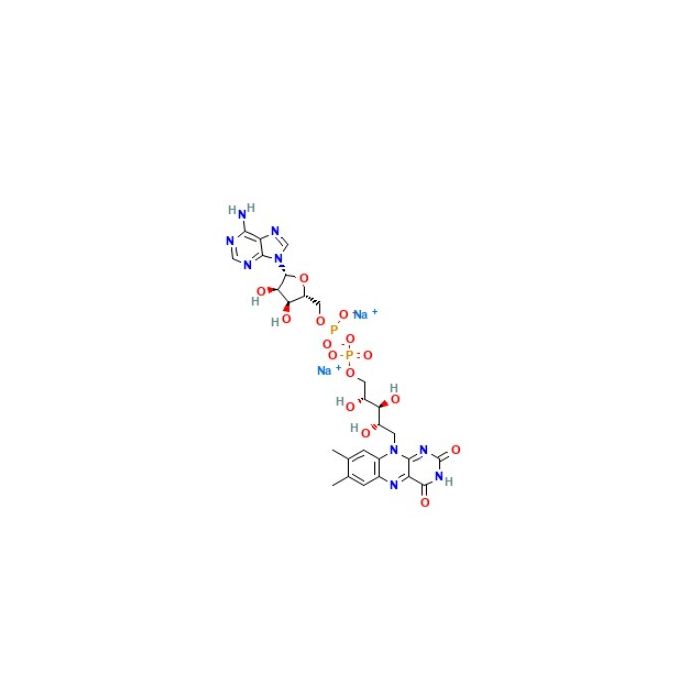
Flavin adenine dinucleotide disodium salt hydrate(FAD-Na2) - for cell culture, ≥95% , CAS No.84366-81-4

CAS: 84366-81-4 Cat. No.: F100990 Molecular Weight: 829.51 (anhydrous basis) Beilstein Registry Number: 5326842 EC Number: 282-733-8 PubChem CID: 2734019
AVAILABLE TO ORDER
GRADE & PURITY for Cell culture ? Cell-culture grade — low endotoxin and contaminants to support viable cell growth. Use in mammalian/other cell culture media and supplements. ≥95%
Synonyms
FAD-Na2 | NCGC00167573-01 | Flavin adenine dinucleotide disodium | FLAVINE ADENINE DINUCLEOTIDE DISODIUM | DTXCID8026723 | DTXSID0046723 | Tox21_112566 | DISODIUM FLAVINE ADENINE DINUCLEOTIDE | FAD sodium salt | CAS-84366-81-4 | UNII-67U7UHJ04C | FLAVIN A
Storage
Store at -20°C,Argon charged
Shipped In
Ice chest + Ice pads
 ·  off list, applied to all prices below.
Size
Status
Price
Qty
100mg
F100990-100mg
3
$131.90
250mg
F100990-250mg
1
$276.90
500mg
F100990-500mg
1
$494.90
Enter a quantity for the sizes you want to add.
🧪

Why this grade

for cell culture, ≥95% for Cell culture for sensitive chromatographic and analytical workflows requiring minimal baseline interference.

🌡

Storage & shipping

Store at -20°C,Argon charged Ships Ice chest + Ice pads Check lot-specific COA for exact specifications.

📋

Quality documents

SDS, COA, datasheet, and spec sheet available for download. Lot-specific COA accessible via lot number lookup.

📚

Literature proof

Cited in 3 peer-reviewed publications across chromatography, organic synthesis, and cross-coupling reactions.

Overview

Product Introduction

Flavin adenine dinucleotide (FAD) is a redox cofactor of flavoproteins, such as cytochrome-b5 reductase enzyme. With the help of nicotinamide adenine dinucleotide phosphate (NADPH), FAD can be reduced to form FADH2.


Application

Flavin adenine dinucleotide disodium salt hydrate has been used as a component in the extraction buffer for plant tissue extraction. It has also been used to study its effects on infarct areas of middle cerebral artery occlusion (MCAO) induced mice.

Flavin adenine dinucleotide (FAD) is used as a redox cofactor (electron carrier) by flavoproteins including succinate dehydrogenase (complex), α-ketoglutarate dehydrogenase, apoptosis-inducing factor 2 (AIF-M2, AMID), folate/FAD-dependent tRNA methyltransferases, and N-hydroxylating flavoprotein monooxygenases. FAD is a component of the pyruvate dehydrogenase complex.

Specifications

Synonyms
FAD-Na2 | NCGC00167573-01 | Flavin adenine dinucleotide disodium | FLAVINE ADENINE DINUCLEOTIDE DISODIUM | DTXCID8026723 | DTXSID0046723 | Tox21_112566 | DISODIUM FLAVINE ADENINE DINUCLEOTIDE | FAD sodium salt | CAS-84366-81-4 | UNII-67U7UHJ04C | FLAVIN A
Specifications & Purity
for cell culture, ≥95%
Biochemical and Physiological Mechanisms
Redox cofactor of flavoproteins. Flavin adenine dinucleotide is a component of pyruvate dehydrogenase complex. Role in nitric oxide synthesis. Active in vitro .
Storage
Store at -20°C, Argon charged
Shipped In
Ice chest + Ice pads
This product requires cold chain shipping. Ground and other economy services are not available.
Grade
for Cell culture
Note
Wherever possible, you should prepare and use solutions on the same day. However, if you need to make up stock solutions in advance, we recommend that you store the solution as aliquots in tightly sealed vials at -20°C. Generally, these will be useable for up to one month. Before use, and prior to opening the vial we recommend that you allow your product to equilibrate to room temperature for at least 1 hour. Need more advice on solubility, usage and handling? Please visit our frequently asked questions (FAQ) page for more details.
Purity
≥95%
Names and Identifiers
Canonical SmilesCC1=CC2=C(C=C1C)N(C3=NC(=O)NC(=O)C3=N2)CC(C(C(COP(=O)([O-])OP(=O)([O-])OCC4C(C(C(O4)N5C=NC6=C(N=CN=C65)N)O)O)O)O)O.[Na+].[Na+]
IUPAC Namedisodium;[[(2R,3S,4R,5R)-5-(6-aminopurin-9-yl)-3,4-dihydroxyoxolan-2-yl]methoxy-oxidophosphoryl] [(2R,3S,4S)-5-(7,8-dimethyl-2,4-dioxobenzo[g]pteridin-10-yl)-2,3,4-trihydroxypentyl] phosphate
InChIKeyXLRHXNIVIZZOON-WFUPGROFSA-L
INCHI1S/C27H33N9O15P2.2Na/c1-10-3-12-13(4-11(10)2)35(24-18(32-12)25(42)34-27(43)33-24)5-14(37)19(39)15(38)6-48-52(44,45)51-53(46,47)49-7-16-20(40)21(41)26(50-16)36-9-31-17-22(28)29-8-30-23(17)36;;/h3-4,8-9,14-16,19-21,26,37-41H,5-7H2,1-2H3,(H,44,45)(H,46,47)(H2,28,29,30)(H,34,42,43);;/q;2*+1/p-2/t14-,15+,16+,19-,20+,21+,26+;;/m0../s1
Isomeric SMILES CC1=CC2=C(C=C1C)N(C3=NC(=O)NC(=O)C3=N2)C[C@@H]([C@@H]([C@@H](COP(=O)([O-])OP(=O)([O-])OC[C@@H]4[C@H]([C@H]([C@@H](O4)N5C=NC6=C(N=CN=C65)N)O)O)O)O)O.[Na+].[Na+]
WGK Germany 3
RTECS AU7470000
PubChem CID 2734019
Molecular Weight 829.51 (anhydrous basis)
Beilstein 5326842
Reaxy-Rn 5326842

Documentation

📋 Safety Data Sheet (SDS)

Comprehensive hazard, handling, storage, and regulatory compliance document.

Download SDS →

✅ Certificate of Analysis (COA)

Lot-specific quality data. Enter your lot number to retrieve the exact COA.

Look up COA →

📊 Datasheet

Quick-reference summary of product specifications and applications.

View datasheet →

🔬 Specification Sheet

Full quality attributes and acceptance criteria for this grade.

View spec sheet →

Advanced Data

Taxonomic Classification

Taxonomy Tree

KingdomOrganic compounds
SuperclassNucleosides, nucleotides, and analogues
ClassFlavin nucleotides
SubclassNot available
Intermediate Tree Nodes Not available
Direct ParentFlavin nucleotides
Alternative Parents (3'->5')-dinucleotides  Purine ribonucleoside diphosphates  Purine ribonucleoside monophosphates  Flavins  Pentose phosphates  Glycosylamines  6-aminopurines  Monosaccharide phosphates  Organic pyrophosphates  Quinoxalines  Aminopyrimidines and derivatives  Pyrimidones  Pyrazines  Benzenoids  Imidolactams  N-substituted imidazoles  Alkyl phosphates  Vinylogous amides  Heteroaromatic compounds  Tetrahydrofurans  Lactams  Secondary alcohols  Polyols  Oxacyclic compounds  Azacyclic compounds  Primary amines  Hydrocarbon derivatives  Organic oxides  Organic sodium salts  Organic zwitterions  Organopnictogen compounds  
Molecular FrameworkAromatic heteropolycyclic compounds
Substituents Flavin nucleotide - (3'->5')-dinucleotide - (3'->5')-dinucleotide or analogue - Purine ribonucleoside diphosphate - Purine ribonucleoside monophosphate - Flavin - Isoalloxazine - Pentose phosphate - Pentose-5-phosphate - Glycosyl compound - N-glycosyl compound - 6-aminopurine - Diazanaphthalene - Monosaccharide phosphate - Organic pyrophosphate - Pentose monosaccharide - Pteridine - Quinoxaline - Imidazopyrimidine - Purine - Aminopyrimidine - Pyrimidone - Monosaccharide - N-substituted imidazole - Organic phosphoric acid derivative - Alkyl phosphate - Benzenoid - Imidolactam - Phosphoric acid ester - Pyrazine - Pyrimidine - Vinylogous amide - Tetrahydrofuran - Imidazole - Heteroaromatic compound - Azole - Lactam - Secondary alcohol - Polyol - Organic alkali metal salt - Organoheterocyclic compound - Oxacycle - Azacycle - Primary amine - Alcohol - Amine - Organonitrogen compound - Organic oxide - Organopnictogen compound - Organic oxygen compound - Organic nitrogen compound - Organic zwitterion - Organooxygen compound - Organic sodium salt - Organic salt - Hydrocarbon derivative - Aromatic heteropolycyclic compound
DescriptionThis compound belongs to the class of organic compounds known as flavin nucleotides. These are nucleotides containing a flavin moiety. Flavin is a compound that contains the tricyclic isoalloxazine ring system, which bears 2 oxo groups at the 2- and 4-positions.
External Descriptors Not available
3D Structure
Interactive Chemical Structure Model


Mechanisms of Action
Certificates(CoA,COO,BSE/TSE and Analysis Chart)
C of A & Other Certificates(BSE/TSE, COO):
Analytical Chart:

Find and download the COA for your product by matching the lot number on the packaging.

19 results found

Lot NumberCertificate TypeDateItem
F2623611Certificate of AnalysisMay 28, 2026 F100990
F2623613Certificate of AnalysisMay 28, 2026 F100990
E2614283Certificate of AnalysisApr 30, 2026 F100990
E2614284Certificate of AnalysisApr 30, 2026 F100990
E2614281Certificate of AnalysisApr 30, 2026 F100990
F2526350Certificate of AnalysisJun 12, 2025 F100990
F2526381Certificate of AnalysisJun 12, 2025 F100990
F2526437Certificate of AnalysisJun 12, 2025 F100990
H2414496Certificate of AnalysisJul 18, 2024 F100990
H2414576Certificate of AnalysisJul 18, 2024 F100990
H2414499Certificate of AnalysisJul 18, 2024 F100990
H2414498Certificate of AnalysisJul 18, 2024 F100990
H2414497Certificate of AnalysisJul 18, 2024 F100990
I2320557Certificate of AnalysisSep 11, 2023 F100990
I2320558Certificate of AnalysisSep 11, 2023 F100990
I2320559Certificate of AnalysisSep 11, 2023 F100990
F2330701Certificate of AnalysisFeb 06, 2023 F100990
K2211476Certificate of AnalysisAug 19, 2022 F100990
K2211505Certificate of AnalysisAug 19, 2022 F100990

Show more ⌵

Chemical and Physical Properties
SensitivityLight&Moisture&Heat sensitive
Specific Rotation[α]-30.0 to -25.0 deg(C=1, H2O)
Molecular Weight829.500 g/mol
XLogP3
Hydrogen Bond Donor Count7
Hydrogen Bond Acceptor Count20
Rotatable Bond Count13
Exact Mass829.121 Da
Monoisotopic Mass829.121 Da
Topological Polar Surface Area362.000 Ų
Heavy Atom Count55
Formal Charge0
Complexity1550.000
Isotope Atom Count0
Defined Atom Stereocenter Count7
Undefined Atom Stereocenter Count0
Defined Bond Stereocenter Count0
Undefined Bond Stereocenter Count0
The total count of all stereochemical bonds0
Covalently-Bonded Unit Count3
Documents & Articles
Citations of This Product
References
1. Jianfeng Zhang, Wenrong Bing, Tiancheng Hu, Xu Zhou, Jiejing Zhang, Jing Liang, Yongguang Li.  (2023)  Enhanced biodegradation of phenol by microbial collaboration: Resistance, metabolite utilization, and pH stabilization.  ENVIRONMENTAL RESEARCH,      [PMID:37776942] [10.1016/j.envres.2023.117269]
2. Hao Fei, Xie Xing, Feng Zhixin, Chen Rong, Wei Yanna, Liu Jin, Xiong Qiyan, Shao Guoqing, Lin Johnson.  (2022)  NADH oxidase of Mycoplasma hyopneumoniae functions as a potential mediator of virulence.  BMC Veterinary Research,  18  (1): (1-14).  [PMID:35366872] [10.1186/s12917-022-03230-7]
3. Lijun Geng, Xudong Yu, Yajuan Li, Yanqiu Wang, Yongquan Wu, Jujie Ren, Fengfeng Xue, Tao Yi.  (2019)  Instant hydrogel formation of terpyridine-based complexes triggered by DNA via non-covalent interaction.  Nanoscale,  11  (9): (4044-4052).  [PMID:30768104] [10.1039/C8NR08532C]
Solution Calculators
Reviews

Customer Reviews

Shall we send you a message when we have discounts available?

Remind me later

Thank you! Please check your email inbox to confirm.

Oops! Notifications are disabled.