Product Introduction:
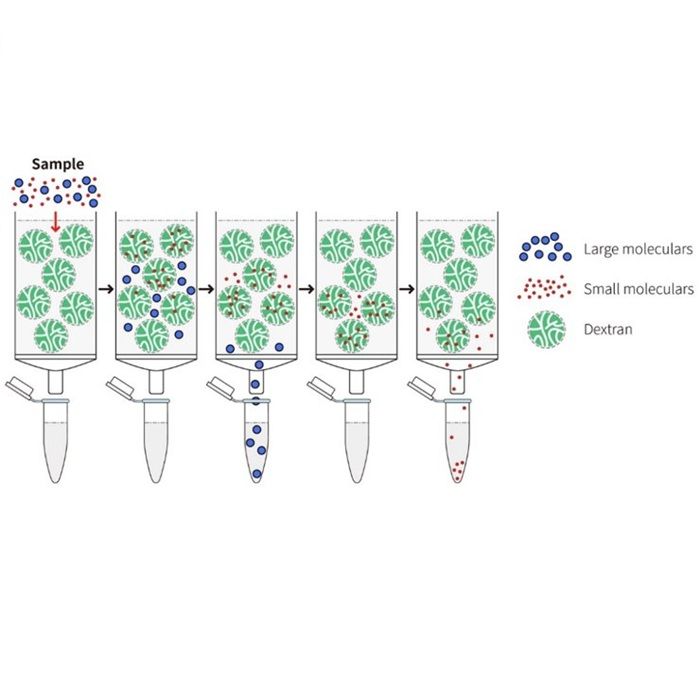
The G25 pre-packed protein desalting column is a ready-to-use chromatography column developed using G25 Sephadex matrix. It is commonly known as a desalting column and is designed to filter out small molecular substances such as salts and imidazole from macromolecular protein samples. This product eliminates the need for column packing and can replace the time-consuming traditional dialysis process, achieving the purpose of rapid protein purification and protein buffer replacement. The removal rate of salts and small molecular substances is over 95%, with high desalting efficiency for protein samples and a recovery rate exceeding 90%.This product supports operation by centrifugation methods. It is mainly used to remove impurities such as salt ions, imidazole, detergents, small molecular dyes, and buffers from samples including proteins, nucleic acids, polypeptides, and polysaccharides with a molecular weight greater than 5 kDa.
Product Specifications:
Column volume: 0.5 mL
Sample loading volume: 50-150 μl
Packaging: 5pieces/25 pieces
Matrix: Sephadex
Exclusion limit: Mr5000
Particle size of filler: 50-150 μm
pH stability: 2-13
Storage: 2-8 ℃
Product Features:
Easy to operate and time-saving, significantly superior to traditional dialysis;
The removal rate of salts and small molecules is over 95%, with high desalting efficiency for protein samples;
High recovery rate of protein samples, reaching more than 90%;
It can efficiently remove impurities such as salt ions, imidazole, detergents, small molecule dyes, and buffers from samples of proteins, polypeptides, nucleic acids, polysaccharides, etc. with a molecular weight greater than 5 kDa.
Instructions for Use
1. Centrifugal Desalting:
1) Drain the protective solution: Loosen the cap on a spin column, twist the tab off of the bottom, then place the column into a collection tube. Centrifuge the column‑tube assembly at 1,000 x g for 2 minutes to remove the storage solution. Discard the flowthrough, then place the column back into the collection tube.
Note: When using a non-horizontal rotor, the centrifugation may cause the resin to compact and form an upward slope. The direction of this slope should be maintained in the subsequent steps. Mark the position of the upward slope on the column shell, and in the subsequent centrifugation steps, adjust the direction of the centrifuge tube to ensure that the direction and position of the slope do not change after centrifugation.
2) Equilibration: Slowly add equilibration buffer along the inner wall of the column using a pipette or dropper until the column is fully filled. Centrifuge the column‑tube assembly at 1,000 x g for 2 minutes to equilibrate the column. Repeat this step 3 times, discarding the buffer from the collection tube each time.
3) Sample loading: Hold the pipette tip close to the center of the filler (being careful not to touch the filler) and slowly add the sample in an amount equivalent to 10%-30% of the column bed volume, allowing the sample to enter the filler.
4) Place the desalting column into a new clean collection tube, centrifuge at 1000 g for 2 minutes. The liquid in the collection tube is the desalted protein.
5) The concentration of the protein sample can be detected by methods such as A280nm ultraviolet absorption, Bradford protein concentration determination, and SDS-PAGE gel electrophoresis.
2. Medium Cleaning and Regeneration:
1) Add deionized water to the used desalting column for cleaning, and repeat this three times.
2) Add 20% ethanol solution to the treated desalting column, place a plug at the lower end, tighten the cap, and store it at 2-8℃.
Precautions:
1) To prevent cross-contamination, it is recommended that this product be used disposable. To avoid ionic interactions, it is advisable to maintain a low salt concentration (25 mM NaCl) in the sample buffer.
2) The filler will lose water and shrink in high-concentration alcohol solutions or saturated salt solutions. Do not pass the above-mentioned solutions through the column.
3) The sample processing amount should be appropriate. Too much will affect the desalting effect, and too little will affect the recovery efficiency. When loading the sample, slowly and evenly add the sample to the center of the tube.
4) When the sample concentration is too low, the sample should first be concentrated to the required volume or concentration using an ultrafiltration tube.
5) The matrix should be kept moist at all times during storage and purification, and avoid bubbles entering the desalting column.

 ZJ26F0636532