The store will not work correctly when cookies are disabled.
JavaScript seems to be disabled in your browser. For the best experience on our site, be sure to turn on Javascript in your browser.
· · COA & SDS available for every product · Same-day shipping on in-stock items Gatifloxacin mesylate - BioReagent, Dry gatifloxacin content>78% , CAS No.316819-28-0
GRADE & PURITY BioReagent ? BioReagent grade — tested suitable for life-science and molecular-biology use. Use for cell culture, assays, and biochemical work needing biological compatibility. Dry gatifloxacin content>78% Storage
Store at 2-8°C,Desiccated
🧪
Why this grade BioReagent, Dry gatifloxacin content>78% BioReagent for sensitive chromatographic and analytical workflows requiring minimal baseline interference.
🌡
Storage & shipping Store at 2-8°C,Desiccated Ships Wet ice Check lot-specific COA for exact specifications.
📋
Quality documents SDS, COA, datasheet, and spec sheet available for download. Lot-specific COA accessible via lot number lookup.
📚
Literature proof Cited in 0 peer-reviewed publications across chromatography, organic synthesis, and cross-coupling reactions.
Specifications Specifications & Purity
BioReagent, Dry gatifloxacin content>78%
Storage
Store at 2-8°C, Desiccated
Shipped In
Wet ice
This product requires cold chain shipping. Ground and other economy services are not available.
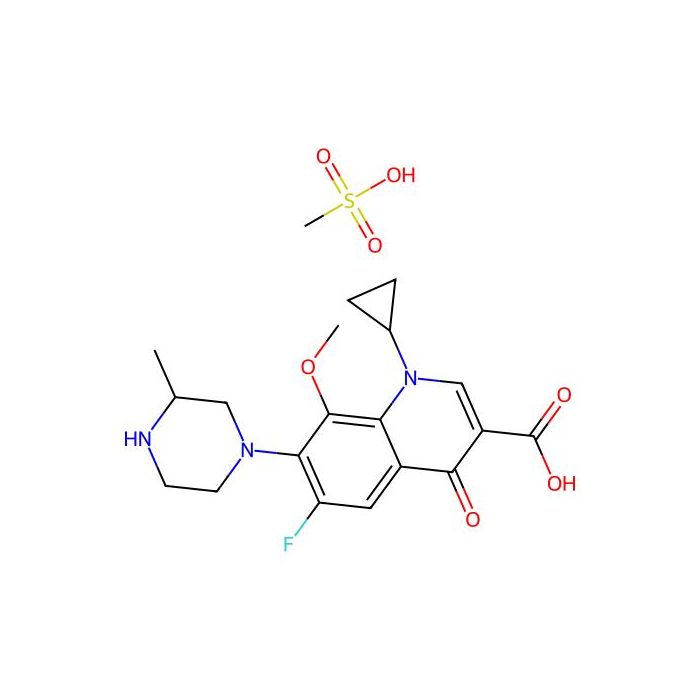
Names and Identifiers Canonical Smiles CC1CN(CCN1)C2=C(C=C3C(=C2OC)N(C=C(C3=O)C(=O)O)C4CC4)F.CS(=O)(=O)O IUPAC Name 1-cyclopropyl-6-fluoro-8-methoxy-7-(3-methylpiperazin-1-yl)-4-oxoquinoline-3-carboxylic acid;methanesulfonic acid InChIKey PMMNVFFMFJMFDB-UHFFFAOYSA-N INCHI 1S/C19H22FN3O4.CH4O3S/c1-10-8-22(6-5-21-10)16-14(20)7-12-15(18(16)27-2)23(11-3-4-11)9-13(17(12)24)19(25)26;1-5(2,3)4/h7,9-11,21H,3-6,8H2,1-2H3,(H,25,26);1H3,(H,2,3,4) Isomeric SMILES CC1CN(CCN1)C2=C(C=C3C(=C2OC)N(C=C(C3=O)C(=O)O)C4CC4)F.CS(=O)(=O)O Alternate CAS 316819-28-0 PubChem CID 16040196
Documentation 📋 Safety Data Sheet (SDS) Comprehensive hazard, handling, storage, and regulatory compliance document.
Download SDS → ✅ Certificate of Analysis (COA) Lot-specific quality data. Enter your lot number to retrieve the exact COA.
Look up COA → 📊 Datasheet Quick-reference summary of product specifications and applications.
View datasheet → 🔬 Specification Sheet Full quality attributes and acceptance criteria for this grade.
View spec sheet →
Advanced Data Taxonomic Classification Kingdom Organic compounds Superclass Organoheterocyclic compounds Class Quinolines and derivatives Subclass Quinoline carboxylic acids Intermediate Tree Nodes Not available Direct Parent Quinoline carboxylic acids Alternative Parents N-arylpiperazines Fluoroquinolones Aminoquinolines and derivatives Hydroquinolones Haloquinolines Hydroquinolines Pyridinecarboxylic acids Methoxyanilines Anisoles Dialkylarylamines Alkyl aryl ethers Aryl fluorides Alkanesulfonic acids Vinylogous amides Sulfonyls Organosulfonic acids Methanesulfonates Heteroaromatic compounds Amino acids Azacyclic compounds Carboxylic acids Dialkylamines Organic oxides Hydrocarbon derivatives Organofluorides Molecular Framework Not available Substituents Quinoline-3-carboxylic acid - Fluoroquinolone - N-arylpiperazine - Aminoquinoline - Haloquinoline - Dihydroquinolone - Dihydroquinoline - Pyridine carboxylic acid - Pyridine carboxylic acid or derivatives - Methoxyaniline - Phenol ether - Anisole - Dialkylarylamine - Tertiary aliphatic/aromatic amine - Alkyl aryl ether - Benzenoid - Aryl fluoride - Piperazine - Pyridine - 1,4-diazinane - Aryl halide - Vinylogous amide - Alkanesulfonic acid - Heteroaromatic compound - Organic sulfonic acid or derivatives - Organosulfonic acid or derivatives - Organosulfonic acid - Sulfonyl - Methanesulfonate - Amino acid - Tertiary amine - Amino acid or derivatives - Azacycle - Secondary amine - Carboxylic acid derivative - Carboxylic acid - Secondary aliphatic amine - Ether - Amine - Organic nitrogen compound - Hydrocarbon derivative - Organooxygen compound - Organosulfur compound - Organonitrogen compound - Organic oxygen compound - Organic oxide - Organofluoride - Organohalogen compound - Aromatic heteropolycyclic compound Description This compound belongs to the class of organic compounds known as quinoline carboxylic acids. These are quinolines in which the quinoline ring system is substituted by a carboxyl group at one or more positions. External Descriptors Not available Data sources 1. Djoumbou Feunang Y, Eisner R, Knox C, Chepelev L, Hastings J, Owen G, Fahy E, Steinbeck C, Subramanian S, Bolton E, Greiner R, and Wishart DS. ClassyFire: Automated Chemical Classification With A Comprehensive, Computable Taxonomy. Journal of Cheminformatics, 2016, 8:61.
3D Structure Certificates(CoA,COO,BSE/TSE and Analysis Chart) Chemical and Physical Properties Molecular Weight 471.500 g/mol XLogP3 Hydrogen Bond Donor Count 3 Hydrogen Bond Acceptor Count 11 Rotatable Bond Count 4 Exact Mass 471.148 Da Monoisotopic Mass 471.148 Da Topological Polar Surface Area 145.000 Ų Heavy Atom Count 32 Formal Charge 0 Complexity 745.000 Isotope Atom Count 0 Defined Atom Stereocenter Count 0 Undefined Atom Stereocenter Count 1 Defined Bond Stereocenter Count 0 Undefined Bond Stereocenter Count 0 The total count of all stereochemical bonds 0 Covalently-Bonded Unit Count 2
Solution Calculators Molarity Calculator Determine the necessary mass, volume, or concentration for preparing a solution.
Dilution Calculator Determine the dilution needed to prepare a stock solution.
Reconstitution Calculator Reviews Need help choosing the grade? Our grade selection guide covers purity, stabilizer status, and application suitability for all variants in our catalog.
View BioReagent grade guide →
We use cookies to ensure the website functions properly and, where permitted, to improve your experience. You can manage your preferences at any time in Settings. Learn more in our
Cookie Policy. Settings Agree All Decline
Shall we send you a message when we have discounts available?
Remind me later Allow
Thank you! Please check your email inbox to confirm.
Oops! Notifications are disabled.
Products are supplied to verified businesses, institutions, and qualified professionals for research and development use only. Not for use in humans, animals, diagnosis, or therapy.
Copyright © 2023–present Aladdin Scientific Corp. All rights reserved.