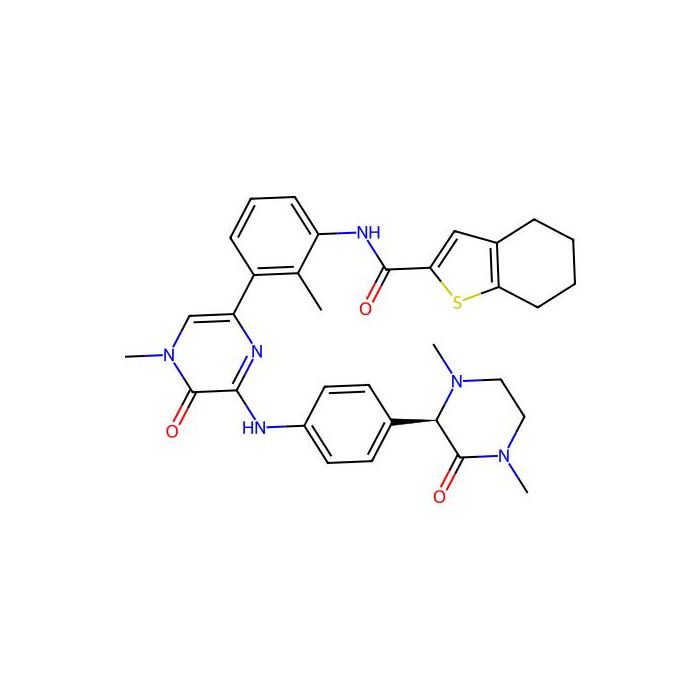
GDC-0834 is a potent and selective BTK inhibitor. GDC-0834 inhibits BTK with an in vitro IC 50 of 5.9 and 6.4 nM in biochemical and cellular assays, respectively, and in vivo IC 50 of 1.1 and 5.6 μM in mouse and rat, respectively.
In Vitro
GDC-0834 suppresses BTK kinase activity with an IC 50 value of 5.9±1.1 nM with Hill slope value of −0.84±0.07 (mean±S.E.). GDC-0834 is shown to be a potent reversible inhibitor of six known aldehyde oxidase (AO) substrates with IC 50 values ranging from 0.86 to 1.87 μM. MCE has not independently confirmed the accuracy of these methods. They are for reference only.
In Vivo
The treatment of BALB/c mice with GDC-0834 results in dose-dependent inhibition of pBTK-Tyr223. Animals dosed with 150 or 100 mg/kg GDC-0834 for 2 h show complete inhibition of pBTK-Tyr223 levels in blood, with a mean inhibition of 97 and 96%, respectively. In the rat CIA study, GDC-0834 inhibits pBTK-Tyr223 in rat blood in a dose-dependent manner. The IC 50 estimate of pBTK-Tyr223 inhibition in rats is determined to be 5.6±1.6 μM with m of 0.51±0.087 (mean±S.E.) . MCE has not independently confirmed the accuracy of these methods. They are for reference only.
GDC-0834 is a potent and selective BTK inhibitor. GDC-0834 inhibits BTK with an in vitro IC 50 of 5.9 and 6.4 nM in biochemical and cellular assays, respectively, and in vivo IC 50 of 1.1 and 5.6 μM in mouse and rat, respectively.
Condiciones de almacenamiento de almacenamiento
Store at -20°C
Enviado en
Ice chest + Ice pads
Este producto requiere envío en cadena de frío. Los servicios terrestres y otros servicios económicos no están disponibles.
This compound belongs to the class of organic compounds known as aromatic anilides. These are aromatic compounds containing an anilide group in which the carboxamide group is substituted with an aromatic group. They have the general structure RNC(=O)R', where R= benzene, and R = aryl group.
External Descriptors
Not available
1. Djoumbou Feunang Y, Eisner R, Knox C, Chepelev L, Hastings J, Owen G, Fahy E, Steinbeck C, Subramanian S, Bolton E, Greiner R, and Wishart DS. ClassyFire: Automated Chemical Classification With A Comprehensive, Computable Taxonomy. Journal of Cheminformatics, 2016, 8:61.
Certificados (CoA, COO, BSE/TSE y tabla de análisis)
C of A & Other Certificates(BSE/TSE, COO):
Analytical Chart:
Propiedades químicas y físicas
Solubilidad
DMSO : ≥ 32 mg/mL (53.62 mM)
Peso molecular
596.700 g/mol
XLogP3
4.300
Hydrogen Bond Donor Count
2
Hydrogen Bond Acceptor Count
6
Rotatable Bond Count
6
Exact Mass
596.257 Da
Monoisotopic Mass
596.257 Da
Topological Polar Surface Area
126.000 Ų
Heavy Atom Count
43
Formal Charge
0
Complexity
1140.000
Isotope Atom Count
0
Defined Atom Stereocenter Count
1
Undefined Atom Stereocenter Count
0
Defined Bond Stereocenter Count
0
Undefined Bond Stereocenter Count
0
The total count of all stereochemical bonds
0
Covalently-Bonded Unit Count
1
Calculadoras de soluciones
Molarity Calculator
Determine the necessary mass, volume, or concentration for preparing a solution.
Dilution Calculator
Determine the dilution needed to prepare a stock solution.
Reconstitution Calculator
Reseñas
Reseñas de cliente
Application Protocols
No vendor-validated protocols are provided for this item.
General best-practice guidance for small-molecule tool compounds (not item-specific):
Solution preparation: Weigh accurately, dissolve in dry DMSO to a convenient stock concentration (e.g., 10–50 mM), aliquot, label with lot/concentration/date, and store at −20 °C or below. Thaw aliquots on ice and avoid repeated freeze–thaw.
Biochemical assays: Titrate compound across a log range to generate full concentration–response curves; include vehicle controls and known positive/negative controls; maintain constant DMSO across all wells.
Cell-based assays: Verify lack of vehicle toxicity at the intended DMSO percentage; preincubate as required by the assay; monitor for precipitation or adsorption to plastics.
Data quality: Aim for Z′ ≥ 0.5 in screening assays; confirm activity with orthogonal readouts and counter-screens for assay interference.
For application-specific parameters (e.g., incubation times, substrate concentrations, detection wavelengths), follow your internal SOPs or relevant literature referencing the exact CAS/CID of interest.
Biological Roles
Item-specific biological targets or MoA are not provided in the Product Data. The following context is general and literature-based for small-molecule tool compounds used in kinase pathway research (not item-specific claims for this SKU):
Small-molecule kinase pathway probes are widely used to modulate signaling cascades in immunology, oncology, and inflammation research. They allow temporal control of pathway activity in cell and biochemical systems, facilitating target validation and mechanistic studies.
Typical experimental readouts include phosphorylation status of downstream effectors, transcriptional reporter assays, cytokine release, proliferation/apoptosis markers, and changes in cell phenotype upon acute inhibition.
In systems biology, these probes help delineate feedback regulation, pathway crosstalk, and compensatory mechanisms by comparing acute chemical inhibition with genetic perturbations (siRNA/CRISPR). Combining titrated inhibitor exposure with phospho-proteomics can reveal on-target versus off-target signatures.
ADME/stability profiling of tool compounds in microsomes, hepatocytes, and plasma informs exposure limits for in vitro experiments and aids in designing more stable analogs.
Important: For this catalog item, no specific target, selectivity, or potency values are provided. Users should consult primary literature and verify the exact mechanism and biochemical profile that correspond to the CAS/CID of interest before drawing biological conclusions. Research use only; not for use in humans or diagnostics.
Buffer Applications
This product is a bioactive small molecule and is not a buffering agent.
Not typically applicable: It does not define or control solution pH and is not used to prepare classical buffer systems.
Practical note: When formulating working solutions for assays, use standard biological buffers (e.g., HEPES, PBS, Tris) appropriate to your system. Introduce the compound from a concentrated DMSO stock to the buffered medium while controlling the final DMSO percentage and monitoring for precipitation.
For any item-specific pKa or solubility data that might influence buffer choice, refer to the CoA/Spec Sheet or primary literature corresponding to the exact structure.
Green Alternatives
As a defined bioactive tool compound, GDC-0834 itself does not have a “green substitute” for its intended role. However, you can implement greener practices around its handling and use.
Greener practice considerations (general):
Stock solutions: Use the minimum effective DMSO concentration in assays (e.g., keep final DMSO ≤0.1–0.2% v/v where assay-tolerated) to reduce solvent burden.
Solvent selection for analytics: Favor acetonitrile/water over chlorinated solvents; use aqueous mobile phases and shorter gradients where consistent with resolution.
Waste minimization: Plan dose–response plates to minimize dead volumes; pool compatible waste streams; employ microscale assays.
Energy and storage: Consolidate aliquots and avoid unnecessary ultra-cold storage time outside the freezer; use light-protective secondary containment only if the compound is light-sensitive (verify).
DMSO vs DMF: Prefer DMSO for biological compatibility and lower hazard profile in screening; avoid DMF unless necessary for solubility.
Acetonitrile vs dichloromethane for sample prep: Prefer acetonitrile or ethanol where technically feasible; avoid halogenated waste.
Note: These are process-level greener choices. There is no interchangeable “green alternative molecule” that replicates the exact activity profile of this specific tool compound.
Pharmaceutical Uses
No pharmacopeial status or formulation role is provided for this item.
Acceptable research-only contexts (non-clinical; no therapeutic claims):
Reference standard in analytical method development (e.g., stability-indicating HPLC/LC–MS methods) and nonclinical bioanalysis where permitted.
Internal control in formulation feasibility studies (e.g., evaluating solubilization strategies such as cyclodextrins, lipid-based vehicles, or amorphous dispersions) strictly for laboratory research.
Comparative tool compound in preclinical discovery workflows (e.g., target validation, SAR benchmarking) with appropriate material control and documentation.
Important restrictions:
This product is for research use only and is not an API, excipient, or GMP-qualified material.
No medical, diagnostic, or therapeutic applications are supported. Do not use in humans or for clinical studies.
Documentation: If you require data for regulatory filings or externally reported studies, obtain the batch CoA/Spec Sheet and SDS, and independently verify identity, purity, and stability of the specific lot employed.
Physical Properties
Item-specific physicochemical specifications have not been provided.
Appearance: Not specified for this item; refer to CoA/Spec Sheet.
Melting point: Not specified for this item; refer to CoA/Spec Sheet.
Boiling point: Not applicable/Not typically reported for complex solids; refer to CoA/Spec Sheet if needed.
Density: Not specified for this item; refer to CoA/Spec Sheet.
Solubility: Not specified for this item; refer to CoA/Spec Sheet.
LogP/logD: Not specified for this item; refer to CoA/Spec Sheet.
pKa: Not specified for this item; refer to CoA/Spec Sheet.
Refractive index: Not applicable to solids; Not specified for this item.
General, literature-based guidance (not item-specific):
Many small-molecule tool compounds used in kinase research are sparingly water-soluble and are commonly prepared as concentrated DMSO stock solutions (e.g., 10–50 mM) and diluted into assay buffers to ≤0.1–0.5% v/v DMSO final. Verify solubility and stability empirically for this lot.
Solubility can often be improved with co-solvents (DMSO, DMF) or aqueous vehicles containing surfactants (e.g., 0.01–0.05% Tween-20) or cyclodextrins; compatibility must be validated for the specific assay.
Important: For method development, reportable physical constants must be sourced from the CoA/Spec Sheet for this catalog item or from peer-reviewed literature using the exact structure.
Quality and Grades
Grade/purity: Not specified for this item; refer to CoA/Spec Sheet.
Typical expectations for screening/tool compounds (general guidance):
Purity is commonly reported by HPLC/UPLC (e.g., area% at a specified wavelength) together with LC–MS identity confirmation and occasionally 1H NMR. Exact acceptance criteria vary by supplier and lot; consult the CoA for this SKU (G650062).
Residual solvents, water content, and salt form (free base vs. salt) significantly influence handling and solubility. Verify form and counterion on the CoA.
Implications for use:
For biochemical and cell-based assays, low UV-absorbing impurities and well-defined salt form support reproducibility. If performing quantitative potency or PK/ADME studies, consider orthogonal purity verification (qNMR, elemental analysis) as appropriate.
If your application is LC–MS-based quantitation, request or determine exact mass and isotopic pattern confirmation to align with your MRM transitions and retention windows.
Stabilizers/inhibitors: Not specified for this item; refer to CoA/Spec Sheet. If no stabilizer is present, minimize exposure to light, heat, and moisture.
Documentation: Batch-specific CoA/Spec Sheet and SDS provide the authoritative specifications, analytical methods, and acceptance criteria for this catalog item.
Reaction and Applications
This product is supplied as a finished small-molecule research tool and is not primarily intended as a synthetic reagent.
Research applications (general, literature context):
Use as a reference/benchmark compound in kinase pathway studies and chemical biology experiments.
Inclusion in small-molecule libraries for target validation, phenotypic screening, and structure–activity relationship (SAR) comparisons.
Analytical reference standard for developing and validating LC–MS/MS methods (e.g., stability-indicating assays, bioanalytical quantitation) where permitted.
Practical tips for experimental use:
Prepare concentrated DMSO stocks (e.g., 10–50 mM), filter if necessary (PTFE, 0.2 µm), and aliquot to minimize freeze–thaw cycles.
Confirm identity and purity of the lot by LC–MS/HPLC prior to critical assays; record retention time and MS transitions for future QC.
Assess adsorption/precipitation risks: precondition plasticware, maintain consistent DMSO percentage during serial dilutions, and inspect for turbidity upon buffer addition.
Not typically applicable:
Named reactions or stoichiometric transformations are not relevant for the end-use of this compound. If you plan to derivatize the molecule, perform a feasibility assessment considering unknown reactive handles and protect/deprotect strategies.
Reaction Conditions
Conventional synthetic reaction conditions are not applicable; this product is intended for use as a finished small-molecule tool compound.
General experimental conditions for assay use (not item-specific, literature-based best practices):
Stock preparation: Dissolve in anhydrous DMSO to a verified concentration (e.g., 10–50 mM), vortex/sonicate as needed, and sterile-filter if required by cell-based protocols.
Working concentrations: Many small-molecule inhibitors are evaluated across 8–12 point serial dilutions spanning low-nanomolar to high-micromolar ranges to define potency curves; exact ranges must be established empirically for the compound/assay.
Incubation parameters: Equilibration times of 15–60 minutes are common in biochemical assays; 1–24 hours in cell-based assays depending on target turnover and readout kinetics.
Compatibility: Maintain constant DMSO percentage across wells; avoid precipitation upon addition to aqueous buffers by slow addition and mixing.
These are general conditions and not specifications for this item. Always consult your assay SOPs and confirm solubility, stability, and non-interference of vehicle at the intended concentrations.
Safety and Handling
Safety information specific to this item has not been provided; always consult the SDS for authoritative guidance.
GHS classification, signal word, hazard statements, pictograms: Not specified for this item; refer to SDS.
Recommended PPE: Laboratory coat, safety glasses, and appropriate chemical-resistant gloves. Use in a chemical fume hood to avoid inhalation of dust or aerosols.
General handling:
Avoid generating dust; prevent contact with skin, eyes, and clothing.
If preparing DMSO stock solutions, note that DMSO enhances dermal absorption—avoid skin contact with both powder and solutions.
Use dedicated tools for small-molecule bioactives to prevent cross-contamination in screening collections.
First-aid overview (general):
Inhalation: Move to fresh air; seek medical attention if symptoms persist.
Skin/eye contact: Rinse with water for at least 15 minutes; remove contaminated clothing; seek medical attention as needed.
Ingestion: Rinse mouth; do not induce vomiting; seek medical attention.
Storage incompatibilities (general): Store away from oxidizing agents, strong acids/bases, and moisture. Keep container tightly closed under inert headspace where feasible.
Spill and disposal: Collect solids with minimal dust, absorb solutions with inert material, and dispose of as organic chemical waste per institutional and local regulations.
Note: This product is for research use only.
Solvent Selection
Item-specific solubility data are not provided for GDC-0834; select solvents empirically based on your assay and analytical needs.
General guidance for small-molecule tool compounds (not item-specific):
Primary stock solvent: DMSO is the most common due to broad solvency and assay compatibility at ≤0.1–0.5% v/v final.
Co-solvents/vehicles: DMF, ethanol, and acetonitrile can aid dissolution; for aqueous delivery, consider co-solvent mixtures or solubilizers (e.g., hydroxypropyl-β-cyclodextrin) after compatibility checks.
Aqueous buffers: If water solubility is limited, dissolve fully in anhydrous DMSO first, then titrate into buffer with vigorous mixing to avoid precipitation.
Analytical workflows: For LC–MS, acetonitrile/water with 0.1% formic acid is typical; ensure the compound remains in solution across the gradient.
Illustrative comparison (general):
DMSO: maximal solvency; biologically compatible at low %; can plasticize labware.
DMF: strong polar aprotic; higher toxicity; less favored for cell assays.
Ethanol: useful co-solvent; volatility can cause concentration drift.
PEG400 or Captisol: enhance aqueous solubility for in vivo method development (research use only); viscosity and matrix effects must be managed.
Always verify solubility and stability for your specific lot and conditions; consult the CoA/Spec Sheet for any item-specific guidance.
Storage and Reconstitution
Storage conditions (item-specific): Store at −20 °C. Keep container tightly closed. Minimize exposure to moisture, heat, and light. This item is shipped in an ice chest with ice pads to maintain the cold chain.
Form: Appearance not specified; refer to CoA/Spec Sheet for physical description and salt form.
Reconstitution and handling (general best practices; not item-specific specifications):
Reconstitution solvent: Typically dissolved in anhydrous DMSO to prepare concentrated stocks (e.g., 10–50 mM). Verify solubility for this specific lot before large-scale aliquoting.
Aliquoting: Prepare single-use aliquots in inert, low-bind tubes to avoid adsorption and repeated freeze–thaw. Label with lot, concentration, and date.
Thawing: Thaw on ice or at room temperature; mix thoroughly to redissolve any precipitate. Inspect visually for particulates or color change.
Short-term storage: Keep working solutions at 2–8 °C for the shortest feasible time; discard if precipitation or degradation is observed.
Long-term stability: Not specified for this item; refer to CoA/Spec Sheet. If stability data are unavailable, periodically recheck purity by HPLC/LC–MS.
Note: For research use only. Always defer to the batch CoA/Spec Sheet and SDS for definitive storage, handling, and stability guidance.
Structure and Identity
GDC-0834 is a research-use small-molecule compound supplied for chemical biology and screening workflows.
Item-specific identifiers (from Product Data):
CAS: 1133432-49-1
PubChem CID: 25234918
InChIKey: 41413 (as provided)
SMILES: Not specified for this item; refer to CoA/Spec Sheet.
Molecular formula: Not specified for this item; refer to CoA/Spec Sheet.
Molecular weight: Not specified for this item; refer to CoA/Spec Sheet.
Structural description (general, literature context):
GDC-0834 is described in the literature as a small-molecule kinase pathway tool compound. Such scaffolds commonly feature heteroaromatic rings with hydrogen-bond donor/acceptor motifs suited for ATP-binding pockets, and may include amide/urea linkages and halogenated or nitrile substituents to tune potency and physicochemical properties. (General description; not item-specific.)
2D structure (verbal, general): typically an aromatic/heteroaromatic core bearing multiple substituents that project into subpockets, with at least one polar linkage enabling hinge-binding interactions. (General literature characterization; exact atom connectivity for this item is not provided here.)
Notes:
Where exact structural strings or formula are required for method development or registration, please consult the product CoA/Spec Sheet or authoritative databases using the provided CAS and CID.
Synthetic Utility
GDC-0834 is supplied as a defined small-molecule tool compound and is not designed to serve as a general synthetic building block.
Not typically applicable: Routine functional group interconversions or named-reaction participation are not the intended use-cases for this product.
Useful roles in synthetic/analytical chemistry workflows (general):
Analytical calibrant or system suitability standard in LC–MS/HPLC to establish retention behavior and instrument performance in methods targeting heteroaromatic, moderately lipophilic analytes.
Positive control in biochemical assays to validate assay window, Z′ factor, and dynamic range prior to screening novel compounds.
Stability challenge studies (oxidative, hydrolytic, photolytic) to characterize degradation pathways and to develop stability-indicating methods for related scaffolds.
If derivatization is contemplated:
Evaluate structural liability and unknown reactive handles; without an explicit structure and reactivity map, chemoselective transformations cannot be guaranteed. Any semisynthesis should start from authenticated intermediates rather than from a finished tool compound.
Conclusion: Treat this material as an end-point research probe or reference standard rather than a synthetic precursor.
Target Specificity
Target, selectivity profile, and biochemical potency are not provided in the Product Data for this SKU.
Item-specific details required for this section (primary target, Ki/IC50, selectivity against related targets, species reactivity) are Not specified for this item; refer to CoA/Spec Sheet and primary literature corresponding to the provided CAS and CID.
Users should independently confirm the mechanism of action and selectivity relevant to their research system using orthogonal assays.
No additional claims are made for target binding or selectivity.
Preguntas frecuentes
What is the purity of this product?
This product is supplied at ≥98% purity (chemical assay). Lot-specific values are stated on the Certificate of Analysis.
How should this product be stored?
Store at ?20 °C. Freezer storage is required to maintain the specified shelf life.
How is this product shipped?
This product ships in an insulated container with ice pads. Unpack on arrival and transfer it to the storage condition stated above.
What are the CAS number, molecular formula and molecular weight?
The CAS Number is 1133432-49-1, the molecular formula is C33H36N6O3S, and the molecular weight is 596.7 g/mol. InChIKey CDOOFZZILLRUQH-GDLZYMKVSA-N.
What documentation is provided?
Available product documentation, including Certificates of Analysis (COA), Safety Data Sheets (SDS), and specification sheets, is shown in the product document area. Document availability and access follow the current site policy.
Utilizamos cookies para garantizar el correcto funcionamiento del sitio web y, cuando esté permitido, para mejorar su experiencia. Puede gestionar sus preferencias en cualquier momento en Configuración. Más información en nuestra Política de Cookies.
¿Quieres que te enviemos un mensaje cuando tengamos descuentos disponibles?
Recordármelo más tarde
¡Gracias! Por favor, revisa tu bandeja de entrada de correo electrónico para confirmar.
Products are supplied to verified businesses, institutions, and qualified professionals for research and development use only. Not for use in humans, animals, diagnosis, or therapy.