
Determine the necessary mass, volume, or concentration for preparing a solution.
IMT1 - ≥98% , CAS No.2304621-31-4
AVAILABLE TO ORDER
GRADE & PURITY ≥98%
Storage
Store at -20°C
Shipped In
Ice chest + Ice pads
≥98% for sensitive chromatographic and analytical workflows requiring minimal baseline interference.
Store at -20°C Ships Ice chest + Ice pads Check lot-specific COA for exact specifications.
SDS, COA, datasheet, and spec sheet available for download. Lot-specific COA accessible via lot number lookup.
Cited in 0 peer-reviewed publications across chromatography, organic synthesis, and cross-coupling reactions.
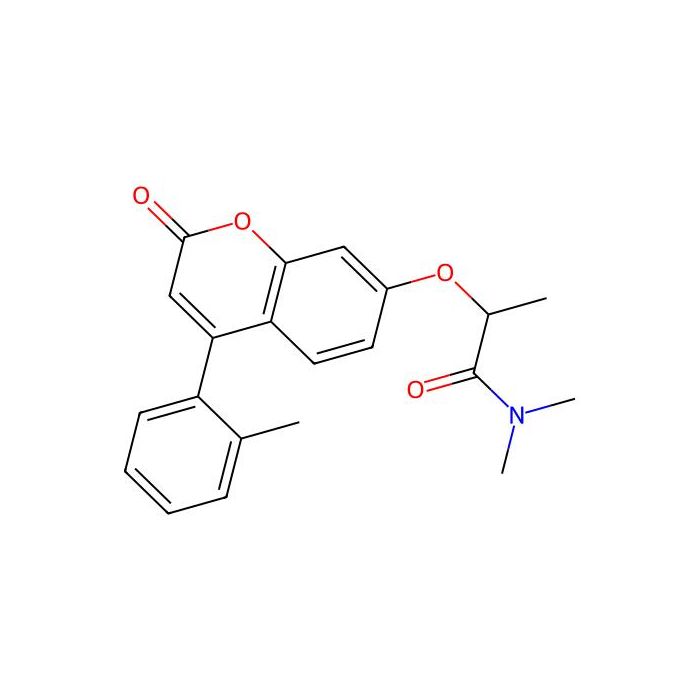
IMT1 is a first-in-class specific and noncompetitive human mitochondrial RNA polymerase (POLRMT) inhibitor. IMT1 causes a conformational change of POLRMT, which blocks substrate binding and transcription in a dose-dependent way in vitro. IMT1 reduces deoxynucleoside triphosphate levels and citric acid cycle intermediates, resulting in a marked depletion of cellular amino acid levels. IMT1 has the potential for mitochondrial transcription disorders related diseases.
In Vitro
IMT1 (0.00001-10 μM; 0-168 h) has a dose-dependent decrease in cell viability in A2780, A549 and HeLa cells. IMT1 shows a strong decrease in cell viability in about one third of the cancer cell lines, 89 cancer cell lines and primary cells (IMR90 lung fibroblasts and human peripheral blood mononuclear cells (PBMCs)), whereas primary cells remained unresponsive. IMT1 (0.01-10 μM; for 24-200 h) causes a dose-dependent decrease in the levels of mitochondrial transcripts and gradual depletion of mtDNA in HeLa cells. There is a dose-dependent decrease in the levels of subunits (NDUFB8, UQCRC2 and COXI) of respiratory chain complexes I, III and IV. IMT1 reveals a time-dependent and marked increase in the levels of mono- and diphosphate nucleotides that results in a considerable increase in the AMP/ATP ratio and levels of phosphorylated AMPK in A2780 cells. IMT1 severely impairs mtDNA gene expression in A2780 cells that express wild-type POLRMT, whereas cells that express mutant POLRMT (L796Q or L816Q) are resistant. POLRMT is essential for mtDNA transcription and biogenesis of the oxidative phosphorylation (OXPHOS) system. MCE has not independently confirmed the accuracy of these methods. They are for reference only. Cell Viability AssayCell Line: A2780, A549 and HeLa cells Concentration: 0.00001-10 μM Incubation Time: 0-168 hours Result: Had a dose-dependent decrease in cell viability in A2780, A549 and HeLa cells, but had not cytotoxic to human PBMCs or pooled primary human hepatocytes.
Form:Solid
| Canonical Smiles | CC1=CC=CC=C1C2=CC(=O)OC3=C2C=CC(=C3)OC(C)C(=O)N(C)C |
|---|---|
| IUPAC Name | N,N-dimethyl-2-[4-(2-methylphenyl)-2-oxochromen-7-yl]oxypropanamide |
| InChIKey | DBIPGWVTQBAHGP-UHFFFAOYSA-N |
| INCHI | 1S/C21H21NO4/c1-13-7-5-6-8-16(13)18-12-20(23)26-19-11-15(9-10-17(18)19)25-14(2)21(24)22(3)4/h5-12,14H,1-4H3 |
| PubChem CID | 138490559 |
| Molecular Weight | 351.40 |
Comprehensive hazard, handling, storage, and regulatory compliance document.
Download SDS →Lot-specific quality data. Enter your lot number to retrieve the exact COA.
Look up COA →Full quality attributes and acceptance criteria for this grade.
View spec sheet →Taxonomy Tree
| Kingdom | Organic compounds |
|---|---|
| Superclass | Phenylpropanoids and polyketides |
| Class | Neoflavonoids |
| Subclass | Neoflavones |
| Intermediate Tree Nodes | Not available |
| Direct Parent | Neoflavones |
| Alternative Parents | Coumarins and derivatives 1-benzopyrans Pyranones and derivatives Alkyl aryl ethers Benzene and substituted derivatives Tertiary carboxylic acid amides Heteroaromatic compounds Lactones Oxacyclic compounds Organopnictogen compounds Organonitrogen compounds Organic oxides Hydrocarbon derivatives |
| Molecular Framework | Aromatic heteropolycyclic compounds |
| Substituents | 4-phenylcoumarin - Coumarin - 1-benzopyran - Benzopyran - Pyranone - Alkyl aryl ether - Benzenoid - Pyran - Monocyclic benzene moiety - Heteroaromatic compound - Tertiary carboxylic acid amide - Lactone - Carboxamide group - Oxacycle - Organoheterocyclic compound - Ether - Carboxylic acid derivative - Organic nitrogen compound - Organic oxygen compound - Organopnictogen compound - Organic oxide - Hydrocarbon derivative - Organooxygen compound - Organonitrogen compound - Aromatic heteropolycyclic compound |
| Description | This compound belongs to the class of organic compounds known as neoflavones. These are neoflavonoids with a structure based on the 4-phenylcoumarin skeleton. |
| External Descriptors | Not available |
| Solubility | DMSO : 50 mg/mL (142.29 mM; Need ultrasonic) |
|---|