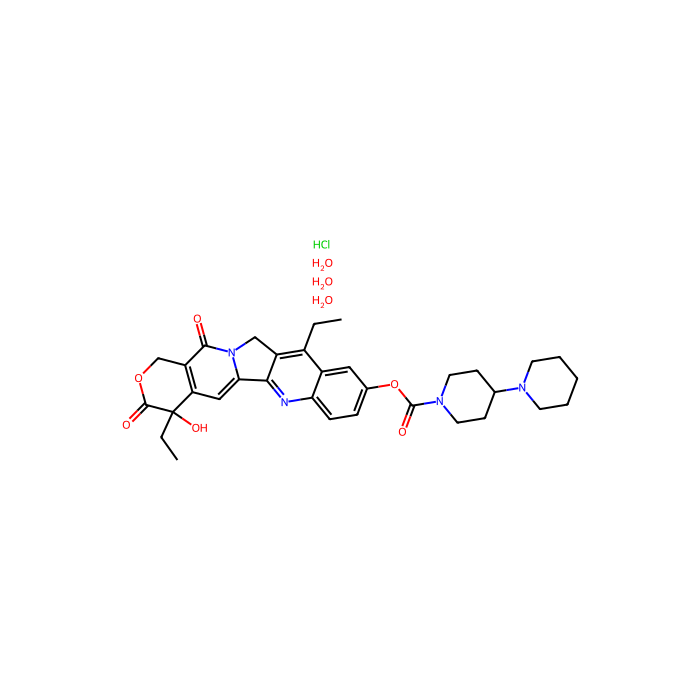
10mM in DMSO for sensitive chromatographic and analytical workflows requiring minimal baseline interference.
🌡
Storage & shipping
Store at -80°C Ships Dry ice packs + Cold packs Check lot-specific COA for exact specifications.
📋
Quality documents
SDS, COA, datasheet, and spec sheet available for download. Lot-specific COA accessible via lot number lookup.
📚
Literature proof
Cited in 3 peer-reviewed publications across chromatography, organic synthesis, and cross-coupling reactions.
Overview
Information
Irinotecan (CPT-11) prevents DNA from unwinding by inhibition oftopoisomerase 1. In vitro
Irinotecan is activated to SN-38 by carboxylesterases to become able to interact with its target, topoisomerase I. Irinotecan induces similar amounts of cleavable complexes at its IC50 in LoVo cells and HT-29 cell lines. SN-38 induces a concentration-dependent formation of cleavable complexes, which is not significantly different in LoVo cells and HT-29 cell lines. Cell accumulation of Irinotecan is markedly different, reaching consistently higher levels in HT-29 cells than in LoVo cells. The lactone E-ring of Irinotecan and SN-38 hydrolyses reversibly in aqueous solutions, and the interconversion between the lactone and carboxylate forms is dependent on pH and temperature. Liver is primarily responsible for the activation of Irinotecan to SN-38. At equal concentrations of Irinotecan and SN-38 glucuronide, the rate of beta-glucuronidase-mediated SN-38 production is higher than that formed from Irinotecan in both tumour and normal tissue. Irinotecan is also converted to SN-38 in intestines, plasma and tumor tissues. Irinotecan is significantly more active in SCLC than in NSCLC cell lines, whereas no significant difference between histological types is observed with SN-38.
In vivo
In COLO 320 xenografts, Irinotecan induces a maximum growth inhibition of 92%. A single dose of Irinotecan significantly increases amounts of topoisomerase I covalently bound to DNA in stomach, duodenum, colon and liver. Concomitantly, the Irinotecan-treated group shows significantly higher amounts of DNA strand breaks in colon mucosa cells compared to the control group. Cell Data
1.Xiawei Zhou, Xiuhua Pan, Ziqi Shen, Ruixin Kang, Yueru Pang, Lin Luo, Feiyang Liu, Siyuan Yu, Jun Zhang, Qi Shen. (2025) Eliminating intratumoral bacteria with cGAS-STING-activating nanodrug-bacteria biohybrids potentiates cancer immunotherapy. BIOMATERIALS, [PMID:40818326][10.1016/j.biomaterials.2025.123629]
2.Xinxin Meng, Zhun Liu, Xubin Qian, Shaoyu Tang, Cheng Fang, Junfeng Niu, Lei Xu. (2022) Enhanced degradation mechanism of anticancer drug irinotecan through low-frequency ultrasound assisted reactive electrochemical membrane. Journal of Cleaner Production, [PMID:][10.1016/j.jclepro.2022.135419]
3.Yongfa Jing, Dongli Yan. (2025) Modulation of gut microbiota and immune response by soy peptides mitigates irinotecan induced intestinal toxicity. Frontiers in Physiology, [PMID:40529994][10.3389/fphys.2025.1538733]
Solution Calculators
Molarity Calculator
Determine the necessary mass, volume, or concentration for preparing a solution.
Dilution Calculator
Determine the dilution needed to prepare a stock solution.
We use cookies to ensure the website functions properly and, where permitted, to improve your experience. You can manage your preferences at any time in Settings. Learn more in our Cookie Policy.
Shall we send you a message when we have discounts available?
Remind me later
Thank you! Please check your email inbox to confirm.
Products are supplied to verified businesses, institutions, and qualified professionals for research and development use only. Not for use in humans, animals, diagnosis, or therapy.