Determine the necessary mass, volume, or concentration for preparing a solution.
| Activity Type | Relation | Activity value | Units | Action Type | Journal | PubMed Id | doi | Assay Aladdin ID |
|---|

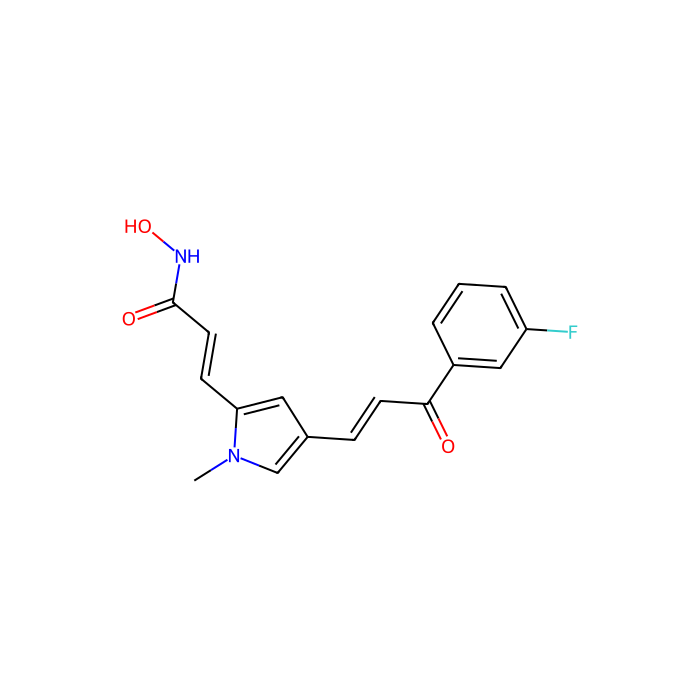
MC1568
Taxonomy Tree
| Kingdom | Organic compounds |
|---|---|
| Superclass | Benzenoids |
| Clase | Benzene and substituted derivatives |
| Subclass | Benzoyl derivatives |
| Intermediate Tree Nodes | Not available |
| Direct Parent | Benzoyl derivatives |
| Alternative Parents | Aryl ketones Fluorobenzenes N-methylpyrroles Aryl fluorides Heteroaromatic compounds Enones Acryloyl compounds Hydroxamic acids Azacyclic compounds Organonitrogen compounds Organofluorides Organic oxides Hydrocarbon derivatives |
| Molecular Framework | Aromatic heteromonocyclic compounds |
| Substituents | Benzoyl - Aryl ketone - Fluorobenzene - Halobenzene - Aryl fluoride - Aryl halide - Substituted pyrrole - N-methylpyrrole - Acryloyl-group - Heteroaromatic compound - Enone - Alpha,beta-unsaturated ketone - Pyrrole - Hydroxamic acid - Ketone - Carboxylic acid derivative - Azacycle - Organoheterocyclic compound - Organooxygen compound - Organic oxygen compound - Organic nitrogen compound - Carbonyl group - Hydrocarbon derivative - Organic oxide - Organonitrogen compound - Organofluoride - Organohalogen compound - Aromatic heteromonocyclic compound |
| Descripción | This compound belongs to the class of organic compounds known as benzoyl derivatives. These are organic compounds containing an acyl moiety of benzoic acid with the formula (C6H5CO-). |
| External Descriptors | Not available |
| Activity Type | Relation | Activity value | Units | Action Type | Journal | PubMed Id | doi | Assay Aladdin ID |
|---|
| Activity Type | Relation | Activity value | Units | Action Type | Journal | PubMed Id | doi | Assay Aladdin ID |
|---|
| Activity Type | Relation | Activity value | Units | Action Type | Journal | PubMed Id | doi | Assay Aladdin ID |
|---|
| Activity Type | Relation | Activity value | Units | Action Type | Journal | PubMed Id | doi | Assay Aladdin ID |
|---|
Find and download the COA for your product by matching the lot number on the packaging.
| Lot Number | Certificate Type | Fecha | Articulo |
|---|---|---|---|
 I2607151 | Certificate of Analysis | Sep 18, 2026 | M127417 |
| H2421016 | Certificate of Analysis | Jun 09, 2026 | M127417 |
| L2215694 | Certificate of Analysis | Jun 09, 2026 | M127417 |
| L2215697 | Certificate of Analysis | Jun 09, 2026 | M127417 |
| L2215743 | Certificate of Analysis | Jun 09, 2026 | M127417 |
| L2215821 | Certificate of Analysis | Jun 09, 2026 | M127417 |
| L2215822 | Certificate of Analysis | Jun 09, 2026 | M127417 |
| K2124280 | Certificate of Analysis | Sep 19, 2023 | M127417 |
| K2124281 | Certificate of Analysis | Sep 19, 2023 | M127417 |
| K2124282 | Certificate of Analysis | Sep 19, 2023 | M127417 |
| K2124299 | Certificate of Analysis | Sep 19, 2023 | M127417 |
| L2215690 | Certificate of Analysis | Jul 27, 2022 | M127417 |
| Solubilidad | Solvent:DMSO, Max Conc. mg/mL: 31.43, Max Conc. mM: 100 |
|---|---|
| Peso molecular | 314.31 |
| XLogP3 | 1.800 |
| Hydrogen Bond Donor Count | 2 |
| Hydrogen Bond Acceptor Count | 4 |
| Rotatable Bond Count | 5 |
| Exact Mass | 314.107 Da |
| Monoisotopic Mass | 314.107 Da |
| Topological Polar Surface Area | 71.300 Ų |
| Heavy Atom Count | 23 |
| Formal Charge | 0 |
| Complexity | 492.000 |
| Isotope Atom Count | 0 |
| Defined Atom Stereocenter Count | 0 |
| Undefined Atom Stereocenter Count | 0 |
| Defined Bond Stereocenter Count | 2 |
| Undefined Bond Stereocenter Count | 0 |
| The total count of all stereochemical bonds | 2 |
| Covalently-Bonded Unit Count | 1 |
H319:Causes serious eye irritation
P280:Wear protective gloves/protective clothing/eye protection/face protection.
P305+P351+P338:IF IN EYES: Rinse cautiously with water for several minutes. Remove contact lenses if present and easy to do - continue rinsing.
P264+P265:Wash hands [and …] thoroughly after handling. Do not touch eyes.
P337+P317:If eye irritation persists: Get medical help.
No tested application protocols are provided in the product data for this item.
General starting points for small-molecule probe use (adapt to your platform):
These are generic templates. Optimize all parameters (enzyme source, buffer, temperature, time) empirically. Refer to the item’s CoA/SDS and primary literature for any compound-specific nuances.
Context from literature (not item-specific claims):
Practical biochemical notes:
Important: The above summarizes general literature use of MC1568-like probes for research only. No therapeutic, diagnostic, or clinical utility is claimed or implied for this catalog item.
This product is not a buffering agent. It does not define pH or ionic strength and is not typically used to prepare classical biological buffers.
Practical notes for assay buffers (general guidance when dosing small-molecule probes):
For buffer recipes, pH ranges, and compatibility, refer to the documentation of your chosen buffer system. MC1568 itself provides no buffering capacity.
As a bioactive screening compound, the “green” considerations center on solvent selection, handling, and waste minimization rather than substituting the molecule itself.
Greener handling strategies:
Comparison of common vehicles (general):
| Vehicle | Greenness/Notes | Typical Use | | --- | --- | --- | | DMSO | Widely accepted; low volatility; biodegradable but high COD—minimize volumes | Primary stock solvent for screening compounds | | Ethanol | Renewable routes available; higher volatility; better EHS profile | Alternative vehicle at low % in biology | | DMF | Reprotoxic concerns; challenging waste profile | Reserve for synthetic steps only |
Operational best practices:
Note: No greener “structural alternative” is proposed here because MC1568’s utility derives from its specific interaction profile. Selection of orthogonal probes should be guided by target validation needs and published probe quality criteria.
No pharmacopeial or excipient role is specified for this item. MC1568 is provided strictly for research use (e.g., target validation, chemical biology, screening) and not for human or veterinary use.
Context (general):
Regulatory note:
For any work beyond basic research (e.g., regulated studies), consult your institutional QA and request detailed CoA/SDS, impurity profiles, and stability data. Absent explicit supplier certification, do not use for clinical or diagnostic purposes.
Item-specific physicochemical specifications are not provided in this record.
General/literature-based expectations for small-molecule screening probes (context only):
Important: Do not treat the above as item specifications. Use the item’s CoA/SDS and your own characterization to establish working properties for your lab.
What Moligand™ typically implies (general guidance):
What is NOT implied:
Batch-to-batch considerations:
Stabilizers/additives:
Primary use case: MC1568 is supplied as a research ligand for chemical biology and screening. It is not typically employed as a synthetic reagent.
Research applications (general):
Practical considerations:
Note: If using MC1568 in any chemical reaction (uncommon), validate compatibility as a neutral organic substrate; avoid conditions that could hydrolyze amide functions or oxidize sensitive motifs. No reaction-class-specific behavior is specified for this item.
As sold, MC1568 is intended for biological assays rather than for use as a reagent in chemical synthesis. Therefore, no item-specific reaction conditions are provided.
General guidance for assay preparation and dosing (research context):
If performing chemical transformations on MC1568 (uncommon):
All conditions above are general literature practices; they are not specifications for this item.
Hazard classification details are not provided in the product data and may vary by batch/source.
General laboratory safety guidance for bioactive small molecules:
Always consult the official SDS for this specific item prior to first use. Implement risk assessments (COSHH/Job Hazard Analysis) appropriate for your scale and assay context.
MC1568 is a bioactive organic small molecule. Item-specific solubility data are not provided.
Practical solvent guidance (general):
Polarity/miscibility (context):
Comparison (general):
Always empirically verify solubility and stability of MC1568 in your chosen vehicle; consult the item’s CoA for any solvent-specific notes if available.
Storage conditions (item-specific):
General best practices for small-molecule probes:
Re-freeze guidance:
Note: Where exact solubility, pH stability, or light sensitivity are critical, consult the CoA/SDS or generate internal stability data under your lab’s conditions.
MC1568 is a bioactive small molecule supplied under the Moligand™ line. Item-specific structural identifiers are limited in the provided data.
Structural features (general, literature context):
2D structure (descriptive, literature):
Identity confirmation recommendations:
MC1568 is primarily a finished bioactive probe and is not typically used as a synthetic building block.
General retrosynthetic context (literature-informed but not item-specific):
If derivatization is desired (e.g., for SAR or PROTAC linker exploration):
Caveat: Without the exact structure from the CoA or primary publication, do not assume reactivity or compatibility. Verify functional groups and stability by small-scale test reactions and orthogonal analytics (LC–MS, NMR).
Item-specific target data are not provided in the product record.
Literature context (for planning only, not a specification):
Recommendation:
Note: The supplier makes no claim here regarding potency or selectivity; consult the CoA/SDS and primary literature.
Nuestra guía de selección de calidades cubre la pureza, el estado del estabilizador y la idoneidad de la aplicación para todas las variantes de nuestro catálogo.
Ver la guía de calidades Moligand™ →