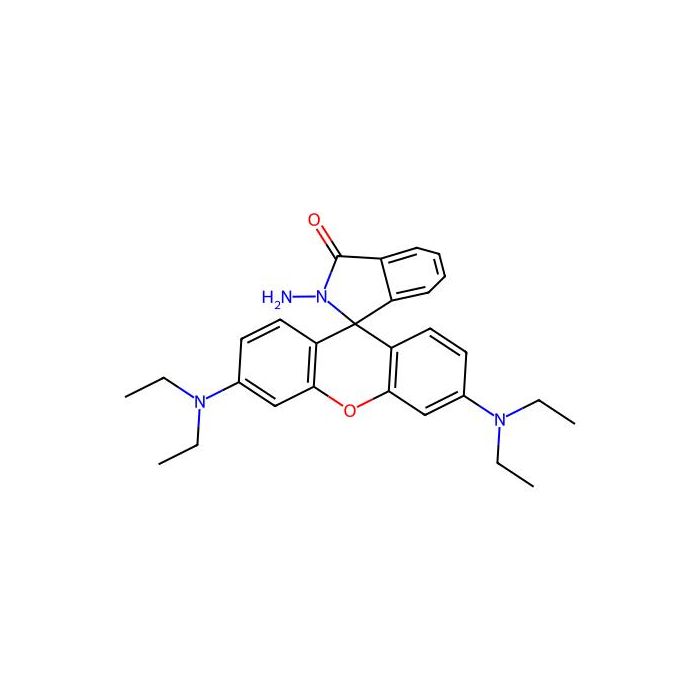
Rhodamine B hydrazide - Moligand™, 10 mM in DMSO , CAS No.74317-53-6

CAS: 74317-53-6 Cat. No.: R1495542 Molecular Weight: 456.59 EC Number: 634-768-9
AVAILABLE TO ORDER
GRADE & PURITY Moligand™ ? Moligand™ — Aladdin's line of ligands and bioactive small molecules. Use for receptor, pathway, and binding studies needing defined small-molecule tools. 10 mM in DMSO
Storage
Protected from light,Store at -80°C
Shipped In
Dry ice packs + Cold packs
 ·  off list, applied to all prices below.
Size
Status
Price
Qty
1ml
R1495542-1ml
8-12 wks(?) Production requires sourcing of materials. We appreciate your patience and understanding.
$40.90
Enter a quantity for the sizes you want to add.
🧪

Why this grade

Moligand™, 10 mM in DMSO Moligand™ for sensitive chromatographic and analytical workflows requiring minimal baseline interference.

🌡

Storage & shipping

Protected from light,Store at -80°C Ships Dry ice packs + Cold packs Check lot-specific COA for exact specifications.

📋

Quality documents

SDS, COA, datasheet, and spec sheet available for download. Lot-specific COA accessible via lot number lookup.

📚

Literature proof

Cited in 11 peer-reviewed publications across chromatography, organic synthesis, and cross-coupling reactions.

Overview

Rhodamine B hydrazide is a good probe for sulfite, with colorless and non-fluorescent properties. While the emission is related to the concentration of sulfite (5-800 ng/mL; detection limit=1.4 ng/mL (3σ)). Sulfite reduces dissolved oxygen to yield superoxide radicals, which binds to Rhodamine B hydrazide to form Rhodamine B. Rhodamine B hydrazide gives Rhodamine B-like fluorescence in the presence of sulfite, which is enhanced by Tween 80 surfactant micelles. Rhodamine B hydrazide has an absorption maximum at 554 nm and a fluorescence emission maximum at 574 nm.

Specifications

Specifications & Purity
Moligand™, 10 mM in DMSO
Storage
Protected from light, Store at -80°C
Shipped In
Dry ice packs + Cold packs
This product requires cold chain shipping. Ground and other economy services are not available.
Grade
Moligand™
Names and Identifiers
Isomeric SMILES CCN(CC)C1=CC2=C(C=C1)C3(C4=C(O2)C=C(C=C4)N(CC)CC)C5=CC=CC=C5C(=O)N3N
Molecular Weight 456.59

Documentation

📋 Safety Data Sheet (SDS)

Comprehensive hazard, handling, storage, and regulatory compliance document.

Download SDS →

✅ Certificate of Analysis (COA)

Lot-specific quality data. Enter your lot number to retrieve the exact COA.

Look up COA →

📊 Datasheet

Quick-reference summary of product specifications and applications.

View datasheet →

🔬 Specification Sheet

Full quality attributes and acceptance criteria for this grade.

View spec sheet →

Advanced Data

Certificates(CoA,COO,BSE/TSE and Analysis Chart)
C of A & Other Certificates(BSE/TSE, COO):
Analytical Chart:
Chemical and Physical Properties
Melt Point(°C)184 °C
Citations of This Product
References
1. Yuyang Qin, Hongjing Li, Jun Ma.  (2022)  Enhanced degradation of organic contaminants by thermally activated peroxymonosulfate in the presence of chloride ion.  CHEMICAL ENGINEERING JOURNAL,      [PMID:] [10.1016/j.cej.2022.138814]
2. Tiaoyan Jiang, Tianying Jia, Yipengchen Yin, Tianyu Li, Xinran Song, Wei Feng, Sheng Wang, Li Ding, Yu Chen, Qin Zhang.  (2025)  Cuproptosis-Inducing Functional Nanocomposites for Enhanced and Synergistic Cancer Radiotherapy.  ACS Nano,      [PMID:39895200] [10.1021/acsnano.4c13753]
3. Xiaoyang Li, Han Zhang, Jiahang Liu, Yingying Chu, Mengying Qian, Zhichao Yang, Ming Hua, Weiming Zhang.  (2024)  Unexpected chloride-triggered organics removal in the zirconium oxide activated peroxymonosulfate system.  JOURNAL OF HAZARDOUS MATERIALS,      [PMID:39581034] [10.1016/j.jhazmat.2024.136621]
4. Yi Tang, Lingli Wang, Yu Fu, Zhaohui Wang.  (2025)  Temperature-regulated non-radical to radical oxidation of organic pollutants by peroxymonosulfate: A tale of ice and fire.  Journal of Water Process Engineering,      [PMID:] [10.1016/j.jwpe.2025.107608]
5. Zhiting Yang, Jiahua Tang, Yan Zhang, Xianzhi Hu, Futing Zi, Yue Lin, Jin Wu.  (2025)  Acid-responsive MSN@RBA enhanced coating wound healing through alerting and releasing repairing agents.  NEW JOURNAL OF CHEMISTRY,      [PMID:] [10.1039/D5NJ01119A]
6. Hongrui Zhang, Ya-nan Zhang, Like Li, Xuegang Li, Yong Zhao.  (2025)  An Enzyme-Catalyzed Optical Fiber Optofluidic Laser Sensor for Cholesterol Detection Using Rhodamine B Hydrazide.  ANALYTICAL CHEMISTRY,      [PMID:39982367] [10.1021/acs.analchem.4c06462]
7. Xiaojiao Di, Zelong Chen, Wenhe Feng, Jiajia Sun, Shuang Chao, Zhichao Pei, Yuxin Pei.  (2025)  A nanoagent based on a supramolecular copper chelator for cancer therapy via copper depletion and glucose deprivation.  JOURNAL OF COLLOID AND INTERFACE SCIENCE,      [PMID:41129944] [10.1016/j.jcis.2025.139297]
8. Qun Gao, Qi Wang, Yanjiao Hu, Fangjie Xin, Jie Chen, Sha Yu, Xinli Chen, Qingqing Lv, Baoxia Cui, Jun Jiao, Xinlin Jiao.  (2025)  SIRT7 deficiency promoted cuproptosis-mediated mitochondrial dysfunction and inhibited malignant development of cervical cancer.  ARCHIVES OF BIOCHEMISTRY AND BIOPHYSICS,      [PMID:41167446] [10.1016/j.abb.2025.110651]
9. Rongxiang Zhang, Xuelei Yin, Zenghui Xu, Qikang Yan.  (2025)  Novel Ce/Cu-modified black ceramics disrupted mitochondrial dysfunction and tricarboxylic acid cycle to induce cuproptosis in osteosarcoma cells.  Biomaterials Advances,      [PMID:41218466] [10.1016/j.bioadv.2025.214576]
10. Lihua Wang, Yang Deng, Xionghongcan Zhou, Kaiyue Song, Cong Jiang, Feng Zhao, Xianglong Li.  (2025)  A biodegradable nanomedicine for potentiated cancer therapy via Ca2+-overload and photothermal dual-amplifying cuproptosis.  JOURNAL OF COLLOID AND INTERFACE SCIENCE,      [PMID:41308482] [10.1016/j.jcis.2025.139548]
11. Junli Yang, Xudong Xie, Qiaojian Duan, Yu Sun, Lin Yang, Bobin Mi, Peng Zhao, Kaiyong Cai.  (2025)  Bone-Targeted Multifunctional Nanoplatform Combining Osteoimmunoregulation and Mild Photothermal Effect to Promote Fracture Repair.  ACS Nano,      [PMID:41467338] [10.1021/acsnano.5c18379]
Solution Calculators
Reviews

Customer Reviews

Need help choosing the grade?

Our grade selection guide covers purity, stabilizer status, and application suitability for all variants in our catalog.

View Moligand™ grade guide →

Shall we send you a message when we have discounts available?

Remind me later

Thank you! Please check your email inbox to confirm.

Oops! Notifications are disabled.