
Determine the necessary mass, volume, or concentration for preparing a solution.
| Activity Type | Activity Value -log(M) | Mechanism of Action | Activity Reference | Publications (PubMed IDs) |
|---|
Moligand™, 10mM in DMSO Moligand™ for sensitive chromatographic and analytical workflows requiring minimal baseline interference.
Store at -80°C Ships Dry ice packs + Cold packs Check lot-specific COA for exact specifications.
SDS, COA, datasheet, and spec sheet available for download. Lot-specific COA accessible via lot number lookup.
Cited in 0 peer-reviewed publications across chromatography, organic synthesis, and cross-coupling reactions.
Information
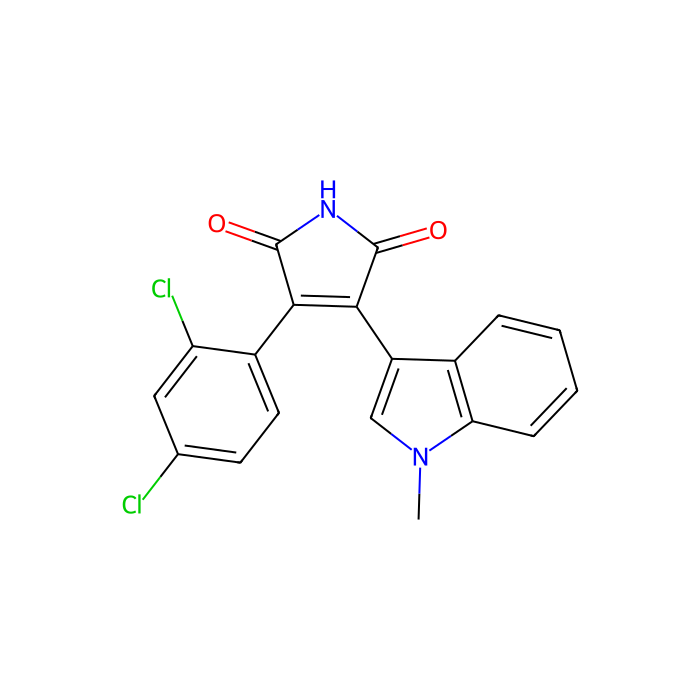
SB216763 is a potent and selectiveGSK-3inhibitor withIC50of 34.3 nM for GSK-3α and equally effective at inhibiting human GSK-3β. SB216763 activatesautophagy.
In vitro
SB 216763 displays similar potency for GSK-3β with 96% inhibition at 10 μM while exhibiting minimal activity against 24 other protein kinases including PKBα and PDK1 with IC50 of >10 μM. SB 216763 stimulates glycogen synthesis in human liver cells with EC50 of 3.6 μM, and induces dose-dependent transcription of a β-catenin-LEF/TCF regulated reporter gene in HEK293 cells with a maximum 2.5-fold induction at 5 μM. SB 216763 protects the cerebellar granule neurones from apoptotic cell death induced by LY-294002 or potassium-deprivation in a concentration-dependent manner, with a maximal neuroprotection at 3 μM in contrast with the effect of lithium chloride at which 10 mM is required. SB 216763 at 3 μM also completely prevents death of chicken dorsal root ganglion sensory neurones induced by LY-294002 regardless of NGF. SB 216763 treatment at 5 μM markedly inhibits the GSK-3-dependent phosphorylation of neuronal-specific microtubule-associated protein tau in cerebellar granule neurones or recombinant tau in HEK293 cells, and induces increased levels of cytoplasmic β-catenin in both cells mimicking the effect of Wnt-mediated inhibition of GSK-3. In pancreatic cancer cell lines including BXPC-3, MIA-PaCa2, PANC1, ASPC1, and CFPAC, SB 216763 treatment at 25-50 μM reduces cell viability in a dose-dependent manner, and leads to significant increase in apoptosis by 50% at 72 hours due to the specific down regulation of GSK-3β, while has no effect in HMEC or WI38 cell lines.
In vivo
Administration of SB 216763 at 20 mg/kg significantly prevents lung inflammation and the subsequent fibrosis in bleomycin (BLM)-induced pulmonary inflammation and fibrosis model in mice by significantly blocking the production of inflammatory cytokines MCP-1 and TNF-α by macrophages, and significantly improves the survival of BLM-treated mice. SB 216763 treatment causes a significant reduction in BLM-induced alveolitis by inhibiting alveolar epithelial cell damage.
Cell Data
cell lines:Breast cancer cells, including MCF-7, HCC1954, MDA-MB-468, and KPL4
Concentrations:Dissolved in DMSO, final concentrations ~50 μM
Incubation Time:24, 48, and 72 hours
Powder Purity:≥95%
| Isomeric SMILES | CN1C=C(C2=CC=CC=C21)C3=C(C(=O)NC3=O)C4=C(C=C(C=C4)Cl)Cl |
|---|---|
| WGK Germany | 3 |
| PubChem CID | 176158 |
| Molecular Weight | 371.22 |
Comprehensive hazard, handling, storage, and regulatory compliance document.
Download SDS →Lot-specific quality data. Enter your lot number to retrieve the exact COA.
Look up COA →Full quality attributes and acceptance criteria for this grade.
View spec sheet →| Activity Type | Activity Value -log(M) | Mechanism of Action | Activity Reference | Publications (PubMed IDs) |
|---|
| Activity Type | Activity Value -log(M) | Mechanism of Action | Activity Reference | Publications (PubMed IDs) |
|---|
| Solubility | Solubility (25°C) In vitro DMSO: 46 mg/mL (199.09 mM); Ethanol: 12 mg/mL (51.93 mM); Water: Insoluble; |
|---|---|
| Melt Point(°C) | 104 °C |
Our grade selection guide covers purity, stabilizer status, and application suitability for all variants in our catalog.
View Moligand™ grade guide →