
Determine the necessary mass, volume, or concentration for preparing a solution.
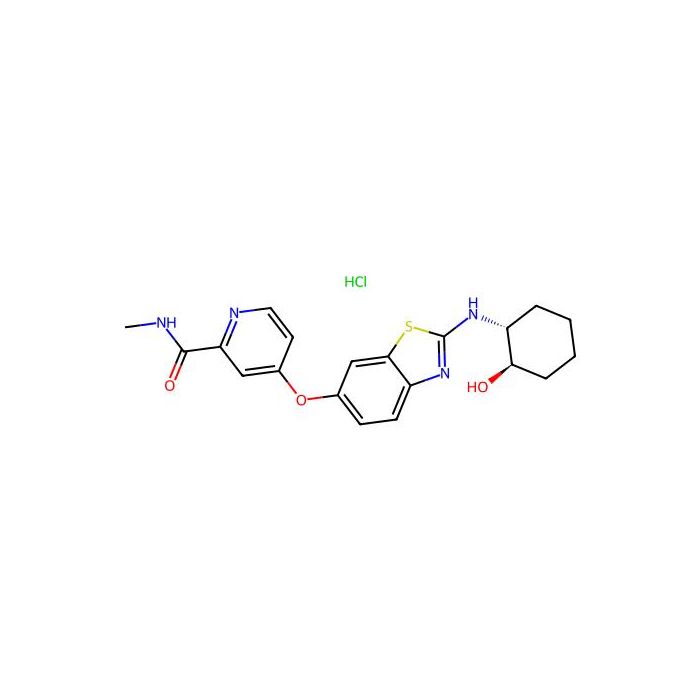
Sotuletinib hydrochloride - ≥98% , CAS No.2222138-31-8
AVAILABLE TO ORDER
GRADE & PURITY ≥98%
Storage
Store at 2-8°C,Desiccated
Shipped In
Wet ice
≥98% for sensitive chromatographic and analytical workflows requiring minimal baseline interference.
Store at 2-8°C,Desiccated Ships Wet ice Check lot-specific COA for exact specifications.
SDS, COA, datasheet, and spec sheet available for download. Lot-specific COA accessible via lot number lookup.
Cited in 0 peer-reviewed publications across chromatography, organic synthesis, and cross-coupling reactions.
Sotuletinib (BLZ945) hydrochloride is a potent, selective and brain-penetrant CSF-1R (c-Fms) inhibitor with an IC 50 of 1 nM, showing more than 1,000-fold selectivity against its closest receptor tyrosine kinase homologs.
In Vitro
Sotuletinib hydrochloride inhibits CSF-1-dependent proliferation (EC 50 =67 nM) in bone marrow-derived macrophages (BMDMs), and decreases CSF-1R phosphorylation, similar to CSF-1R antibody blockade. Sotuletinib hydrochloride also reduces viability of CRL-2467 microglia, Ink4a/Arf ?/? BMDMs (PDG genetic background), and NOD/SCID BMDMs. Importantly, Sotuletinib hydrochloride treatment in culture does not affect proliferation of any PDG-derived tumor cell lines (all Csf-1r -negative), or U-87 MG human glioma cells, and PDG cell tumor sphere formation is unaffected. Thus, Sotuletinib hydrochloride has no direct effects on glioma cells, and perturbs macrophage survival through CSF-1R inhibition. MCE has not independently confirmed the accuracy of these methods. They are for reference only.
In Vivo
Mice are treated with Sotuletinib hydrochloride or vehicle, and evaluated for symptom-free survival. Median survival in the vehicle-treated cohort is 5.7 weeks. In striking contrast, Sotuletinib hydrochloride significantly improves long-term survival with 64.3% surviving to the 26-week trial endpoint. This endpoint is chosen because Ink4a/Arf ?/? mice develop spontaneous tumors, including lymphomas and sarcomas, beginning at ~30 weeks. Sotuletinib hydrochloride is well-tolerated over long-term treatment, with no visible side-effects, consistent with histopathological studies. Histological grading revealed high-grade, invasive gliomas in all vehicle-treated mice. By contrast, Sotuletinib hydrochloride-treated animals have significantly less-malignant tumors, and no detectable lesions in 55.6% of asymptomatic mice at the endpoint . Mice receiving Sotuletinib hydrochloride shows reduced CSF1R staining in both cervical tumors and the associated stroma, with a significant decrease in CSF1R + stromal macrophages relative to vehicle-treated mice (P<0.05). MCE has not independently confirmed the accuracy of these methods. They are for reference only.
Form:Solid
| Canonical Smiles | O=C(C1=NC=CC(OC2=CC=C3N=C(N[C@H]4[C@H](O)CCCC4)SC3=C2)=C1)NC.[H]Cl |
|---|---|
| Molecular Weight | 434.94 |
Comprehensive hazard, handling, storage, and regulatory compliance document.
Download SDS →Lot-specific quality data. Enter your lot number to retrieve the exact COA.
Look up COA →Full quality attributes and acceptance criteria for this grade.
View spec sheet →| Solubility | H2O : 100 mg/mL (229.92 mM; Need ultrasonic) DMSO : 100 mg/mL (229.92 mM; Need ultrasonic) |
|---|