≥99% for sensitive chromatographic and analytical workflows requiring minimal baseline interference.
🌡
Storage & shipping
Store at 2-8°C,Desiccated Ships Wet ice Check lot-specific COA for exact specifications.
📋
Quality documents
SDS, COA, datasheet, and spec sheet available for download. Lot-specific COA accessible via lot number lookup.
📚
Literature proof
Cited in 0 peer-reviewed publications across chromatography, organic synthesis, and cross-coupling reactions.
Overview
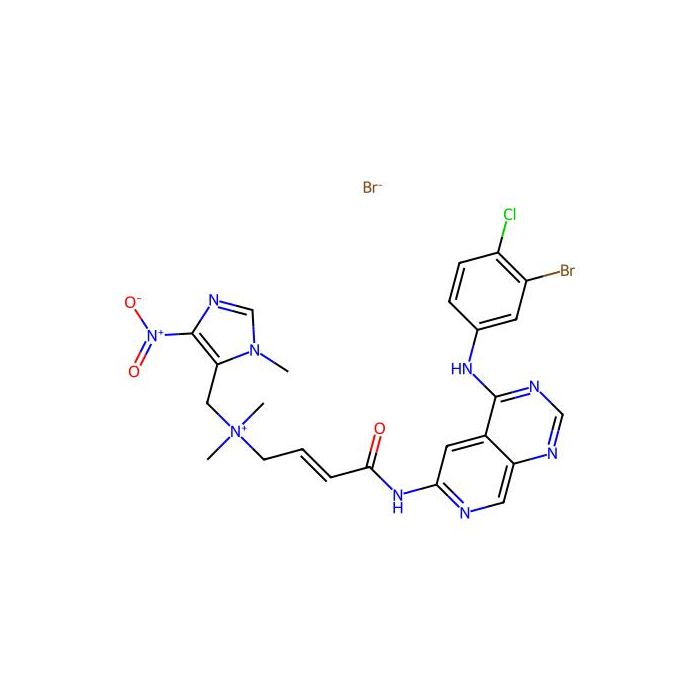
Tarloxotinib bromide (TH-4000) is an irreversible EGFR/HER2 inhibitor.
In Vitro
To confirm the mechanism of action, Tarloxotinib bromide is shown to be metabolized efficiently under hypoxia using a panel of human NSCLC cell lines (rate of TKI release 0.4-2.1 nM/hr/10 6 cells), a process that is inhibited by oxygen (TKI release <0.002 nM/hr/10 6 cells). Cellular anti-proliferative and receptor phosphorylation assays demonstrate a 14-80 fold reduction of Tarloxotinib bromide activity relative to TKI. Using PC9 tumors, hyperbaric oxygen breathing suppresse release of TKI from Tarloxotinib bromide by >80% (538 vs 99 nM/kg; p<0.01) compared to air breathing controls. Collectively, these data further validate that Tarloxotinib bromide is a hypoxia-activated irreversible EGFR-TKI, and show that Tarloxotinib bromide has greater activity compared with erlotinib. MCE has not independently confirmed the accuracy of these methods. They are for reference only.
In Vivo
A prototypic WT EGFR driven xenograft model (A431) is used to benchmark Tarloxotinib bromide activity against each EGFR-TKI by “retrotranslation” of reported plasma exposure for each agent in human subjects back to the xenograft model. Only treatment with clinically relevant doses and schedules of Tarloxotinib bromide is associated with tumor regression and durable inhibition of WT EGFR tumor phosphorylation. Consistent with these findings, Tarloxotinib bromide treatment can also regress the WT EGFR NSCLC tumor models H125 and H1648, demonstrating Tarloxotinib bromide provides the necessary therapeutic index to inhibit WT EGFR in vivo . MCE has not independently confirmed the accuracy of these methods. They are for reference only.
This compound belongs to the class of organic compounds known as pyrido[3,4-d]pyrimidines. These are compounds containing the pyrido[3,4-d]pyrimidine ring system, which is a pyridopyrimidine isomer with three ring nitrogen atoms at the 1-, 3-, and 7- position.
External Descriptors
Not available
1. Djoumbou Feunang Y, Eisner R, Knox C, Chepelev L, Hastings J, Owen G, Fahy E, Steinbeck C, Subramanian S, Bolton E, Greiner R, and Wishart DS. ClassyFire: Automated Chemical Classification With A Comprehensive, Computable Taxonomy. Journal of Cheminformatics, 2016, 8:61.
We use cookies to ensure the website functions properly and, where permitted, to improve your experience. You can manage your preferences at any time in Settings. Learn more in our Cookie Policy.
Shall we send you a message when we have discounts available?
Remind me later
Thank you! Please check your email inbox to confirm.
Products are supplied to verified businesses, institutions, and qualified professionals for research and development use only. Not for use in humans, animals, diagnosis, or therapy.