GRADE & PURITYMoligand™?Moligand™ — Aladdin's line of ligands and bioactive small molecules. Use for receptor, pathway, and binding studies needing defined small-molecule tools.≥96%
Moligand™,≥96% Moligand™ for sensitive chromatographic and analytical workflows requiring minimal baseline interference.
🌡
Storage & shipping
Store at -20°C Ships Ice chest + Ice pads Check lot-specific COA for exact specifications.
📋
Quality documents
SDS, COA, datasheet, and spec sheet available for download. Lot-specific COA accessible via lot number lookup.
📚
Literature proof
Cited in 0 peer-reviewed publications across chromatography, organic synthesis, and cross-coupling reactions.
Descripción general
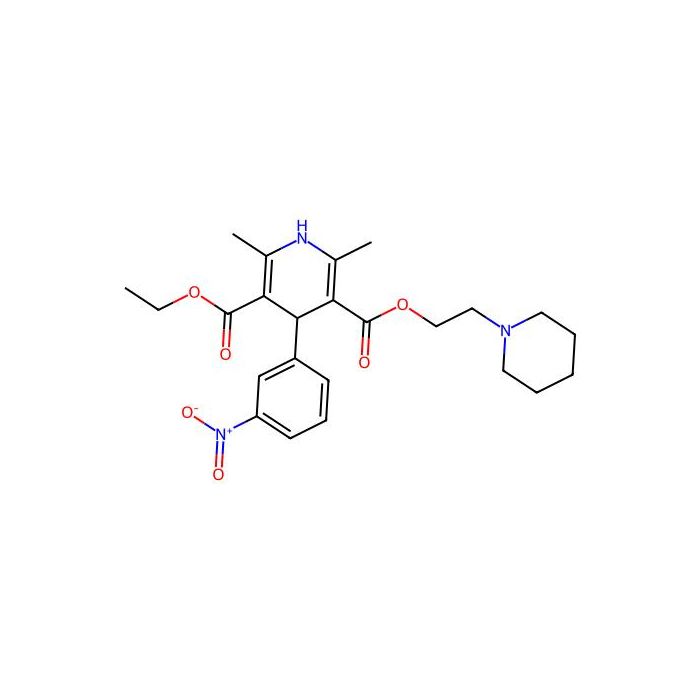
YS-201 is a dihydropyridine-type calcium channel antagonist. YS-201 has the potential for angina pectoris and hypertension treatment.
In Vivo
YS-201 (Diperdipine) markedly reduces systemic vascular resistance and improves stroke index and left ventricular ejection fraction. Mean pulmonary artery and wedge pressures are slightly increased as a possible consequence of enhanced venous return, whereas right atrial and left ventricular end-diastolic pressures are not significantly changed. Nevertheless, an increase in preload is clearly indicated by an augmented left ventricular end-diastolic volume index after administration of diperdipine . After intravenous and oral doses, absolute bioavailability is calculated to be 18.7%. Biliaryexcretion accounts for about 0.1% of the total clearance of diperdipine and does not contribute to the overall elimination of the drug. After intraportal administration, the bioavailable fraction of diperdipine is increasing up to 44.3% suggesting a prehepatic site of loss of the drug. The single application of diperdipine to mice and rats by gavage causes intolerance reactions starting at the lowest tested dose level of 200 mg/kg b.w. p.o. (mice) and at 250 mg/kg b.w. p.o. (rats). In the rat, toxic effects occur from 15 mg diperdipine/kg b.w./day p.o. onwards. MCE has not independently confirmed the accuracy of these methods. They are for reference only.
This compound belongs to the class of organic compounds known as dihydropyridinecarboxylic acids and derivatives. These are compounds containing a dihydropyridine moiety bearing a carboxylic acid group.
External Descriptors
Not available
1. Djoumbou Feunang Y, Eisner R, Knox C, Chepelev L, Hastings J, Owen G, Fahy E, Steinbeck C, Subramanian S, Bolton E, Greiner R, and Wishart DS. ClassyFire: Automated Chemical Classification With A Comprehensive, Computable Taxonomy. Journal of Cheminformatics, 2016, 8:61.
We use cookies to ensure the website functions properly and, where permitted, to improve your experience. You can manage your preferences at any time in Settings. Learn more in our Cookie Policy.
Shall we send you a message when we have discounts available?
Remind me later
Thank you! Please check your email inbox to confirm.
Products are supplied to verified businesses, institutions, and qualified professionals for research and development use only. Not for use in humans, animals, diagnosis, or therapy.

 H2627505