≥95% for sensitive chromatographic and analytical workflows requiring minimal baseline interference.
🌡
Storage & shipping
Store at -20°C Ships Ice chest + Ice pads Check lot-specific COA for exact specifications.
📋
Quality documents
SDS, COA, datasheet, and spec sheet available for download. Lot-specific COA accessible via lot number lookup.
📚
Literature proof
Cited in 1 peer-reviewed publications across chromatography, organic synthesis, and cross-coupling reactions.
Overview
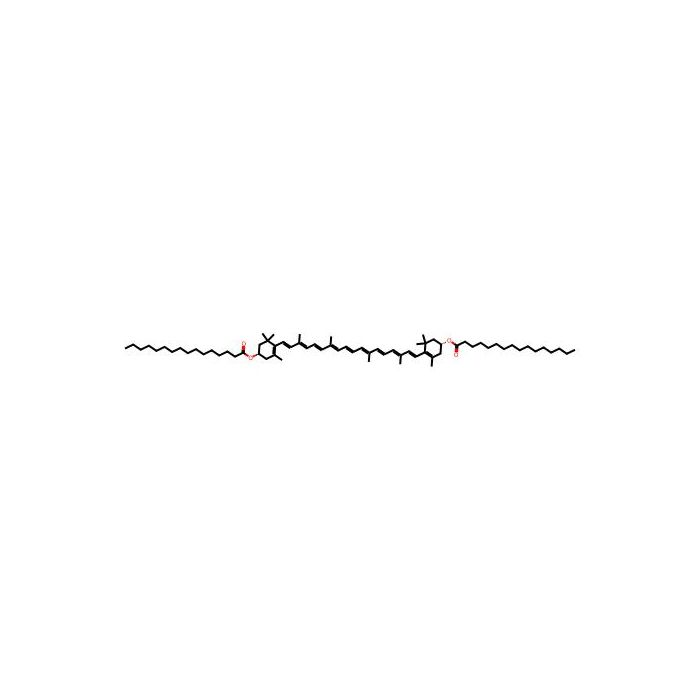
Zeaxanthin dipalmitate (Physalien) is a wolfberry-derived carotenoid, has anti-inflammatory and anti-oxidative stress effects. Zeaxanthin dipalmitate directly interact with p2X7 receptor ( K d =81.2 nM) and adiponectin receptor 1 ( AdipoR1 ; K d =533 nM) in a positive dose-dependent manner. Zeaxanthin dipalmitate restores mitochondrial autophagy functions suppressed by ethanol intoxication. Zeaxanthin dipalmitate can be used in the research of alcoholic fatty liver disease (AFLD) and retinitis pigmentosa (RP)
In Vitro
Zeaxanthin dipalmitate (1 µM; 2 h) totally or partially reverses the down-regulation of Atg5, beclin-1, and LC3A/B by ethanol (250 mM), and the up-regulation of p62 by ethanol in BRL-3A cells. Zeaxanthin dipalmitate (1 µM; 2 h) partially recovers the ethanol-suppressed LC3B in BRL-3A cells. Zeaxanthin dipalmitate (1 µM; 2 h) partially recovers the ethanol-suppressed cell viability and ethanol-induced aspase-3/7 activity of BRL-3A cells. Zeaxanthin dipalmitate (1 µM; 2 h) recovers the ethanol-induced inhibition of mitophagy in BRL-3A cells. MCE has not independently confirmed the accuracy of these methods. They are for reference only.
In Vivo
Zeaxanthin dipalmitate (10 mg/kg; p.o.; daily for 2 weeks) reduces the serum ALT and AST levels increased by long-term ethanol challenge in at AFLD Model . Zeaxanthin dipalmitate (10 mg/kg; p.o.; daily for 2 weeks) effectively attenuates the histological injury . Zeaxanthin dipalmitate (10 mg/kg; p.o.; daily for 2 weeks) attenuates the AFLD-induced hepatic apoptosis (reveal by caspase-3/7 activity) and inflammation (TNF-α) in rat . Zeaxanthin dipalmitate (approximately 4 μM; intravitreal injection for once) improves the visual behavior of rd10 mice and delays the degeneration of retinal photoreceptors. Zeaxanthin dipalmitate (approximately 4 μM; intravitreal injection for once) improves the light responses of photoreceptors, bipolar cells and retinal ganglion cells. Zeaxanthin dipalmitate (approximately 4 μM; intravitreal injection for once) reduces the expression of genes that are involved in inflammation, apoptosis and oxidative stress in rd10 mice. MCE has not independently confirmed the accuracy of these methods. They are for reference only.
Zeaxanthin dipalmitate (Physalien) is a wolfberry-derived carotenoid, has anti-inflammatory and anti-oxidative stress effects. Zeaxanthin dipalmitate directly interact with p2X7 receptor ( K d =81.2 nM) and adiponectin receptor 1 ( AdipoR1 ; K d =533 nM)
Storage
Store at -20°C
Shipped In
Ice chest + Ice pads
This product requires cold chain shipping. Ground and other economy services are not available.
This compound belongs to the class of organic compounds known as xanthophylls. These are carotenoids containing an oxygenated carotene backbone. Carotenes are characterized by the presence of two end-groups (mostly cyclohexene rings, but also cyclopentene rings or acyclic groups) linked by a long branched alkyl chain. Carotenes belonging form a subgroup of the carotenoids family. Xanthophylls arise by oxygenation of the carotene backbone.
External Descriptors
C40 isoprenoids (tetraterpenes)
1. Djoumbou Feunang Y, Eisner R, Knox C, Chepelev L, Hastings J, Owen G, Fahy E, Steinbeck C, Subramanian S, Bolton E, Greiner R, and Wishart DS. ClassyFire: Automated Chemical Classification With A Comprehensive, Computable Taxonomy. Journal of Cheminformatics, 2016, 8:61.
1.Irma Belinda Yossa Nzeuwa, Baofu Guo, Ting Zhang, Liya Wang, Qian Ji, Hui Xia, Guiju Sun. (2019) Comparative Metabolic Profiling of Lycium Fruits (Lycium barbarum and Lycium chinense) from Different Areas in China and from Nepal. JOURNAL OF FOOD QUALITY, [PMID:][10.1155/2019/4396027]
Solution Calculators
Molarity Calculator
Determine the necessary mass, volume, or concentration for preparing a solution.
Dilution Calculator
Determine the dilution needed to prepare a stock solution.
We use cookies to ensure the website functions properly and, where permitted, to improve your experience. You can manage your preferences at any time in Settings. Learn more in our Cookie Policy.
Shall we send you a message when we have discounts available?
Remind me later
Thank you! Please check your email inbox to confirm.
Products are supplied to verified businesses, institutions, and qualified professionals for research and development use only. Not for use in humans, animals, diagnosis, or therapy.