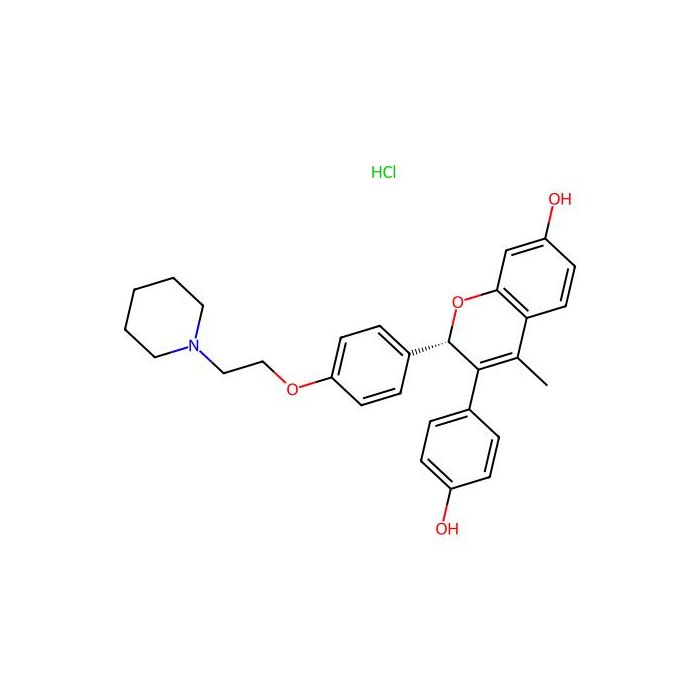
≥98% for sensitive chromatographic and analytical workflows requiring minimal baseline interference.
🌡
Storage & shipping
Store at 2-8°C,Desiccated Ships Wet ice Check lot-specific COA for exact specifications.
📋
Quality documents
SDS, COA, datasheet, and spec sheet available for download. Lot-specific COA accessible via lot number lookup.
📚
Literature proof
Cited in 0 peer-reviewed publications across chromatography, organic synthesis, and cross-coupling reactions.
Overview
Acolbifene (EM-652) hydrochloride, an active metabolite of EM800, is an orally active, cancer-preventing selective estrogen receptor modulator (SERM). Acolbifene (EM-652) hydrochloride inhibits estradiol (E2)-induced transcriptional activity of ERα (IC 50 =2 nM) and ERβ (IC 50 =0.4 nM). Acolbifene (EM-652) hydrochloride exerts a potent and pure antiestrogenic action in the mammary gland and uterus. Anticarcinogenic properties.
In Vitro
Acolbifene (ACOL) does not affect pathways of cholesterol synthesis, supporting the involvement of the clearance-related receptors in its hypocholesterolemic action. Acolbifene (EM-652) shows no agonistic activity on ERα and ERβ transcriptional function and blocks the estradiol (E2)-mediated activation of both ERα and ERβ. Acolbifene (EM-652) shows the most potent inhibition of estradiol-stimulated cell proliferation in human breast cancer cells (ZR-75-1, MCF-7, T-47D) and is devoid of any intrinsic estrogenic activity . MCE has not independently confirmed the accuracy of these methods. They are for reference only.
In Vivo
Acolbifene (ACOL) reduces food intake and strongly decreases cholesterolemia in rats fed a cholesterol-free diet. Acolbifene (ACOL) reduces food intake (16%) and weight gain (45%, mainly fat) similarly in both dietary cohorts. MCE has not independently confirmed the accuracy of these methods. They are for reference only. Animal Model: Female Sprague-Dawley rats (n = 42) initially weighing 175-200 g. Dosage: 2.5 mg/kg. Administration: Oral gavage, once daily for 21 d. Result: Prevents tumor growth in rats.
This compound belongs to the class of organic compounds known as 7-hydroxyflavonoids. These are flavonoids that bear one hydroxyl group at the C-7 position of the flavonoid skeleton.
External Descriptors
Not available
1. Djoumbou Feunang Y, Eisner R, Knox C, Chepelev L, Hastings J, Owen G, Fahy E, Steinbeck C, Subramanian S, Bolton E, Greiner R, and Wishart DS. ClassyFire: Automated Chemical Classification With A Comprehensive, Computable Taxonomy. Journal of Cheminformatics, 2016, 8:61.
We use cookies to ensure the website functions properly and, where permitted, to improve your experience. You can manage your preferences at any time in Settings. Learn more in our Cookie Policy.
Shall we send you a message when we have discounts available?
Remind me later
Thank you! Please check your email inbox to confirm.
Products are supplied to verified businesses, institutions, and qualified professionals for research and development use only. Not for use in humans, animals, diagnosis, or therapy.