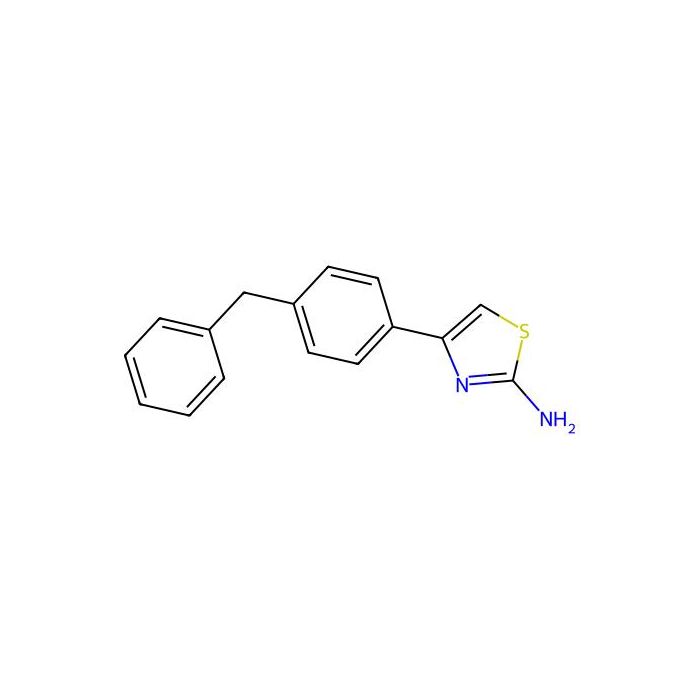
ARM1 (4BSA) is a potent aminopeptidase and epoxide hydrolase inhibitor. ARM1 shows aminopeptidase inhibitory activity with an IC 50 7.61 µM and epoxide hydrolase inhibitory activity with an IC 50 12.4 µM.
Form:Solid
Spécifications
Spécifications et pureté
≥99%
Mécanismes biochimiques et physiologiques
ARM1 (4BSA) is a potent aminopeptidase and epoxide hydrolase inhibitor. ARM1 shows aminopeptidase inhibitory activity with an IC 50 7.61 µM and epoxide hydrolase inhibitory activity with an IC 50 12.4 µM.
Conditions de stockage de stockage
Store at -20°C
Expédié en
Ice chest + Ice pads
Ce produit nécessite l'expédition en chaîne froide. Les services terrestres et autres services économiques ne sont pas disponibles.
This compound belongs to the class of organic compounds known as diphenylmethanes. These are compounds containing a diphenylmethane moiety, which consists of a methane wherein two hydrogen atoms are replaced by two phenyl groups.
External Descriptors
Not available
1. Djoumbou Feunang Y, Eisner R, Knox C, Chepelev L, Hastings J, Owen G, Fahy E, Steinbeck C, Subramanian S, Bolton E, Greiner R, and Wishart DS. ClassyFire: Automated Chemical Classification With A Comprehensive, Computable Taxonomy. Journal of Cheminformatics, 2016, 8:61.
Certificats (CoA, COO, BSE/TSE et tableau d'analyse)
C of A & Other Certificates(BSE/TSE, COO):
Analytical Chart:
Propriétés chimiques et physiques
Solubilité
DMSO : 250 mg/mL (938.58 mM; Need ultrasonic)
Poids moléculaire
266.4
XLogP3
4.200
Hydrogen Bond Donor Count
1
Hydrogen Bond Acceptor Count
3
Rotatable Bond Count
3
Exact Mass
266.088 Da
Monoisotopic Mass
266.088 Da
Topological Polar Surface Area
67.200 Ų
Heavy Atom Count
19
Formal Charge
0
Complexity
270.000
Isotope Atom Count
0
Defined Atom Stereocenter Count
0
Undefined Atom Stereocenter Count
0
Defined Bond Stereocenter Count
0
Undefined Bond Stereocenter Count
0
The total count of all stereochemical bonds
0
Covalently-Bonded Unit Count
1
Calculateurs de solution
Molarity Calculator
Determine the necessary mass, volume, or concentration for preparing a solution.
Dilution Calculator
Determine the dilution needed to prepare a stock solution.
Reconstitution Calculator
Avis
Avis des clients
Application Protocols
No tested application protocols are provided in the Product Data for this item.
General usage guidance for screening compounds
Stock solution: Dissolve in DMSO to 10–50 mM. Vortex and, if needed, sonicate briefly. Filter through 0.22 µm PTFE for particulate removal if compatible.
Plate preparation: Use acoustic dispensing or low-volume pintool transfer to minimize DMSO carryover; include solvent-only controls in every plate.
Dose–response: Prepare 10-point 3-fold or 1:2 serial dilutions, covering expected potency ranges; cap DMSO ≤0.5–1% v/v in wells.
Data QC: Confirm concentration by UV or quantitative NMR where feasible. Verify purity by LC–MS before and after key experiments.
Documentation
Record lot number, dissolution solvent, concentration, preparation time/date, and storage conditions. Attach CoA to ELN entries for traceability.
Biological Roles
Item-specific (from Product Data)
No biological role, target, pathway, or mechanism is specified for this item. It is supplied for research use only.
General notes
Screening compounds are often used as chemical probes or hit matter in discovery programs. Any inferred biological role must be supported by a validated structure and primary literature; absent that, no claims can be made for ARM1.
If this material corresponds to a known literature tool, consult peer-reviewed sources for mechanism, selectivity, and off-target profiles, and confirm that the structure and salt form match your lot.
Practical guidance
When exploring potential biological activity, include counterscreens, orthogonal readouts, and concentration–response curves with appropriate solvent controls to distinguish compound effects from assay artifacts.
Consider pan-assay interference (PAINS) and redox/aggregation liabilities; include detergent controls or dynamic light scattering where appropriate.
Data integrity
Document the exact lot number, solvent, final concentration, and plate map in all records. Re-confirm purity by LC–MS after extended storage before repeating critical biological experiments.
Buffer Applications
Buffering is not typically applicable to an unknown small-molecule library member itself; however, dissolution into buffered assay media is common.
Practical notes (general)
Prepare concentrated DMSO stocks, then dilute into assay buffers (e.g., PBS pH 7.4, HEPES 25 mM pH 7.4, Tris 50 mM pH 7.5) to the desired final concentration while keeping DMSO at ≤0.5–1% v/v.
If ionizable functionality is later confirmed (acidic/basic groups), modest pH adjustments (±0.5 pH unit) can improve solubility, but avoid extreme pH without stability data.
For poorly soluble compounds, consider additives such as 0.01–0.05% nonionic surfactant (e.g., Tween-20) or 1–5 mM HP-β-cyclodextrin, after confirming assay compatibility.
Recipes and specifications
No compound-specific buffer system or pKa is available for ARM1. Any buffer recipes should follow your assay SOPs. Do not infer buffer capacity or pH preferences without structural information.
Green Alternatives
Because the primary use of a screening compound is in bioassays rather than synthesis, “green alternatives” focus on solvent choices and handling practices that reduce hazard and waste.
Preferred greener practices (general)
Use water-based buffers with minimal co-solvent where feasible; keep DMSO or ethanol at the lowest possible percentage compatible with solubility and assay performance.
Avoid chlorinated solvents (e.g., dichloromethane) for routine dissolution. If a non-aqueous medium is required, consider ethanol, isopropanol, or ethyl acetate depending on solubility and downstream use.
Scale minimally for screening; prepare only the amount of stock solution needed for immediate experiments to limit waste and decomposition.
Comparison of common options (general)
DMSO vs Ethanol: DMSO offers superior solvency but can perturb certain biological assays; ethanol is greener and often tolerated but may not dissolve highly lipophilic compounds.
DMF/NMP vs 2-MeTHF/EtOAc: For synthetic contexts, DMF/NMP are effective yet problematic from a green-chemistry standpoint; if ARM1 is used synthetically and is soluble, ethyl acetate or 2-MeTHF can be safer choices.
Waste minimization
Employ microvolume dispensing for plate-making (acoustic or pin tools) to reduce solvent consumption.
Consolidate compatible solvent wastes and label clearly for compliant disposal.
Pharmaceutical Uses
No pharmaceutical excipient status, compendial monograph, or formulation role is specified for this product. It is provided strictly for research use only and not for human or veterinary use.
General considerations (if used in pre-formulation research)
If evaluating as a research tool or lead-like molecule, characterize polymorph/form, hygroscopicity, and stability in common vehicles (water, simple buffers, PEG400, Captisol) under ICH-like stress conditions (temperature/humidity/light) in a research setting.
Establish solubility across pH 1–8 (shake-flask) and permeability (PAMPA or cell-based) only after the definitive structure is available.
Do not assign any therapeutic indications or safety/efficacy claims without robust data and regulatory pathways; none are implied for ARM1.
Physical Properties
Item-specific (from Product Data)
Appearance: Not specified for this item; refer to CoA/Spec Sheet.
Physical state, melting/boiling point, density, refractive index, pKa, logP/logD, UV cutoff: Not specified for this item; refer to CoA/Spec Sheet.
Literature/computed values
Not available without an unambiguous chemical structure. If needed, we can supply predicted properties (cLogP, pKa, TPSA) once a structure (SMILES/SDF) is confirmed for this lot.
Practical guidance for handling unknown physical properties (general)
Solubility screening hierarchy (typical for discovery compounds):
DMSO (anhydrous) at 10–50 mg/mL; warm gently (≤40 °C) and vortex/sonicate.
If required in aqueous media, prepare a DMSO stock (10–50 mM), then dilute into buffered systems keeping final DMSO ≤0.5–1% v/v to minimize assay interference.
For lipophilic solids, try co-solvents: DMF, NMP, ethanol, isopropanol; for basic amines, salt formation with HCl (methanolic) can increase aqueous solubility; for acids, brief basification (e.g., NaOH) can help, followed by pH readjustment.
Hygroscopicity/volatility unknown: open vials briefly in low-humidity conditions. If the compound is odorous/volatile, manipulate in a fume hood and re-cap promptly.
Thermal behavior: absent a known mp, avoid heating above 60 °C during dissolution to prevent degradation.
Quality and Grades
Item-specific (from Product Data)
Grade/Purity: Not specified for this item; refer to CoA/Spec Sheet.
How to interpret typical grades for screening compounds (general guidance)
Library/Screening Grade: Commonly supplied at ≥90–98% LC purity by area with identity confirmed by MS (and often 1H NMR). Verify the exact specification on the lot-specific CoA.
Analytical Reagent (AR) / HPLC Grade: Terminology more relevant to solvents/reagents; for solids, look for LC purity, residual solvents, water (KF), and counterion content for salts.
Stabilizers: If present, will be declared on the label/CoA. None are listed for this item.
QC documentation and what to request for ARM1
Lot-specific CoA: LC–MS purity trace (multi-wavelength), retention time, MS m/z, and assay method details.
Structural confirmation: 1H/13C NMR data (solvent, frequency), HRMS, and, when relevant, chiral purity (ee) or isomer ratio (dr/E:Z).
Trace impurities/limits (metals, halides, water, residual solvents): Not specified for this item; refer to CoA/Spec Sheet.
Practical tips
Upon receipt, record vial mass and appearance; if using as a screening hit/control, re-verify purity after long-term storage or multiple freeze–thaw cycles to ensure data integrity.
Reaction and Applications
This item is cataloged as a small-molecule screening/library member rather than a general-purpose synthetic reagent.
Not typically applicable
Without a confirmed structure or functional-group information, recommending specific synthetic reactions (e.g., cross-coupling, condensations, nucleophilic substitutions) is not appropriate.
Where it may be used (general discovery context)
As a reference/positive control in phenotypic or target-based assays, if ARM1 corresponds to a literature tool compound—confirm via structure/CoA before use.
As a building block only if the structure is validated to contain a reactive handle (e.g., halide, boronate, amine, acid). In such cases, standard transformations could apply; verify compatibility and purity beforehand.
Practical guidance for assay utilization
Verify identity and purity by LC–MS prior to primary screening or mechanistic studies to avoid false positives/negatives.
Prepare fresh DMSO stocks and limit freeze–thaw. Include solvent-only controls and, when available, an orthogonal assay to confirm activity.
If the structure becomes available, contact us for reaction/application notes tailored to the compound’s functional groups and stability profile.
Reaction Conditions
Specific reaction conditions are not applicable without structural information. No catalysts, temperatures, or solvent systems can be responsibly recommended for ARM1 as a reagent.
General notes (if later used synthetically once structure is known)
Moisture/air sensitivity: Assess by small-scale test under ambient vs inert conditions.
Temperature: Start at room temperature, escalate cautiously while monitoring by TLC/LC–MS.
Solvent: Choose based on substrate polarity and stability; avoid strong bases/acids until stability is profiled.
Workup: Favor mild aqueous quench and buffered extractions to preserve labile motifs.
Expected yields/timelines: Literature benchmarks require a defined structure; consult reaction-specific references once ARM1’s functional groups are identified.
Safety and Handling
Item-specific (from Product Data)
GHS Classification: Not specified for this item; refer to SDS.
Signal Word: Not specified for this item; refer to SDS.
H-Statements/Pictograms: Not specified for this item; refer to SDS.
Storage Conditions: Store at -20 °C.
Shipped In: Ice chest + Ice pads.
Research Use: For research use only.
General laboratory safety (defer to SDS for authoritative guidance)
Handle in a chemical fume hood. Avoid inhalation of dust/aerosols and contact with skin or eyes.
Recommended PPE: lab coat, safety glasses, and disposable nitrile gloves; upgrade to splash goggles/chemically resistant gloves for larger operations.
Incompatibilities (general for organic small molecules): strong oxidizers, strong acids/bases, and ignition sources. Avoid moisture if the compound is moisture-sensitive (unknown—keep container tightly closed).
First aid overview: If on skin—wash with soap and water; eyes—rinse cautiously with water for several minutes; inhalation—move to fresh air; ingestion—rinse mouth, seek medical attention. Provide SDS to responders.
Spill response: Contain, avoid dust, absorb with inert material, collect for disposal per local regulations.
Waste: Dispose as organic chemical waste; do not discharge to drains.
Special risks to consider
Unknown sensitization, mutagenicity, or aquatic toxicity potential—treat as potentially harmful. Minimize exposure and environmental release.
If dissolved in DMSO/DMF, note enhanced dermal absorption risk.
Solvent Selection
This product is a small organic molecule for screening; polarity and ionization state are unknown from the provided data. Selection should therefore be empirical and guided by assay constraints.
Primary stock preparation (general best practice)
DMSO (anhydrous) is the default solvent for discovery compounds due to broad solvating power and biological compatibility at ≤1% v/v final.
Alternatives when DMSO is incompatible: DMF or NMP (for very lipophilic molecules), ethanol or isopropanol (when higher biocompatibility is required), or PEG400/glycerol blends for solubility enhancement.
Aqueous work
Use buffer compatible with the assay (e.g., PBS, HEPES) and include co-solvent (0.1–1% DMSO/EtOH) or cyclodextrin if needed. Adjust pH only if the ionization state is known; avoid strong pH swings absent structural information.
Small comparison (general)
DMSO: maximal solubility, low volatility; can affect some enzyme/ion channel assays above 0.5–1%.
Ethanol: higher volatility, broader biological tolerance at low %; lower solvating power for highly lipophilic compounds.
DMF/NMP: strong solvency; consider cytotoxicity and handling hazards; keep final assay % very low.
Practical tip: Perform a 2–3 point solubility test (e.g., 10, 25, 50 mg/mL in DMSO) with visual inspection and LC–MS confirmation to ensure clear solutions before creating master plates.
Storage and Reconstitution
Item-specific (from Product Data)
Storage Conditions: Store at -20 °C.
Shipped In: Ice chest + Ice pads.
General storage guidance for small-molecule screening compounds
Keep tightly sealed in the original amber vial to protect from moisture and light. If hygroscopicity/light sensitivity is unknown, err on the side of protection (desiccant, low light).
For solid material: Equilibrate to room temperature in a desiccator before opening to prevent condensation. Reseal promptly after use.
For DMSO stocks: Prepare concentrated solutions (e.g., 10–50 mM) using anhydrous DMSO. Aliquot into low-bind, airtight microtubes or matrix tubes to avoid repeated freeze–thaw. Store at -20 °C or -80 °C depending on assay timelines.
Freeze–thaw: Minimize cycles; thaw quickly at ambient temperature, vortex to homogenize, and return to freezer promptly. Discard aliquots showing precipitation, discoloration, or degraded LC–MS profiles.
Reconstitution
Solvent choice and target concentration will depend on confirmed solubility; DMSO is the default. Aqueous reconstitution without co-solvent is not advised unless solubility is confirmed experimentally.
Stability
Item-specific stability data (solution/solid, light/moisture sensitivity, shelf life): Not specified for this item; refer to CoA/Spec Sheet. Verify by periodic LC–MS for long-term studies.
Structure and Identity
Brief overview: This listing (ARM1, SKU A649420) is supplied as a small-molecule screening/compound-library member. Structural identifiers are limited in the Product Data.
Item-specific (from Product Data)
Product Name: ARM1
SKU: A649420
CAS: 68729-05-5
PubChem CID: 3768902
InChIKey: 430405 (as provided)
SMILES: Not specified for this item; refer to CoA/Spec Sheet.
Molecular Formula: Not specified for this item; refer to CoA/Spec Sheet.
Molecular Weight: Not specified for this item; refer to CoA/Spec Sheet.
Structural features (general notes)
A precise functional-group description, ring systems, and stereochemistry cannot be detailed without the definitive structure. Please consult the CoA/SDS or contact technical support for the current structural file (SDF/MOL/SMILES).
Practical identity guidance
If you require confirmation for informatics or registration, request: high-resolution mass spectrum (HRMS), 1H/13C NMR, and LC–MS chromatogram. Many library members are documented with ≥95% LC purity and single main peak by UV at multiple wavelengths; verify on the specific CoA.
For screening and ELN registration, use the CAS and/or CID above as provisional keys until the full structure file is provided.
Synthetic Utility
Not applicable in a specific sense: no functional groups or reactive handles are disclosed for this item, so detailed synthetic transformations cannot be recommended.
General guidance if structural information becomes available
If ARM1 contains halides, boronates, or vinyl/aryl triflates: cross-couplings (Suzuki–Miyaura, Buchwald–Hartwig, Sonogashira) may be relevant.
If it contains carbonyls (acids, esters, amides): reductions (e.g., borohydrides), amidations, or condensations could apply.
If it contains amines/phenols: acylation, sulfonylation, alkylation, or urea/carbamate formation may be feasible.
Chiral centers would necessitate enantioselective synthesis or resolution; monitor enantiopurity by chiral HPLC.
Practical reminder
Confirm identity, purity, and presence/absence of protecting groups or salt forms before attempting any derivatization. Always refer to the item’s CoA for exact composition.
Target Specificity
Item-specific (from Product Data)
No target, selectivity profile, or binding data are provided for this product.
General guidance for determining specificity (for screening compounds)
Employ orthogonal assay formats (biochemical vs. biophysical vs. cellular) to confirm on-target activity.
Run selectivity panels against close homologs or key off-target families relevant to your project.
Use counterscreens to exclude assay interference (fluorescence quenching, redox cycling, colloidal aggregation).
Nous utilisons des cookies pour garantir le bon fonctionnement du site et, lorsque cela est autorisé, pour améliorer votre expérience. Vous pouvez gérer vos préférences à tout moment dans les Paramètres. Pour en savoir plus, consultez notre Politique relative aux cookies.
Souhaitez-vous que nous vous envoyions un message lorsque des réductions seront disponibles?
Me rappeler plus tard
Merci ! Veuillez vérifier votre boîte de réception e-mail pour confirmer.
Products are supplied to verified businesses, institutions, and qualified professionals for research and development use only. Not for use in humans, animals, diagnosis, or therapy.