
Determine the necessary mass, volume, or concentration for preparing a solution.
| Activity Type | Activity Value -log(M) | Mechanism of Action | Activity Reference | Publications (PubMed IDs) |
|---|
Moligand™, 10mM in DMSO Moligand™ for sensitive chromatographic and analytical workflows requiring minimal baseline interference.
Store at -80°C Ships Dry ice packs + Cold packs Check lot-specific COA for exact specifications.
SDS, COA, datasheet, and spec sheet available for download. Lot-specific COA accessible via lot number lookup.
Cited in 3 peer-reviewed publications across chromatography, organic synthesis, and cross-coupling reactions.
Information
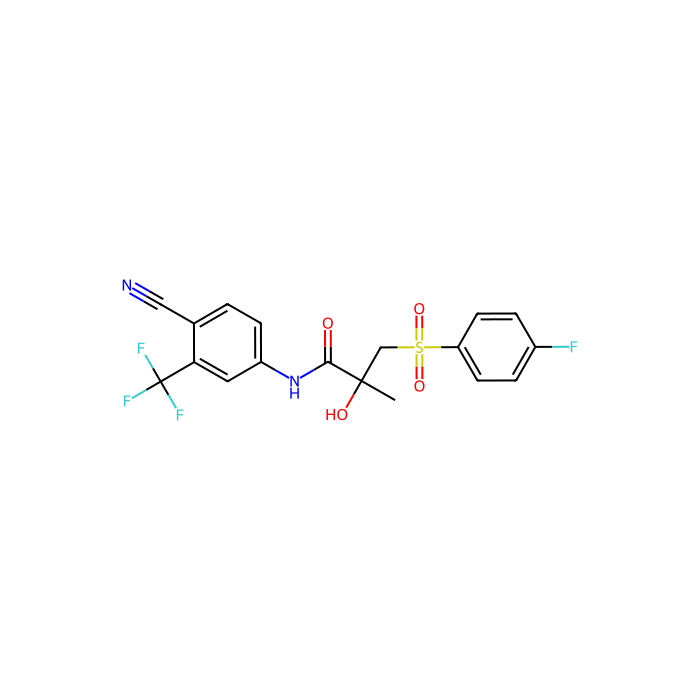
Bicalutamide (ICI-176334) Bicalutamide (ICI-176334) is an androgen receptor (AR) antagonist with IC50 of 0.16 μM in LNCaP/AR(cs)cell line. Bicalutamide promotes autophagy .
In vitro
Bicalutamide undergoes an antagonist-to-agonist switch, stimulating AR activity. Bicalutamide treatment of LNCaP/AR(cs) cells in absence of the synthetic androgen R1881 results in altered gene expression consistent with its well-documented agonist activity in context of AR overexpression. Bicalutamide induces cell proliferation in a dose-dependent manner, and only partially antagonized the effects of R1881. Bicalutamide treatment also results in a significant amount of nuclear AR, although less than that observed with R1881. Bicalutamide exhibits partial agonist activity as evidenced by induction of DNA binding at AR target genes and incomplete antagonism of the effects of R1881. In absence of R1881, Bicalutamide partially activates VP16-AR–mediated transcription, indicative of AR binding to DNA. In LNCaP/AR-luc cells with a stably integrates AR-driven luciferase reporter construct. In the presence of R1881, Bicalutamide shows only weak partial antagonism of VP16-AR–mediated transcription with an IC50 of 0.35 μM. Micromolar bicalutamide causes a significant dose-dependent reduction in clonogenicity. Dual inhibition of the AR and mTOR signaling pathways provides further benefit with the ridaforolimus-bicalutamide combination producing syner -gistic antiproliferative effects in prostate cancer cells in vitro when compared with each agent alone.
In vivo
Single bicalutamide reduces tumor growth by 79%, at defined submaximal doses. The ridaforolimus-bicalutamide combination exhibits improved and potent antitumor activity, almost completely abrogating tumor growth. The combination is also well tolerated, as evidenced by no significant changes in body weight over the course of treatment. Plasma PSA levels are again tightly linked to tumor growth in the combination-treated mice.
Cell Data
cell lines:
Concentrations:0-1 μM
Incubation Time:72 hours
Powder Purity:≥99%
| ALogP | 2.3 |
|---|
| Isomeric SMILES | CC(CS(=O)(=O)C1=CC=C(C=C1)F)(C(=O)NC2=CC(=C(C=C2)C#N)C(F)(F)F)O |
|---|---|
| WGK Germany | 3 |
| RTECS | TX1413500 |
| Molecular Weight | 430.37 |
| Reaxy-Rn | 5364666 |
| Reaxys-RN_link_address | https://www.reaxys.com/reaxys/secured/hopinto.do?context=S&query=IDE.XRN=5364666&ln= |
Comprehensive hazard, handling, storage, and regulatory compliance document.
Download SDS →Lot-specific quality data. Enter your lot number to retrieve the exact COA.
Look up COA →Full quality attributes and acceptance criteria for this grade.
View spec sheet →| Activity Type | Activity Value -log(M) | Mechanism of Action | Activity Reference | Publications (PubMed IDs) |
|---|
| Melt Point(°C) | 196 °C |
|---|
| 1. Xinyu Cheng, Xiuzhi Chen, Chengfeng Liang, Hongjun Jin, Shizhao Ren, Rongrong Xue, Fenghua Chen. (2023) Explanation and prediction for the crystallized products from amorphous bicalutamide and bicalutamide solutions by using mid-frequency Raman difference spectra. VIBRATIONAL SPECTROSCOPY, [PMID:] [10.1016/j.vibspec.2023.103565] |
| 2. Jian Zhao, Nannan Liu, Shuchen Sun, Shaohua Gou, Xinyi Wang, Zhimei Wang, Xiaoyan Li, Wenjing Zhang. (2019) Light-activated ruthenium (II)-bicalutamide prodrugs for prostate cancer. JOURNAL OF INORGANIC BIOCHEMISTRY, [PMID:31054419] [10.1016/j.jinorgbio.2019.03.024] |
| 3. Ren Yuanyuan, Cui Yue, Wang Zhen, Luo Yizhi, Jin Junchang, Yuan Yiyi, Li Xuan, Zhang Yaning, Cao Nan, Li Xiaofang, Yu Yi, Xiong Yuyan. (2025) ALDH3A2 negatively orchestrates gastric cancer progression through a synergistic induction of ferroptosis and ferroptosis-driven macrophage reprogramming. Cell Death & Disease, [PMID:41444219] [10.1038/s41419-025-08364-8] |
Our grade selection guide covers purity, stabilizer status, and application suitability for all variants in our catalog.
View Moligand™ grade guide →