Determine the necessary mass, volume, or concentration for preparing a solution.
Information
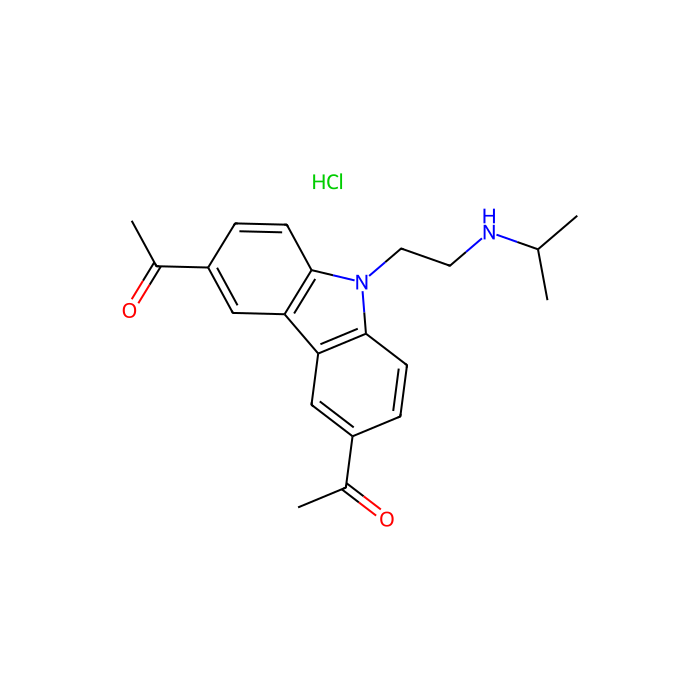
CBL0137 HCl CBL0137 (CBLC137, Curaxin 137) HCl activates p53 and inhibits NF-kB with EC50s of 0.37 μM and 0.47 μM in the cell-based p53 and NF-kB reporter assays, respectively. It also inhibits histone chaperone FACT (facilitates chromatin transcription complex).
Targets
FACT ; p53 (Cell-free assay); NF-κB (Cell-free assay) ; 0.37 μM(EC50); 0.47 μM(EC50)
In vitro
CBL0137 is a potent inducer of apoptosis in pancreatic cancer cell lines and is toxic not only for proliferating bulk tumor cells, but also for pancreatic cancer stem cells. CBL0137 and related molecules can simultaneously activate p53 and inhibit cellular stress pathways mediated by NF-κB and HSF-1. CBL0137 binds DNA but does not cause any sort of chemical modifications in DNA and therefore lacks genotoxicity. However, CBL0137 binding to DNA leads to functional inactivation of the Facilitates Chromatin Transcription (FACT) complex, a chromatin remodeling complex involved in transcription, replication, and DNA repair. In CBL0137-treated cells, FACT is lost from the nucleoplasm and trapped in chromatin, resulting in the inhibition of FACT-dependent transcription, including NF-kB-mediated transcription. Additionally, chromatin trapping of FACT leads to casein kinase 2 (CK2)-dependent phosphorylation and activation of p53.
In vivo
In mice, CBL0137 is effective against several Pancreatic ductal adenocarcinoma (PDA) models, including orthotopic gemcitabine resistant PANC-1 model and patient derived xenografts, in which CBL0137 anti-tumor effect correlated with overexpression of FACT. CBL0137 targets glioblastoma (GBM) according to its proposed mechanism of action, crosses the blood-brain barrier, and is efficacious in both TMZ-responsive and -resistant orthotopic models. The property of crossing the blood-brain barrier, especially when administered i.v, bodes well for the potential of this drug to treat CNS tumors. In orthotopic models, i.v. administration leads to greater tumor tissue accumulation than oral dosing, leading to greater bioavailability. Normal brain tissue accumulation of CBL0137 does not cause observable neurotoxicity.
Cell Research(from reference)
Cell lines:tumor (HT1080, RCC45, MiaPaca) and normal cells (Wi38, NKE-hTERT)
Concentrations:2 μM
Incubation Time:24 h
| Pubchem Sid | 504770358 |
|---|---|
| Pubchem Sid Url | https://pubchem.ncbi.nlm.nih.gov/substance/504770358 |
| Canonical Smiles | CC(C)NCCN1C2=C(C=C(C=C2)C(=O)C)C3=C1C=CC(=C3)C(=O)C.Cl |
| IUPAC Name | 1-[6-acetyl-9-[2-(propan-2-ylamino)ethyl]carbazol-3-yl]ethanone;hydrochloride |
| InChIKey | IXRKBBVMDMKAEB-UHFFFAOYSA-N |
| INCHI | 1S/C21H24N2O2.ClH/c1-13(2)22-9-10-23-20-7-5-16(14(3)24)11-18(20)19-12-17(15(4)25)6-8-21(19)23;/h5-8,11-13,22H,9-10H2,1-4H3;1H |
| Isomeric SMILES | CC(C)NCCN1C2=C(C=C(C=C2)C(=O)C)C3=C1C=CC(=C3)C(=O)C.Cl |
| Molecular Weight | 372.9 |
| Reaxy-Rn | 27322822 |
| Reaxys-RN_link_address | https://www.reaxys.com/reaxys/secured/hopinto.do?context=S&query=IDE.XRN=27322822&ln= |
Comprehensive hazard, handling, storage, and regulatory compliance document.
Download SDS →Lot-specific quality data. Enter your lot number to retrieve the exact COA.
Look up COA →Full quality attributes and acceptance criteria for this grade.
View spec sheet →Taxonomy Tree
| Kingdom | Organic compounds |
|---|---|
| Superclass | Organoheterocyclic compounds |
| Class | Indoles and derivatives |
| Subclass | Carbazoles |
| Intermediate Tree Nodes | Not available |
| Direct Parent | Carbazoles |
| Alternative Parents | N-alkylindoles Indoles Acetophenones Aryl alkyl ketones Substituted pyrroles Heteroaromatic compounds Dialkylamines Azacyclic compounds Organic oxides Hydrochlorides Hydrocarbon derivatives |
| Molecular Framework | Aromatic heteropolycyclic compounds |
| Substituents | Carbazole - N-alkylindole - Acetophenone - Indole - Aryl ketone - Aryl alkyl ketone - Substituted pyrrole - Benzenoid - Heteroaromatic compound - Pyrrole - Ketone - Secondary amine - Secondary aliphatic amine - Azacycle - Hydrocarbon derivative - Amine - Organic nitrogen compound - Organooxygen compound - Organonitrogen compound - Organic oxide - Organic oxygen compound - Hydrochloride - Aromatic heteropolycyclic compound |
| Description | This compound belongs to the class of organic compounds known as carbazoles. These are compounds containing a three ring system containing a pyrrole ring fused on either side to a benzene ring. |
| External Descriptors | Not available |
| Solubility | Solubility (25°C) In vitro DMSO: 20 mg/mL (53.63 mM); Water: 20 mg/mL (53.63 mM); Ethanol: Insoluble; |
|---|---|
| Sensitivity | Moisture sensitive |
| Molecular Weight | 372.900 g/mol |
| XLogP3 | |
| Hydrogen Bond Donor Count | 2 |
| Hydrogen Bond Acceptor Count | 3 |
| Rotatable Bond Count | 6 |
| Exact Mass | 372.16 Da |
| Monoisotopic Mass | 372.16 Da |
| Topological Polar Surface Area | 51.100 Ų |
| Heavy Atom Count | 26 |
| Formal Charge | 0 |
| Complexity | 466.000 |
| Isotope Atom Count | 0 |
| Defined Atom Stereocenter Count | 0 |
| Undefined Atom Stereocenter Count | 0 |
| Defined Bond Stereocenter Count | 0 |
| Undefined Bond Stereocenter Count | 0 |
| The total count of all stereochemical bonds | 0 |
| Covalently-Bonded Unit Count | 2 |