Determine the necessary mass, volume, or concentration for preparing a solution.
≥99% for sensitive chromatographic and analytical workflows requiring minimal baseline interference.
Store at 2-8°C,Desiccated Ships Wet ice Check lot-specific COA for exact specifications.
SDS, COA, datasheet, and spec sheet available for download. Lot-specific COA accessible via lot number lookup.
Cited in 0 peer-reviewed publications across chromatography, organic synthesis, and cross-coupling reactions.
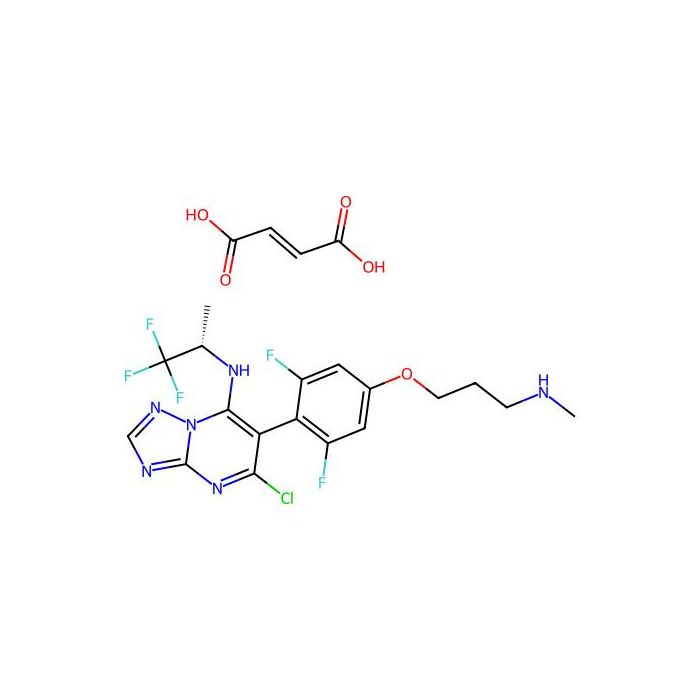
Cevipabulin fumarate (TTI-237 fumarate) is an oral, microtubule-active, antitumor compound and inhibits the binding of [ 3 H]NSC 49842 to tubulin, with an IC 50 of 18-40 nM for cytotoxicity in human tumor cell line
In Vitro
Cevipabulin (0-50 nM, 72 hours) shows good activity (between 18 and 40 nM IC 50 values) on cell lines from ovarian, breast, prostate, and cervical tumors. Flow cytometry experiments reveal that, Cevipabulin (TTI-237) at low concentrations (20-40 nM) produces sub-G 1 nuclei and, at concentrations above 50 nM, it causes a strong G 2 -M block. MCE has not independently confirmed the accuracy of these methods. They are for reference only. Cell Cytotoxicity AssayCell Line: Human cancer cell lines (SK-OV-3, MDA-MB-435, MDA-MB-468, LnCaP, and Hela cells). Concentration: 0-50 nM Incubation Time: 72 hours Result: The IC 50 values are 24±8 nM, 21±4 nM, 18±6 nM, 22±7 nM and 40 nM in SK-OV-3, MDA-MB-435, MDA-MB-468, LnCaP and Hela cells.
In Vivo
Cevipabulin (TTI-2370)( 5, 10, 15, and 20 mg/kg, every 4 days for 4 cycles, in mice) is active by i.v. and p.o. administration against human tumor xenografts, showing dose-dependent effects, with good antitumor activity at 20 and 15 mg/kg . MCE has not independently confirmed the accuracy of these methods. They are for reference only. Animal Model: Athymic nu/nu female mice implanted s.c. in the flank with 1×10 7 LoVo human colon adenocarcinoma cells . Dosage: 5, 10, 15, and 20 mg/kg Administration: I.V. injection every 4 days for 4 cycles. Result: The compound showed dose-dependent effects, with good antitumor activity at 20 and 15 mg/kg. Animal Model: Athymic nu/nu female mice implanted s.c. in the flank with 1×10 6 U87-MG human glioblastoma cells . Dosage: 25 mg/kg. Administration: P.O. or I.V. on days 0, 7, 14. Result: The compound was active by p.o. or i.v. administration against human tumor xenografts.
Form:Solid
IC50& Target:IC50: 18-40 nM (microtubule in human tumor cells)
| Canonical Smiles | CC(C(F)(F)F)NC1=C(C(=NC2=NC=NN12)Cl)C3=C(C=C(C=C3F)OCCCNC)F.C(=CC(=O)O)C(=O)O |
|---|---|
| IUPAC Name | (E)-but-2-enedioic acid;5-chloro-6-[2,6-difluoro-4-[3-(methylamino)propoxy]phenyl]-N-[(2S)-1,1,1-trifluoropropan-2-yl]-[1,2,4]triazolo[1,5-a]pyrimidin-7-amine |
| InChIKey | TUXZQBYIZLWUKK-AFIAKLHKSA-N |
| INCHI | 1S/C18H18ClF5N6O.C4H4O4/c1-9(18(22,23)24)28-16-14(15(19)29-17-26-8-27-30(16)17)13-11(20)6-10(7-12(13)21)31-5-3-4-25-2;5-3(6)1-2-4(7)8/h6-9,25,28H,3-5H2,1-2H3;1-2H,(H,5,6)(H,7,8)/b;2-1+/t9-;/m0./s1 |
| Isomeric SMILES | C[C@@H](C(F)(F)F)NC1=C(C(=NC2=NC=NN12)Cl)C3=C(C=C(C=C3F)OCCCNC)F.C(=C/C(=O)O)\C(=O)O |
| Alternate CAS | 849550-67-0 |
| PubChem CID | 71587814 |
| Molecular Weight | 580.89 |
Comprehensive hazard, handling, storage, and regulatory compliance document.
Download SDS →Lot-specific quality data. Enter your lot number to retrieve the exact COA.
Look up COA →Full quality attributes and acceptance criteria for this grade.
View spec sheet →Taxonomy Tree
| Kingdom | Organic compounds |
|---|---|
| Superclass | Organoheterocyclic compounds |
| Class | Diazines |
| Subclass | Pyrimidines and pyrimidine derivatives |
| Intermediate Tree Nodes | Not available |
| Direct Parent | Phenylpyrimidines |
| Alternative Parents | Triazolopyrimidines Phenoxy compounds Phenol ethers Secondary alkylarylamines Alkyl aryl ethers Aminopyrimidines and derivatives Halopyrimidines Fluorobenzenes Unsaturated fatty acids Aryl chlorides Aryl fluorides Dicarboxylic acids and derivatives Triazoles Heteroaromatic compounds Azacyclic compounds Carboxylic acids Dialkylamines Organofluorides Hydrocarbon derivatives Organic oxides Carbonyl compounds Alkyl fluorides Organochlorides |
| Molecular Framework | Not available |
| Substituents | 5-phenylpyrimidine - Triazolopyrimidine - Phenoxy compound - Phenol ether - Alkyl aryl ether - Aminopyrimidine - Fluorobenzene - Halobenzene - Halopyrimidine - Secondary aliphatic/aromatic amine - Aryl chloride - Aryl fluoride - Aryl halide - Monocyclic benzene moiety - Dicarboxylic acid or derivatives - Fatty acyl - Fatty acid - Benzenoid - Unsaturated fatty acid - 1,2,4-triazole - Triazole - Heteroaromatic compound - Azole - Secondary amine - Azacycle - Carboxylic acid derivative - Ether - Carboxylic acid - Secondary aliphatic amine - Alkyl halide - Organic oxygen compound - Organic oxide - Carbonyl group - Amine - Hydrocarbon derivative - Organooxygen compound - Organohalogen compound - Organic nitrogen compound - Organochloride - Organofluoride - Organonitrogen compound - Alkyl fluoride - Aromatic heteropolycyclic compound |
| Description | This compound belongs to the class of organic compounds known as phenylpyrimidines. These are polycyclic aromatic compounds containing a benzene ring linked to a pyrimidine ring through a CC or CN bond. Pyrimidine is a 6-membered ring consisting of four carbon atoms and two nitrogen centers at the 1- and 3- ring positions. |
| External Descriptors | Not available |
| Solubility | DMSO : 50 mg/mL (86.07 mM; Need ultrasonic) H2O : 1.43 mg/mL (2.46 mM; ultrasonic and warming and heat to 60°C) |
|---|---|
| Molecular Weight | 580.900 g/mol |
| XLogP3 | |
| Hydrogen Bond Donor Count | 4 |
| Hydrogen Bond Acceptor Count | 15 |
| Rotatable Bond Count | 10 |
| Exact Mass | 580.126 Da |
| Monoisotopic Mass | 580.126 Da |
| Topological Polar Surface Area | 151.000 Ų |
| Heavy Atom Count | 39 |
| Formal Charge | 0 |
| Complexity | 685.000 |
| Isotope Atom Count | 0 |
| Defined Atom Stereocenter Count | 1 |
| Undefined Atom Stereocenter Count | 0 |
| Defined Bond Stereocenter Count | 1 |
| Undefined Bond Stereocenter Count | 0 |
| The total count of all stereochemical bonds | 1 |
| Covalently-Bonded Unit Count | 2 |