Determine the necessary mass, volume, or concentration for preparing a solution.
| Activity Type | Activity Value -log(M) | Mechanism of Action | Activity Reference | Publications (PubMed IDs) |
|---|

Moligand™, 10mM in DMSO Moligand™ for sensitive chromatographic and analytical workflows requiring minimal baseline interference.
Store at -80°C Ships Dry ice packs + Cold packs Check lot-specific COA for exact specifications.
SDS, COA, datasheet, and spec sheet available for download. Lot-specific COA accessible via lot number lookup.
Cited in 0 peer-reviewed publications across chromatography, organic synthesis, and cross-coupling reactions.
Information
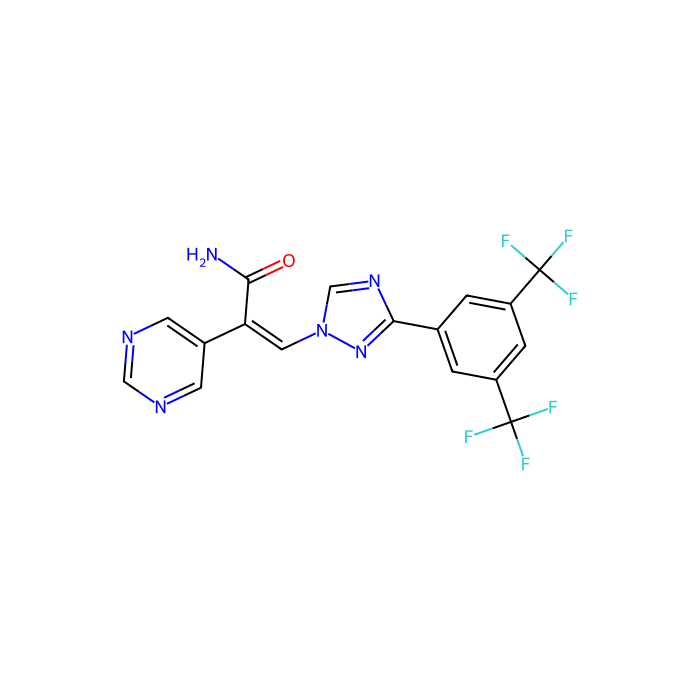
Eltanexor (KPT-8602) Eltanexor (KPT-8602, ONO-7706,ATG-016) is a second-generation, orally bioavailable XPO1 (also known as CRM1) inhibitor with IC50 values of 20−211 nM in 10 AML lines after 3 days exposure.
Targets
XPO1
In vitro
KPT-8602 is a potent inhibitor of AML cells in cell-based viability assays. KPT-8602 inhibits XPO1/cargo interactions and nuclear export, induces apoptosis of primary CLL cells and significantly inhibits proliferation of diffuse large B-cell lymphoma cell lines
In vivo
KPT-8602 is orally bioavailable and has similar pharmacokinetic properties to selinexor, but has markedly reduced (approximately 30-fold less) penetration across the blood−brain barrier. Toxicology studies in rats and monkeys indicate that KPT-8602 has a substantially better tolerability profile, probably due to its inability to penetrate into the CNS, with reduced anorexia, malaise and weight loss compared to selinexor. KPT-8602 exhibits superior anti-leukemic activity and better tolerability in the AML PDX models tested, with nearly complete elimination of human AML cells in the AML-CN model. KPT-8602 is minimally toxic to normal hematopoietic stem and progenitor cells. KPT-8602 does not accumulate in plasma after repetitive dosing and prolongs survival in a human leukemia xenograft model of AML.
Cell Research(from reference)
Cell lines:Human CLL cells
Concentrations:0-10 μM
Incubation Time:24 h and 48 h
| ALogP | 2.002 |
|---|---|
| hba_count | 5 |
| Nombre de HBD | 1 |
| Liaison rotative | 6 |
| Pubchem Sid | 528764390 |
|---|---|
| Sourires canoniques | C1=C(C=C(C=C1C(F)(F)F)C(F)(F)F)C2=NN(C=N2)C=C(C3=CN=CN=C3)C(=O)N |
| IUPAC Name | (E)-3-[3-[3,5-bis(trifluoromethyl)phenyl]-1,2,4-triazol-1-yl]-2-pyrimidin-5-ylprop-2-enamide |
| InChIKey | JFBAVWVBLRIWHM-AWNIVKPZSA-N |
| INCHI | 1S/C17H10F6N6O/c18-16(19,20)11-1-9(2-12(3-11)17(21,22)23)15-27-8-29(28-15)6-13(14(24)30)10-4-25-7-26-5-10/h1-8H,(H2,24,30)/b13-6+ |
| Isomères SMILES | C1=C(C=C(C=C1C(F)(F)F)C(F)(F)F)C2=NN(C=N2)/C=C(\C3=CN=CN=C3)/C(=O)N |
| Poids moléculaire | 428.29 |
| Reaxy-Rn | 31333010 |
| Reaxys-RN_link_address | https://www.reaxys.com/reaxys/secured/hopinto.do?context=S&query=IDE.XRN=31333010&ln= |
Comprehensive hazard, handling, storage, and regulatory compliance document.
Download SDS →Lot-specific quality data. Enter your lot number to retrieve the exact COA.
Look up COA →Full quality attributes and acceptance criteria for this grade.
View spec sheet →Taxonomy Tree
| Kingdom | Organic compounds |
|---|---|
| Superclass | Organoheterocyclic compounds |
| Classe | Azoles |
| Subclass | Triazoles |
| Intermediate Tree Nodes | Phenyltriazoles |
| Direct Parent | Phenyl-1,2,4-triazoles |
| Alternative Parents | Trifluoromethylbenzenes Pyrimidines and pyrimidine derivatives Vinylogous amides Heteroaromatic compounds Primary carboxylic acid amides Azacyclic compounds Organonitrogen compounds Organofluorides Organic oxides Hydrocarbon derivatives Carbonyl compounds Alkyl fluorides |
| Molecular Framework | Aromatic heteromonocyclic compounds |
| Substituents | Phenyl-1,2,4-triazole - Trifluoromethylbenzene - Monocyclic benzene moiety - Pyrimidine - Benzenoid - Heteroaromatic compound - Vinylogous amide - Carboxamide group - Primary carboxylic acid amide - Carboxylic acid derivative - Azacycle - Organic oxide - Organic oxygen compound - Alkyl halide - Organooxygen compound - Organonitrogen compound - Organofluoride - Organohalogen compound - Alkyl fluoride - Carbonyl group - Organic nitrogen compound - Hydrocarbon derivative - Aromatic heteromonocyclic compound |
| Description | This compound belongs to the class of organic compounds known as phenyl-1,2,4-triazoles. These are organic compounds containing a 1,2,4-triazole substituted by a phenyl group. |
| External Descriptors | Not available |
| Activity Type | Activity Value -log(M) | Mechanism of Action | Activity Reference | Publications (PubMed IDs) |
|---|
| Activity Type | Relation | Activity value | Units | Action Type | Journal | PubMed Id | doi | Assay Aladdin ID |
|---|
| Activity Type | Relation | Activity value | Units | Action Type | Journal | PubMed Id | doi | Assay Aladdin ID |
|---|
| Activity Type | Relation | Activity value | Units | Action Type | Journal | PubMed Id | doi | Assay Aladdin ID |
|---|
| DMSO (mg/mL) Solubilité maximale | 85 |
|---|---|
| DMSO (mM) Solubilité maximale | 198.4636578 |
| Eau (mg/mL) Solubilité maximale | <1 |
| Poids moléculaire | 428.290 g/mol |
| XLogP3 | 2.500 |
| Hydrogen Bond Donor Count | 1 |
| Hydrogen Bond Acceptor Count | 11 |
| Rotatable Bond Count | 4 |
| Exact Mass | 428.082 Da |
| Monoisotopic Mass | 428.082 Da |
| Topological Polar Surface Area | 99.600 Ų |
| Heavy Atom Count | 30 |
| Formal Charge | 0 |
| Complexity | 626.000 |
| Isotope Atom Count | 0 |
| Defined Atom Stereocenter Count | 0 |
| Undefined Atom Stereocenter Count | 0 |
| Defined Bond Stereocenter Count | 1 |
| Undefined Bond Stereocenter Count | 0 |
| The total count of all stereochemical bonds | 1 |
| Covalently-Bonded Unit Count | 1 |
Our grade selection guide covers purity, stabilizer status, and application suitability for all variants in our catalog.
View Moligand™ grade guide →