N-(Methyl)mercaptoacetamide is a reducing agent that reacts with methionine sulfoxide moieties. N-(Methyl)mercaptoacetamide may be used as a reference material in assays wherein this molecule is an expected leaving group. N-(Methyl)mercaptoacetamide is us
Conditions de stockage de stockage
Store at 2-8°C
Expédié en
Wet ice
Ce produit nécessite l'expédition en chaîne froide. Les services terrestres et autres services économiques ne sont pas disponibles.
This compound belongs to the class of organic compounds known as secondary carboxylic acid amides. These are compounds containing a secondary carboxylic acid amide functional group, with the general structure RC(=O)N(R')H (R,R'=alkyl, aryl).
External Descriptors
monocarboxylic acid amide
1. Djoumbou Feunang Y, Eisner R, Knox C, Chepelev L, Hastings J, Owen G, Fahy E, Steinbeck C, Subramanian S, Bolton E, Greiner R, and Wishart DS. ClassyFire: Automated Chemical Classification With A Comprehensive, Computable Taxonomy. Journal of Cheminformatics, 2016, 8:61.
Determine the necessary mass, volume, or concentration for preparing a solution.
Dilution Calculator
Determine the dilution needed to prepare a stock solution.
Reconstitution Calculator
Avis
Avis des clients
Application Protocols
No manufacturer-validated biological assay protocols are provided for this item. For chemical applications, consider the following general workflows (literature/general):
Preparing a 0.1–1.0 M stock solution: Dissolve in degassed water, methanol, or DMSO under nitrogen; filter (0.22 µm) if needed; store aliquots cold and protected from air.
S-alkylation screen: Combine thiol (1.0 eq), electrophile (1.2 eq), K2CO3 (2.0 eq) in ACN; stir at rt; monitor by LC–MS every 30–60 min; quench with water; extract or purify by prep HPLC.
Thioester formation: Activate carboxylic acid with EDC/NHS in water/ACN (pH 5.5); add thiol; stir 1–2 h; quench and purify.
Disulfide formation: Treat with 0.5 eq I2 in MeOH at rt; monitor until thiol is consumed; quench with sodium thiosulfate; isolate disulfide.
These are illustrative only; adapt stoichiometry, solvent, and conditions to your system. Always confirm compatibility with your analytes and desired downstream use. For research use only.
Biological Roles
No biological data are provided for this item. The following comments are general and literature-based for small thiol amides; they are not product specifications nor usage claims.
Functional analogy (literature/general)
Structurally, N-(Methyl)mercaptoacetamide resembles simple cysteamine/cysteine derivatives in possessing a terminal thiol adjacent to an amide. Such motifs are common in enzymatic active sites and cofactors where thiol/disulfide redox cycling occurs.
The thiol can participate in reversible oxidation to disulfides and in metal coordination (soft metal ions), features relevant to protein folding and metalloprotein chemistry in model systems.
Application context in biochemistry (research-only)
Model compound for studying thiol pKa, redox potentials, and reactivity trends relative to peptide thiols.
Potential handle for bioconjugation method development (e.g., forming thioesters or thioethers as surrogates for cysteine modifications) in vitro.
Notes
This product is for research use only. It is not intended for diagnostic, therapeutic, or clinical use. Any biological role discussion here is conceptual and must be validated in the user’s specific experimental system.
Buffer Applications
This compound is not a conventional buffering agent. However, in experiments involving thiol chemistry, buffer choice strongly influences reactivity and stability (literature/general):
pH considerations
Thiol deprotonation (to thiolate) increases markedly above pH ~8–9 (typical range for aliphatic thiols). Mildly basic buffers (e.g., borate, bicarbonate, Tris) can accelerate S-alkylation/Michael additions, but also increase oxidation risk.
Near-neutral pH (phosphate, HEPES) slows background oxidation and may favor selective conjugations in the presence of other nucleophiles.
Practical tips
Degas buffers (N2 sparge) and add 0.1–1 mM EDTA to chelate trace metals that catalyze thiol oxidation, if compatible.
Avoid amine-rich buffers (e.g., high Tris) for acyl-transfer steps where competitive N-acylation can occur. For thioester formation, MES or phosphate buffers are often preferred.
Maintain low headspace and minimize light exposure; consider adding small amounts of reducing agent immediately before use (e.g., TCEP) when preventing disulfide formation is critical.
For preparative buffering capacity (pKa, ionic strength), select standard Good’s buffers; this compound itself should not be used as the buffering species.
Green Alternatives
Opportunities to improve sustainability when working with N-(Methyl)mercaptoacetamide focus on solvent choice, redox control, and workup.
Greener solvent choices (literature/general)
Prefer water, ethanol, or isopropanol where reactivity allows (e.g., thiol–Michael additions, some S-alkylations with phase-transfer catalysis).
Replace DMF/DMSO with acetonitrile, 2-MeTHF, or ethyl acetate when feasible; for moisture-sensitive steps, 2-MeTHF and CPME can substitute THF/Et2O with improved safety.
Reaction design
Use photoinitiated thiol–ene chemistry to avoid metal catalysts and minimize waste.
Employ carbodiimide or CDI-mediated thioesterifications in aqueous or mixed aqueous-organic media to reduce chlorinated reagents.
Workup/waste minimization
Aqueous bicarbonate or citrate buffers enable phase separations with reduced solvent volumes.
Capture thiol odors using activated carbon or bleach-scrubbed off-gas traps; segregate sulfur waste to improve treatment.
Comparison snapshot (literature/general):
Water/EtOH vs DMF/DMSO: lower toxicity and easier removal, but may require surfactants or phase-transfer catalysts.
2-MeTHF vs THF: similar solvency for acylations; 2-MeTHF often derived from renewable sources and offers better safety (higher bp, lower peroxide rates), though odor control for thiols is still needed.
Always balance greener choices with the need to suppress oxidation (degassing, inert gas) and to achieve chemoselectivity.
Pharmaceutical Uses
No pharmacopeial status, excipient role, or formulation grade is provided for this item. The notes below are general and for research/manufacturing process discussions only; no clinical or therapeutic claims are made.
Potential roles in pharmaceutical R&D (literature/general)
Synthetic intermediate: The thiol can be converted to thioethers or thioesters as part of API or linker synthesis.
Linker chemistry: Useful in forming stable or redox-responsive linkages (thioether vs disulfide) in conjugates or pro-moieties explored during preclinical development.
Process chemistry probes: Model substrate to optimize thiol-activation, coupling, or odor-control strategies.
Considerations
Odor management and oxidative stability are key for scale-up; closed systems and nitrogen blankets are recommended.
Impurity control should monitor disulfide formation and residual solvents.
Regulatory
No specific pharmacopoeial monograph is implied for this SKU. For any GMP-related work, obtain full specifications, CoA, and consider additional in-house qualification.
Physical Properties
Item-specific specifications are not provided in the product data. The following are qualitative or literature-based notes to assist with planning; verify with primary literature or CoA for exact values.
Appearance: Not specified for this item; refer to CoA/Spec Sheet.
Melting/boiling point: Not broadly tabulated in standard handbooks for this specific N-methyl derivative (literature). Expect behavior consistent with a small polar thiol-amide (solid or low-melting solid/liquid). Confirm experimentally.
Density/refractive index: Not specified for this item; refer to CoA/Spec Sheet.
Solubility (qualitative, literature/general):
Expected to be highly soluble in water due to the amide and potential thiolate formation.
Readily soluble in polar organics (methanol, ethanol, DMSO, DMF) and likely less soluble in nonpolar hydrocarbons.
pKa/logP (literature/general for related structures):
Thiol pKa typically in the 8–10 range for aliphatic thiols; amide N is non-basic.
LogP expected to be low (polar, hydrogen-bonding). Obtain exact value from computational or experimental sources if needed.
Hygroscopicity/volatility: Small polar molecules of this type may absorb moisture and can oxidize in air; monitor for odor and discoloration as indicators of degradation (literature/general).
Note: Because thiols can slowly oxidize to disulfides, handling under inert atmosphere and using degassed solvents helps maintain material integrity.
Quality and Grades
Grade/purity: Not specified for this item; refer to CoA/Spec Sheet.
UV cutoff, residual water/peroxide/metal limits: Not specified for this item; refer to CoA/Spec Sheet.
Guidance on interpreting grades (general):
Research or synthetic grade: Suitable for most preparative transformations, screening, and method development where trace UV-absorbing impurities and metals are not critical.
High-purity or assay-specified material: Preferred for analytical studies, kinetics, and applications sensitive to trace oxidation products (e.g., disulfides) or metal contamination that can complex with thiols.
Amide thiols are prone to air oxidation. For quality-sensitive work:
Check the CoA for assay, related substances (including disulfide), and loss on drying. Recheck purity by HPLC or NMR after opening, as thiol/disulfide equilibria can shift with handling.
If necessary, reduce any disulfide impurity in situ (e.g., with TCEP or a brief sulfhydryl-reducing step) immediately before use. Validate that any reductant/byproducts are compatible with the downstream application.
Batch-specific guidance
If your application requires low non-volatile residue, trace metal control, or defined water content, request the latest CoA/Spec Sheet for this SKU (M124593) and consider additional in-lab QC (Karl Fischer, ICP-MS) as appropriate.
Reaction and Applications
As a bifunctional building block bearing a nucleophilic thiol and a secondary amide, N-(Methyl)mercaptoacetamide is versatile across sulfur chemistry and peptide/bioconjugation contexts.
S-alkylation: Formation of thioethers via reaction with alkyl halides, epoxides, or activated electrophiles under basic conditions.
Thioester synthesis: Acylation of the thiol using acid chlorides, anhydrides, or EDC/NHS-activated carboxylic acids; useful in acyl transfer chemistry.
Oxidation to disulfides: Controlled dimerization with iodine, air/O2, or H2O2 at low equivalents; valuable for redox-switchable linkers.
Thiol–Michael additions: Conjugate addition to α,β-unsaturated carbonyls/acrylates for polymer and linker formation; base, photoinitiated, or catalyst-free protocols.
Thiol–ene/-yne click: Radical addition across alkenes/alkynes using UV/thermal initiation.
Metal coordination: Soft-thiol binding to Au, Ag, Cu, Hg surfaces/ions for materials interfaces and sensing.
Practical tips
Minimize oxidation by working under N2/Ar, using degassed solvents, and adding the thiol late.
For selective S-functionalization over N-acylation, use conditions favoring thiolate formation and avoid highly reactive acylating agents that can attack the amide nitrogen.
Monitor reactions by LC–MS or HPLC; thiol/disulfide interconversion can complicate purity profiles.
Use contexts (manufacturer category expansion)
General chemical/biochemical reagent for sulfur chemistry, linker design, probe synthesis, and as a cysteamine/cysteine surrogate in model systems. For research use only.
Reaction Conditions
Typical conditions below are literature/general guidance for thiol-containing amides; optimize for your substrate set and scale.
S-alkylation (thioether formation)
Conditions: Substrate (1.0 eq), alkyl halide (1.1–1.5 eq), K2CO3 or Cs2CO3 (1.5–2.0 eq) in DMF or acetonitrile, 0–25 °C to rt, 1–6 h.
Notes: Additive phase-transfer catalysts (TBAB) can enable reactions in alcohols or water. Avoid strong bases that risk amide hydrolysis at elevated temperature.
Thioesterification
Acid chlorides/anhydrides: Base (DIPEA, pyridine) in DCM/ACN at 0–25 °C, 0.5–2 h.
Carbodiimide route: Carboxylic acid (1.0 eq), EDC·HCl (1.2 eq), catalytic DMAP or NHS (1.2 eq) in aqueous-organic (e.g., water/ACN), pH 5–6; 1–4 h.
Thiol–Michael addition
Base-catalyzed: K2CO3 or triethylamine (5–20 mol%) in MeOH/EtOH or water/EtOH, rt, 0.5–3 h.
Photoinitiated: AIBN or photoinitiator (1–2 mol%), UV or 365–405 nm LEDs, bulk or solvent-free conditions for polymer precursors.
Oxidation to disulfide
I2 (0.5 eq) in MeOH or ACN, rt, minutes to 1 h; or air/O2 with catalytic base and light stirring. Quench excess oxidant and purge iodine residues.
Analytical/controls
Monitor by LC–MS/HPLC; thiol peak areas can diminish via adventitious oxidation. Include EDTA and degas eluents for reproducibility.
All conditions are general literature guidance, not item-specific specifications.
Safety and Handling
No item-specific GHS classification, signal word, or pictograms are provided in the product data. Always consult the SDS for authoritative information. The guidance below reflects general properties of low-molecular-weight thiol amides.
Anticipated hazards (general for thiols)
Strong, characteristic thiol odor; even trace amounts can be noticeable. Work in a certified fume hood.
May cause skin/eye irritation and respiratory irritation on vapor/aerosol exposure (literature/general). Avoid inhalation and contact.
Thiols can oxidize to disulfides; exothermic oxidation is possible with strong oxidants.
PPE and engineering controls
Wear lab coat, safety goggles, and appropriate chemically resistant gloves (e.g., nitrile). Use in a fume hood.
Avoid open-air weighing for extended periods; promptly recap to minimize odor and oxidation.
Incompatibilities (general)
Strong oxidizers (can cause rapid oxidation to disulfides or further).
Acid chlorides/anhydrides and strong bases will react with the thiol or amide functionality.
Heavy metal salts may form complexes/precipitates via thiol coordination.
First-aid overview (general)
Skin/eye contact: Rinse with water for at least 15 minutes; remove contaminated clothing; seek medical attention if irritation persists.
Inhalation: Move to fresh air; seek medical attention if symptoms occur.
Ingestion: Rinse mouth; do not induce vomiting; seek medical attention.
Special handling for thiols
Store under inert gas if possible and minimize headspace oxygen; use antioxidants only if compatible with your application. Dispose of waste promptly to control odor.
Solvent Selection
This compound is a small, polar thiol-amide and is typically handled in polar protic or dipolar aprotic media.
Polarity and miscibility (literature/general)
Expected to be miscible or highly soluble in water, methanol, ethanol.
Highly soluble in dipolar aprotic solvents (DMSO, DMF, acetonitrile). Limited solubility in nonpolar solvents.
Choosing a solvent by application
Nucleophilic S-alkylation/acylation: DMF, DMSO, or acetonitrile with a mild base (K2CO3, DIPEA) to promote thiolate formation.
Thioester formation with acyl chlorides/activated esters: Anhydrous dichloromethane, acetonitrile, or THF with base; aqueous-organic biphasic systems also work with carbodiimide coupling.
Thiol–Michael additions and thiol–ene: Alcohols, water/organic mixtures, or bulk monomer media; select solvent to control rate via thiol ionization.
Bioconjugation or metal-binding studies: Aqueous buffers (pH 7–8.5) or water/DMSO cosolvent; degas to minimize oxidation.
Quick comparison (literature/general)
Water: Green, ideal for redox/bioconjugation; requires degassing/antioxidant to limit disulfide formation.
MeOH/EtOH: Convenient and greenish; good solubility, easy removal.
DMSO/DMF: Excellent solvating power; consider removal challenges and potential side reactions with activators.
ACN/THF: Good for moisture-sensitive acylations; ensure inert atmosphere.
Drying and degassing of solvents are recommended to suppress oxidative side reactions of the thiol.
Storage and Reconstitution
Storage conditions (product data)
Store at 2–8 °C. Shipped on wet ice.
Practical storage guidance (general for thiols)
Keep container tightly closed, protected from air and light. If feasible, blanket headspace with nitrogen or argon to suppress oxidation to disulfide.
Minimize repeated warming/cooling cycles. Bring container to room temperature before opening to prevent moisture condensation.
Stability notes
Thiols can slowly oxidize in the presence of oxygen, trace metals, or light. Add small amounts of chelator (e.g., EDTA) to aqueous solutions when compatible, and work with degassed solvents.
Reconstitution and stock solutions (general)
Solvents: Readily dissolved in water, methanol/ethanol, DMSO, or DMF (literature/general). Use degassed, oxygen-poor media for maximum stability.
Typical stock concentrations: 0.1–1.0 M, depending on solvent and application. Filter sterilize if required for sensitive assays.
Aliquoting: Prepare single-use aliquots to avoid repeated air exposure. For short-term use, keep at 2–8 °C. For longer-term storage of solutions, freezing at approximately −20 °C is commonly employed (literature/general), provided this does not contradict your application requirements.
Shelf-life and specifications
Assay, water content, and related impurities are batch-dependent. Not specified for this item; refer to CoA/Spec Sheet. Reassess purity by HPLC/NMR after extended storage or multiple openings.
For research use only.
Structure and Identity
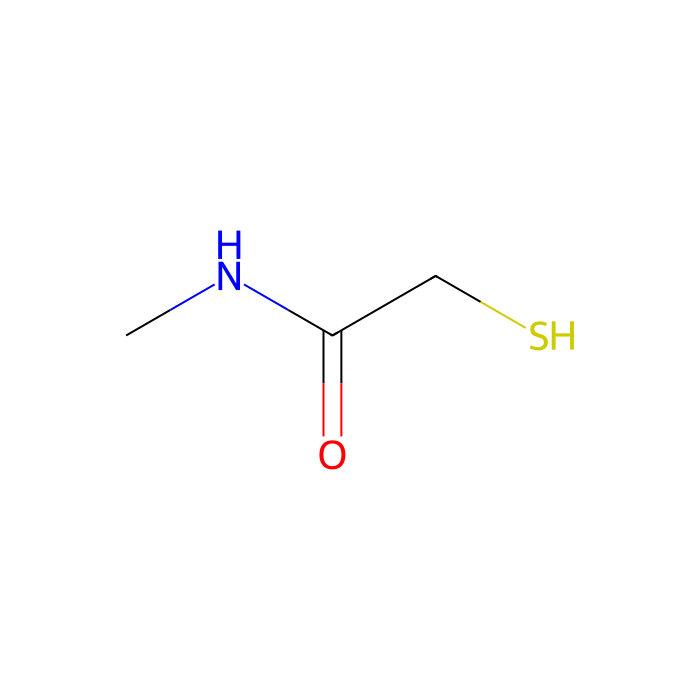
N-(Methyl)mercaptoacetamide is the N-methyl derivative of mercaptoacetamide, featuring a thiol (–SH) adjacent to an amide carbonyl and a methyl-substituted amide nitrogen. The backbone corresponds to HS–CH2–C(=O)–NH–CH3.
Ring systems: none; acyclic, two-carbon chain linking S and carbonyl.
Stereochemistry: none (achiral, no stereogenic centers).
2D description: from left to right, a terminal thiol (S–H) bound to methylene (–CH2–), then a carbonyl carbon (C=O) of an amide, followed by an amide nitrogen bearing one hydrogen and one methyl substituent.
The amide is weakly basic/non-basic; the thiol can deprotonate near mildly basic pH to give a nucleophilic thiolate. The carbonyl is strongly polar, enabling hydrogen bonding and high polarity overall.
Synthetic Utility
N-(Methyl)mercaptoacetamide provides orthogonal functionality: a nucleophilic/soft Lewis-basic sulfur and a relatively inert secondary amide.
Strategic features (literature/general)
Chemoselective S-functionalization: Generate thiolate (base) and engage alkyl halides, epoxides, sulfonates to afford thioethers. Neighboring amide attenuates N-nucleophilicity, aiding S-selectivity.
Thioester gateway: Acylate sulfur with acid chlorides or via EDC/NHS or CDI activation, enabling downstream native chemical ligation-type transformations or acyl transfer studies (as a simple model).
Redox handles: Disulfide formation/cleavage provides reversible linkages for responsive materials and protecting-group strategies.
Click-type additions: Thiol–Michael and thiol–ene/-yne additions give rapid access to diversified scaffolds under mild conditions.
Metal-binding and surface modification: Thiol attachment to Au/Ag/Cu surfaces for self-assembled monolayers or labels; amide provides polarity and H-bonding without excessive basicity.
Retrosynthesis/use
As a masked acyl-equivalent at sulfur (thioester), permitting convergent coupling.
As a cysteine/cysteamine surrogate for mapping site-selective transformations without peptide complexity.
Protecting-group notes
Temporary protection of S as thioacetate or S-alkyl groups can be used to control chemoselectivity; deprotection under mild nucleophilic or reductive conditions restores the thiol.
Target Specificity
This product is a small-molecule reagent, not a biological targeting reagent (e.g., antibody, ligand with defined target panel). No antigen, epitope, clone, isotype, or species reactivity applies to this SKU. For selectivity in chemical reactions, see Reaction & Applications and Synthetic Utility.
We use cookies to ensure the website functions properly and, where permitted, to improve your experience. You can manage your preferences at any time in Settings. Learn more in our Cookie Policy.
Shall we send you a message when we have discounts available?
Remind me later
Thank you! Please check your email inbox to confirm.
Products are supplied to verified businesses, institutions, and qualified professionals for research and development use only. Not for use in humans, animals, diagnosis, or therapy.

 H2401149