≥98% for sensitive chromatographic and analytical workflows requiring minimal baseline interference.
🌡
Storage & shipping
Protected from light,Store at -20°C,Desiccated Ships Ice chest + Ice pads Check lot-specific COA for exact specifications.
📋
Quality documents
SDS, COA, datasheet, and spec sheet available for download. Lot-specific COA accessible via lot number lookup.
📚
Literature proof
Cited in 0 peer-reviewed publications across chromatography, organic synthesis, and cross-coupling reactions.
Overview
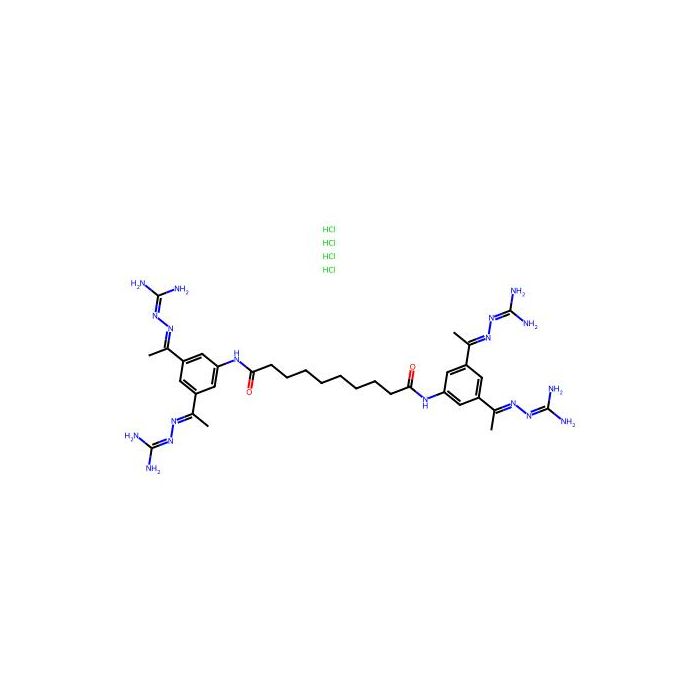
Semapimod tetrahydrochloride (CNI-1493), an inhibitor of proinflammatory cytokine production, can inhibit TNF-α , IL-1β , and IL-6. Semapimod tetrahydrochloride inhibits TLR4 signaling (IC 50 ≈0.3 μM). Semapimod tetrahydrochloride inhibits p38 MAPK and nitric oxide production in macrophages. Semapimod tetrahydrochloride has potential in a variety of inflammatory and autoimmune disorders .
In Vitro
Semapimod tetrahydrochloride leads to a significant decrease of p38-MAPK phosphorylation in macrophages, proinflammatory gene expression of macrophage inflammatory protein-1alpha, interleukin-6, monocyte chemoattractant protein-1, and intercellular adhesion molecule-1, and neutrophil infiltration. Semapimod tetrahydrochloride completely abrogated nitric oxide production within the tunica muscularis. ?\nSemapimod tetrahydrochloride desensitizes TLR signaling via its effect on the TLR chaperone gp96. Semapimod tetrahydrochloride inhibits ATP-binding and ATPase activities of gp96 in vitro (IC 50 ≈0.2-0.4 μM). Semapimod tetrahydrochloride desensitizes TLR signaling via its effect on the TLR chaperone gp96. MCE has not independently confirmed the accuracy of these methods. They are for reference only.
In Vivo
Semapimod tetrahydrochloride (5 mg/kg; i.p; daily for 2 weeks) ameliorates endothelial dysfunction in Obese Zucker (OZ) rats . ?\nSemapimod tetrahydrochloride restores AM-induced akt phosphorylation and cGMP production in OZ rats . MCE has not independently confirmed the accuracy of these methods. They are for reference only. Animal Model: Male OZ rats Dosage: 5 mg/kg Administration: I.p; daily for 2 weeks Result: Restored endothelium-dependent vasorelaxation in OZ rats.
This compound belongs to the class of organic compounds known as anilides. These are organic heterocyclic compounds derived from oxoacids RkE(=O)l(OH)m (l not 0) by replacing an OH group by the NHPh group or derivative formed by ring substitution.
External Descriptors
Not available
1. Djoumbou Feunang Y, Eisner R, Knox C, Chepelev L, Hastings J, Owen G, Fahy E, Steinbeck C, Subramanian S, Bolton E, Greiner R, and Wishart DS. ClassyFire: Automated Chemical Classification With A Comprehensive, Computable Taxonomy. Journal of Cheminformatics, 2016, 8:61.
We use cookies to ensure the website functions properly and, where permitted, to improve your experience. You can manage your preferences at any time in Settings. Learn more in our Cookie Policy.
Shall we send you a message when we have discounts available?
Remind me later
Thank you! Please check your email inbox to confirm.
Products are supplied to verified businesses, institutions, and qualified professionals for research and development use only. Not for use in humans, animals, diagnosis, or therapy.