
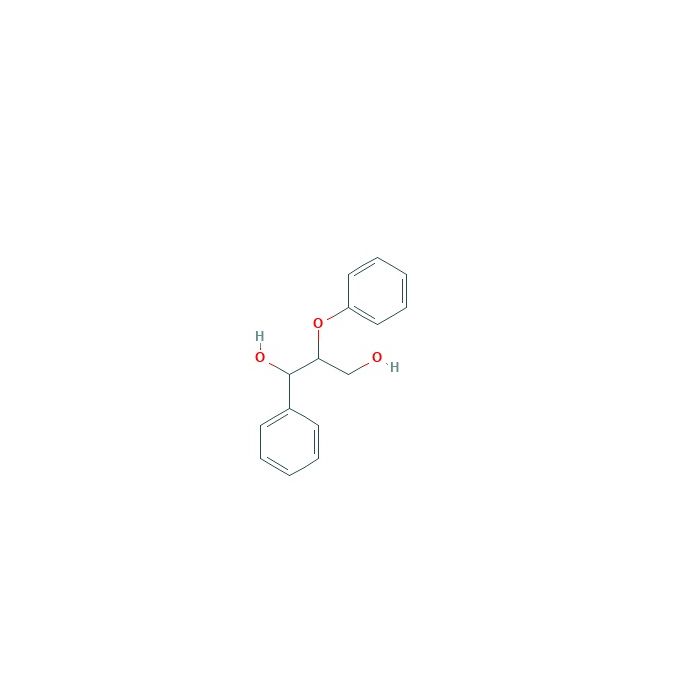
 E2417258
Determine the necessary mass, volume, or concentration for preparing a solution.
2-Phenoxy-1-phenylpropane-1,3-diol - ≥97% , CAS No.70110-65-5
AVAILABLE TO ORDER
GRADE & PURITY ≥97%
Storage
Store at 2-8°C,Argon charged
Shipped In
Wet ice
≥97% for sensitive chromatographic and analytical workflows requiring minimal baseline interference.
Store at 2-8°C,Argon charged Ships Wet ice Check lot-specific COA for exact specifications.
SDS, COA, datasheet, and spec sheet available for download. Lot-specific COA accessible via lot number lookup.
Cited in 0 peer-reviewed publications across chromatography, organic synthesis, and cross-coupling reactions.
| Canonical Smiles | C1=CC=C(C=C1)C(C(CO)OC2=CC=CC=C2)O |
|---|---|
| IUPAC Name | 2-phenoxy-1-phenylpropane-1,3-diol |
| InChIKey | POAUKTKCUURWJL-UHFFFAOYSA-N |
| INCHI | 1S/C15H16O3/c16-11-14(18-13-9-5-2-6-10-13)15(17)12-7-3-1-4-8-12/h1-10,14-17H,11H2 |
| Isomeric SMILES | C1=CC=C(C=C1)C(C(CO)OC2=CC=CC=C2)O |
| PubChem CID | 66898687 |
| Molecular Weight | 244.28 |
Comprehensive hazard, handling, storage, and regulatory compliance document.
Download SDS →Lot-specific quality data. Enter your lot number to retrieve the exact COA.
Look up COA →Full quality attributes and acceptance criteria for this grade.
View spec sheet →Taxonomy Tree
| Kingdom | Organic compounds |
|---|---|
| Superclass | Lignans, neolignans and related compounds |
| Class | Not available |
| Subclass | Not available |
| Intermediate Tree Nodes | Not available |
| Direct Parent | Lignans, neolignans and related compounds |
| Alternative Parents | Phenoxy compounds Phenol ethers Alkyl aryl ethers Secondary alcohols Primary alcohols Hydrocarbon derivatives Aromatic alcohols |
| Molecular Framework | Aromatic homomonocyclic compounds |
| Substituents | Neolignan skeleton - Phenoxy compound - Phenol ether - Alkyl aryl ether - Benzenoid - Monocyclic benzene moiety - Secondary alcohol - Ether - Organic oxygen compound - Hydrocarbon derivative - Aromatic alcohol - Primary alcohol - Organooxygen compound - Alcohol - Aromatic homomonocyclic compound |
| Description | This compound belongs to the class of organic compounds known as lignans, neolignans and related compounds. These are plant products of low molecular weight formed primarily from oxidative coupling of two p-propylphenol moieties. They can also be described as micromolecules with two phenylpropanoid units coupled together. They can be attached in various manners, like C5-C5', C8-C8'. Most known natural lignans are oxidized at C9 and C9´ and, based upon the way in which oxygen is incorporated into the skeleton and on the cyclization patterns, a wide range of lignans of very different structural types can be formed. |
| External Descriptors | Not available |