
Determine the necessary mass, volume, or concentration for preparing a solution.
| Activity Type | Activity Value -log(M) | Mechanism of Action | Activity Reference | Publications (PubMed IDs) |
|---|
10mM in DMSO for sensitive chromatographic and analytical workflows requiring minimal baseline interference.
Store at -80°C Ships Dry ice packs + Cold packs Check lot-specific COA for exact specifications.
SDS, COA, datasheet, and spec sheet available for download. Lot-specific COA accessible via lot number lookup.
Cited in 0 peer-reviewed publications across chromatography, organic synthesis, and cross-coupling reactions.
Information
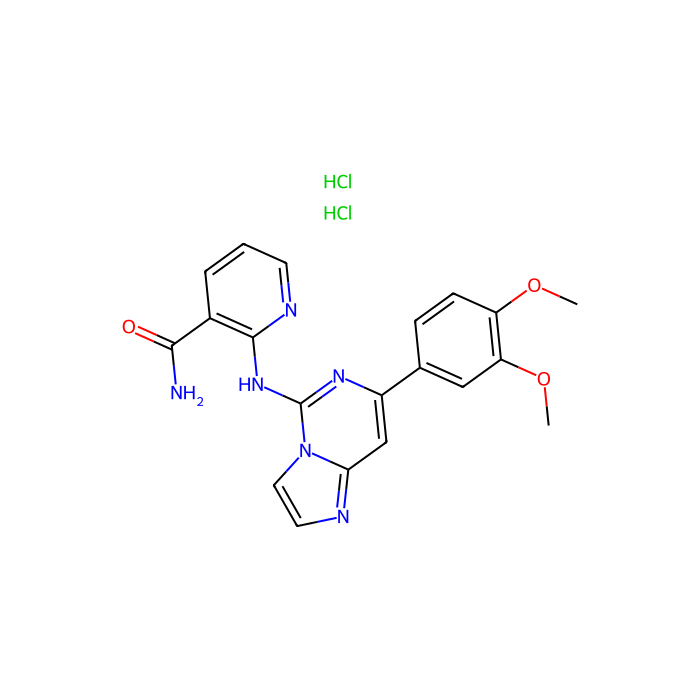
BAY-61-3606 BAY-61-3606 is a potent and selective inhibitor of Syk kinase (Ki = 7.5 nM). BAY-61-3606 induces cell cycle arrest and apoptosis .
Targets
Syk (Cell-free assay) 7.5 nM(Ki)
In vitro
BAY 61-3606 is a highly selective inhibitor of Syk kinase. Other selected tyrosine kinases, Lyn, Fyn, Src, Itk, and Btk, are not inhibited by BAY 61-3606 in concentrations up to 4.7 μM. BAY 61-3606 is also found to inhibit B cell receptor (BCR)-mediated signaling. Bay 61-3606 is a sensitizer of TRAIL-induced apoptosis. Mcl-1 downregulation by Bay 61-3606 are concentration- and time-dependent in MCF-7 cells. phosphorylation of Syk is reduced by Bay 61-3606 in MCF-7 and T47D cells. Downregulation of Mcl-1 by Bay 61-3606 is independent of Syk in breast cancer cells. Bay 61-3606 promotes the ubiquitin/proteasome-dependent degradation of the Mcl-1 protein in MCF-7 cells. Bay 61-3606 inhibits the phosphorylation of CDK9, RNA polymerase II, and Mcl-1 expression in MCF-7 cells. Bay 61-3606 inhibits CDK9 kinase activity with an in vitro IC50 of 37 nM.
In vivo
After 20 days of drug administration, the volume of the xenografted tumor was significantly (P <0.001) reduced the efficacy of Bay 61–3606 when administered in TRAIL combination. Oral administration of BAY 61-3606 to rats significantly suppresses antigen-induced passive cutaneous anaphylactic reaction, bronchoconstriction, and bronchial edema at 3 mg/kg. Furthermore, BAY 61-3606 attenuates antigen-induced airway inflammation in rats.
Cell Research(from reference)
Cell lines:MCF-7 cells
Concentrations:2.5 μM or 5 μM
Incubation Time:12 h or 24 h
| ALogP | 3.082 |
|---|---|
| HBD Count | 2 |
| Rotatable Bond | 6 |
| Canonical Smiles | COC1=C(C=C(C=C1)C2=CC3=NC=CN3C(=N2)NC4=C(C=CC=N4)C(=O)N)OC.Cl.Cl |
|---|---|
| IUPAC Name | 2-[[7-(3,4-dimethoxyphenyl)imidazo[1,2-c]pyrimidin-5-yl]amino]pyridine-3-carboxamide;dihydrochloride |
| InChIKey | SPMFEULFGGPQLN-UHFFFAOYSA-N |
| INCHI | 1S/C20H18N6O3.2ClH/c1-28-15-6-5-12(10-16(15)29-2)14-11-17-22-8-9-26(17)20(24-14)25-19-13(18(21)27)4-3-7-23-19;;/h3-11H,1-2H3,(H2,21,27)(H,23,24,25);2*1H |
| Isomeric SMILES | COC1=C(C=C(C=C1)C2=CC3=NC=CN3C(=N2)NC4=C(C=CC=N4)C(=O)N)OC.Cl.Cl |
| PubChem CID | 11784504 |
| Molecular Weight | 463.32 |
Comprehensive hazard, handling, storage, and regulatory compliance document.
Download SDS →Lot-specific quality data. Enter your lot number to retrieve the exact COA.
Look up COA →Full quality attributes and acceptance criteria for this grade.
View spec sheet →Taxonomy Tree
| Kingdom | Organic compounds |
|---|---|
| Superclass | Organoheterocyclic compounds |
| Class | Diazines |
| Subclass | Pyrimidines and pyrimidine derivatives |
| Intermediate Tree Nodes | Not available |
| Direct Parent | Phenylpyrimidines |
| Alternative Parents | Dimethoxybenzenes Imidazopyrimidines Nicotinamides Anisoles Phenoxy compounds Alkyl aryl ethers Aminopyrimidines and derivatives Aminopyridines and derivatives N-substituted imidazoles Imidolactams Heteroaromatic compounds Vinylogous amides Primary carboxylic acid amides Azacyclic compounds Hydrochlorides Hydrocarbon derivatives Amines Organic oxides |
| Molecular Framework | Aromatic heteropolycyclic compounds |
| Substituents | 4-phenylpyrimidine - Dimethoxybenzene - O-dimethoxybenzene - Imidazopyrimidine - Pyridine carboxylic acid or derivatives - Pyridinecarboxamide - Nicotinamide - Phenoxy compound - Anisole - Methoxybenzene - Phenol ether - Aminopyridine - Aminopyrimidine - Alkyl aryl ether - Monocyclic benzene moiety - N-substituted imidazole - Imidolactam - Benzenoid - Pyridine - Heteroaromatic compound - Azole - Imidazole - Vinylogous amide - Carboxamide group - Primary carboxylic acid amide - Ether - Carboxylic acid derivative - Azacycle - Organic oxide - Hydrochloride - Hydrocarbon derivative - Amine - Organic oxygen compound - Organonitrogen compound - Organooxygen compound - Organic nitrogen compound - Aromatic heteropolycyclic compound |
| Description | This compound belongs to the class of organic compounds known as phenylpyrimidines. These are polycyclic aromatic compounds containing a benzene ring linked to a pyrimidine ring through a CC or CN bond. Pyrimidine is a 6-membered ring consisting of four carbon atoms and two nitrogen centers at the 1- and 3- ring positions. |
| External Descriptors | Not available |
| Activity Type | Activity Value -log(M) | Mechanism of Action | Activity Reference | Publications (PubMed IDs) |
|---|
| Activity Type | Relation | Activity value | Units | Action Type | Journal | PubMed Id | doi | Assay Aladdin ID |
|---|
| Activity Type | Relation | Activity value | Units | Action Type | Journal | PubMed Id | doi | Assay Aladdin ID |
|---|
| Activity Type | Relation | Activity value | Units | Action Type | Journal | PubMed Id | doi | Assay Aladdin ID |
|---|
| DMSO(mg / mL) Max Solubility | 14 |
|---|---|
| DMSO(mM) Max Solubility | 30.21669688 |
| Water(mg / mL) Max Solubility | <1 |
| Molecular Weight | 463.300 g/mol |
| XLogP3 | |
| Hydrogen Bond Donor Count | 4 |
| Hydrogen Bond Acceptor Count | 7 |
| Rotatable Bond Count | 6 |
| Exact Mass | 462.097 Da |
| Monoisotopic Mass | 462.097 Da |
| Topological Polar Surface Area | 117.000 Ų |
| Heavy Atom Count | 31 |
| Formal Charge | 0 |
| Complexity | 566.000 |
| Isotope Atom Count | 0 |
| Defined Atom Stereocenter Count | 0 |
| Undefined Atom Stereocenter Count | 0 |
| Defined Bond Stereocenter Count | 0 |
| Undefined Bond Stereocenter Count | 0 |
| The total count of all stereochemical bonds | 0 |
| Covalently-Bonded Unit Count | 3 |