
Determine the necessary mass, volume, or concentration for preparing a solution.
| Activity Type | Activity Value -log(M) | Mechanism of Action | Activity Reference | Publications (PubMed IDs) |
|---|
Information
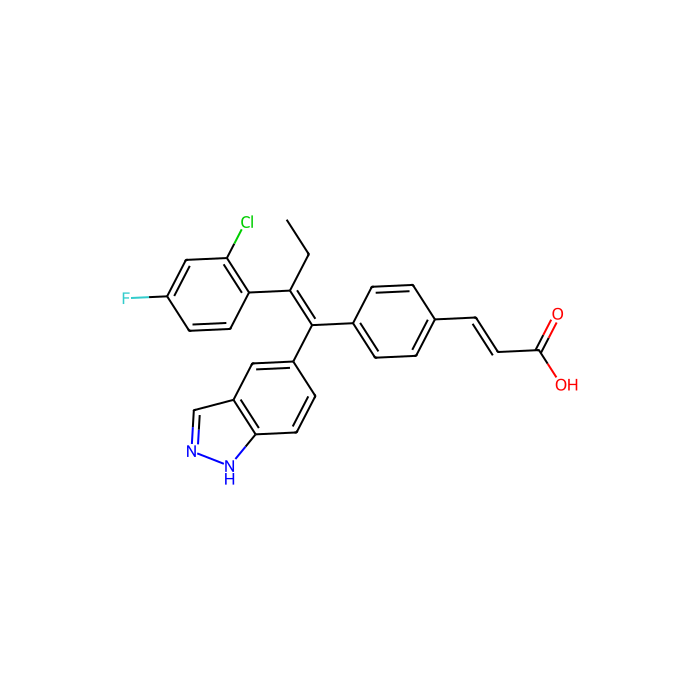
Brilanestrant (GDC-0810, ARN-810) is a potentER-αbinder (ER-α, IC50 = 6.1 nM; ER-β, IC50 = 8.8 nM), a full transcriptional antagonist with no agonism and displays good potency and efficacy in ER-α degradation (EC50 = 0.7 nM) and MCF-7 breast cancer cell viability (IC50 = 2.5 nM) assays with good selectivity over other nuclear hormone receptors.
Targets
ERα (Cell-free); ERβ (Cell-free) 6.1 nM; 8.8 nM
In vitro
In cell-free radio-ligand competitive binding assays, GDC-0810 binds both ERα and ERβ with low nanomolar affinity. GDC-0810 has little to no inhibition against CYP1A2, CYP2D6, or CYP3A4 (IC50 > 20 μM), modest inhibitory effect on CYP2C9 and CYP2C19 (IC50 = 2.2 and 3.3 μM respectively), and potent inhibition of CYP2C8 (IC50 of <0.1 μM). Selectivity of GDC-0810 over other nuclear hormone receptors is also found to be good. In transcriptional reporter assays for the mineralocorticoid (MR), progesterone-A (PR-A), progesterone (PR-B), and glucocorticoid (GR) receptors, GDC-0810 has minimal activity (IC50 > 1 μM). While in binding assays, GDC-0810 displays little activity toward the androgen receptor (AR; IC50 > 4 μM) and GR (IC50 = 0.99 μM). GDC-0810-mediated ERα depletion is dependent on the 26S proteasome. GDC-0810 antagonizes ERα ligand binding domain mutants in vitro and in vivo. In cell-free E2 competitive binding assays that was used to determine the binding of GDC-0810 to ER.WT, ER.Y537S and ER.D538G ligand binding domains, GDC-0810 retains its ability to potently displace E2 from the ligand binding domain, albeit with a slightly increased IC50 (WT: 2.6 nM vs. ER.Y537S: 5.5 nM and ER.D538G: 5.4 nM). GDC-0810 can compete the PGC1α co-activator peptide off the mutated ligand binding domain, implying that GDC-0810 is capable of driving an \'active\' to \'inactive\' conformational shift of mutant ER, though with a ~five-seven fold reduction in biochemical potency compared to wild-type ER.
In vivo
The pharmacokinetic profile of GDC-0810 shows it is a low clearance molecule across species, with good bioavailability (40−60%). As would be expected for a lipophilic carboxylic acid, the compound is highly bound to plasma proteins (>99.5% across species) and has a low to moderate volume of distribution (Vss = 0.2−2.0 L/kg across species). GDC-0810 exhibits good bioavailability across species and displays robust activity in tamoxifen-sensitive and tamoxifen-resistant xenograft models of breast cancer. GDC-0810 displays mild estrogenic activity in uterine models in vitro and in vivo.
Cell Research(from reference)
Cell lines:MCF-7 cells
Incubation Time:4 h
| ALogP | 6.808 |
|---|---|
| hba_count | 2 |
| HBD Count | 1 |
| Rotatable Bond | 6 |
| Canonical Smiles | CCC(=C(C1=CC=C(C=C1)C=CC(=O)O)C2=CC3=C(C=C2)NN=C3)C4=C(C=C(C=C4)F)Cl |
|---|---|
| IUPAC Name | (E)-3-[4-[(E)-2-(2-chloro-4-fluorophenyl)-1-(1H-indazol-5-yl)but-1-enyl]phenyl]prop-2-enoic acid |
| InChIKey | BURHGPHDEVGCEZ-KJGLQBJMSA-N |
| INCHI | 1S/C26H20ClFN2O2/c1-2-21(22-10-9-20(28)14-23(22)27)26(18-8-11-24-19(13-18)15-29-30-24)17-6-3-16(4-7-17)5-12-25(31)32/h3-15H,2H2,1H3,(H,29,30)(H,31,32)/b12-5+,26-21+ |
| Isomeric SMILES | CC/C(=C(/C1=CC=C(C=C1)/C=C/C(=O)O)\C2=CC3=C(C=C2)NN=C3)/C4=C(C=C(C=C4)F)Cl |
| Molecular Weight | 446.9 |
| Reaxy-Rn | 28709093 |
| Reaxys-RN_link_address | https://www.reaxys.com/reaxys/secured/hopinto.do?context=S&query=IDE.XRN=28709093&ln= |
Comprehensive hazard, handling, storage, and regulatory compliance document.
Download SDS →Lot-specific quality data. Enter your lot number to retrieve the exact COA.
Look up COA →Full quality attributes and acceptance criteria for this grade.
View spec sheet →Taxonomy Tree
| Kingdom | Organic compounds |
|---|---|
| Superclass | Phenylpropanoids and polyketides |
| Class | Stilbenes |
| Subclass | Not available |
| Intermediate Tree Nodes | Not available |
| Direct Parent | Stilbenes |
| Alternative Parents | Cinnamic acids Phenylpropanes Indazoles Styrenes Chlorobenzenes Fluorobenzenes Aryl chlorides Aryl fluorides Pyrazoles Heteroaromatic compounds Azacyclic compounds Carboxylic acids Monocarboxylic acids and derivatives Hydrocarbon derivatives Organic oxides Carbonyl compounds Organochlorides Organofluorides Organonitrogen compounds |
| Molecular Framework | Aromatic heteropolycyclic compounds |
| Substituents | Stilbene - Cinnamic acid or derivatives - Cinnamic acid - Indazole - Phenylpropane - Benzopyrazole - Styrene - Chlorobenzene - Fluorobenzene - Halobenzene - Benzenoid - Aryl chloride - Aryl halide - Aryl fluoride - Monocyclic benzene moiety - Heteroaromatic compound - Pyrazole - Azole - Azacycle - Organoheterocyclic compound - Carboxylic acid derivative - Carboxylic acid - Monocarboxylic acid or derivatives - Organooxygen compound - Organic oxide - Organic oxygen compound - Carbonyl group - Organic nitrogen compound - Organonitrogen compound - Organofluoride - Organochloride - Organohalogen compound - Hydrocarbon derivative - Aromatic heteropolycyclic compound |
| Description | This compound belongs to the class of organic compounds known as stilbenes. These are organic compounds containing a 1,2-diphenylethylene moiety. Stilbenes (C6-C2-C6 ) are derived from the common phenylpropene (C6-C3) skeleton building block. The introduction of one or more hydroxyl groups to a phenyl ring lead to stilbenoids. |
| External Descriptors | Not available |
| Activity Type | Activity Value -log(M) | Mechanism of Action | Activity Reference | Publications (PubMed IDs) |
|---|
| Activity Type | Activity Value -log(M) | Mechanism of Action | Activity Reference | Publications (PubMed IDs) |
|---|
| Activity Type | Relation | Activity value | Units | Action Type | Journal | PubMed Id | doi | Assay Aladdin ID |
|---|
| Activity Type | Relation | Activity value | Units | Action Type | Journal | PubMed Id | doi | Assay Aladdin ID |
|---|
| Activity Type | Relation | Activity value | Units | Action Type | Journal | PubMed Id | doi | Assay Aladdin ID |
|---|
| Activity Type | Relation | Activity value | Units | Action Type | Journal | PubMed Id | doi | Assay Aladdin ID |
|---|
| Activity Type | Relation | Activity value | Units | Action Type | Journal | PubMed Id | doi | Assay Aladdin ID |
|---|
| Activity Type | Relation | Activity value | Units | Action Type | Journal | PubMed Id | doi | Assay Aladdin ID |
|---|
| Activity Type | Relation | Activity value | Units | Action Type | Journal | PubMed Id | doi | Assay Aladdin ID |
|---|
| Activity Type | Relation | Activity value | Units | Action Type | Journal | PubMed Id | doi | Assay Aladdin ID |
|---|
| Activity Type | Relation | Activity value | Units | Action Type | Journal | PubMed Id | doi | Assay Aladdin ID |
|---|
| Activity Type | Relation | Activity value | Units | Action Type | Journal | PubMed Id | doi | Assay Aladdin ID |
|---|
| Activity Type | Relation | Activity value | Units | Action Type | Journal | PubMed Id | doi | Assay Aladdin ID |
|---|
| Activity Type | Relation | Activity value | Units | Action Type | Journal | PubMed Id | doi | Assay Aladdin ID |
|---|
| Activity Type | Relation | Activity value | Units | Action Type | Journal | PubMed Id | doi | Assay Aladdin ID |
|---|
| Activity Type | Relation | Activity value | Units | Action Type | Journal | PubMed Id | doi | Assay Aladdin ID |
|---|
| Activity Type | Relation | Activity value | Units | Action Type | Journal | PubMed Id | doi | Assay Aladdin ID |
|---|
| Activity Type | Relation | Activity value | Units | Action Type | Journal | PubMed Id | doi | Assay Aladdin ID |
|---|
| Activity Type | Relation | Activity value | Units | Action Type | Journal | PubMed Id | doi | Assay Aladdin ID |
|---|
| Activity Type | Relation | Activity value | Units | Action Type | Journal | PubMed Id | doi | Assay Aladdin ID |
|---|
| Activity Type | Relation | Activity value | Units | Action Type | Journal | PubMed Id | doi | Assay Aladdin ID |
|---|
| Activity Type | Relation | Activity value | Units | Action Type | Journal | PubMed Id | doi | Assay Aladdin ID |
|---|
| Activity Type | Relation | Activity value | Units | Action Type | Journal | PubMed Id | doi | Assay Aladdin ID |
|---|
| Activity Type | Relation | Activity value | Units | Action Type | Journal | PubMed Id | doi | Assay Aladdin ID |
|---|
| Activity Type | Relation | Activity value | Units | Action Type | Journal | PubMed Id | doi | Assay Aladdin ID |
|---|
| Activity Type | Relation | Activity value | Units | Action Type | Journal | PubMed Id | doi | Assay Aladdin ID |
|---|
| Activity Type | Relation | Activity value | Units | Action Type | Journal | PubMed Id | doi | Assay Aladdin ID |
|---|
| Activity Type | Relation | Activity value | Units | Action Type | Journal | PubMed Id | doi | Assay Aladdin ID |
|---|
| DMSO(mg / mL) Max Solubility | 89 |
|---|---|
| DMSO(mM) Max Solubility | 199.1496979 |
| Water(mg / mL) Max Solubility | <1 |
| Molecular Weight | 446.900 g/mol |
| XLogP3 | 7.400 |
| Hydrogen Bond Donor Count | 2 |
| Hydrogen Bond Acceptor Count | 4 |
| Rotatable Bond Count | 6 |
| Exact Mass | 446.12 Da |
| Monoisotopic Mass | 446.12 Da |
| Topological Polar Surface Area | 66.000 Ų |
| Heavy Atom Count | 32 |
| Formal Charge | 0 |
| Complexity | 719.000 |
| Isotope Atom Count | 0 |
| Defined Atom Stereocenter Count | 0 |
| Undefined Atom Stereocenter Count | 0 |
| Defined Bond Stereocenter Count | 2 |
| Undefined Bond Stereocenter Count | 0 |
| The total count of all stereochemical bonds | 2 |
| Covalently-Bonded Unit Count | 1 |