Determine the necessary mass, volume, or concentration for preparing a solution.
≥99% for sensitive chromatographic and analytical workflows requiring minimal baseline interference.
Store at 2-8°C Ships Wet ice Check lot-specific COA for exact specifications.
SDS, COA, datasheet, and spec sheet available for download. Lot-specific COA accessible via lot number lookup.
Cited in 5 peer-reviewed publications across chromatography, organic synthesis, and cross-coupling reactions.
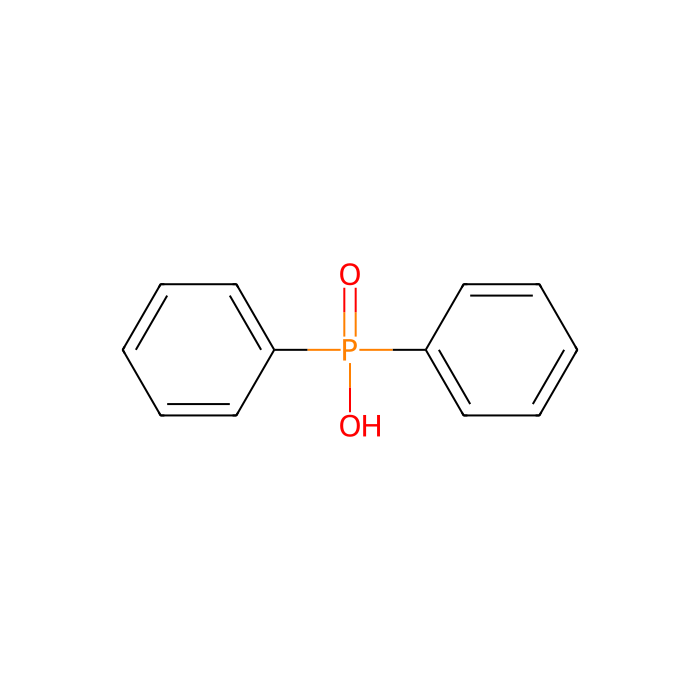
Diphenylphosphinic acid (DPPA, hdpp) is an organophosphinic acid compound. It finds application as a reactive flame-retardant and promoter for palladium catalytic systems. Thermal degradation of DPPA has been studied by thermogravimetric analysis (TGA) method.DPPA reacts with cadmium nitrate in dimethylformamide solvent to afford the one-dimensional coordination polymer catena-poly[[bis(dimethylformamide-κO)cadmium(II)]-bis(μ-diphenylphosphinato-κ(2)O:O′)].[1] It has been repoted to promote the carbonylation of nitrobenzene and aniline to diphenylurea. Ortho-lithiated DPPA can form mono ortho-functionalized derivatives by electrophilic trapping and biphenyl-2,2′-diylbis(phenylphosphinic acid) by copper catalyzed coupling.
Diphenylphosphinic acid is an important starting material for the synthesis of organophosphinic compounds. Diphenylphosphinic acid may be used for the preparation of coordination polymers, via reaction with alkaline earth metal salts in dimethylformamide (DMF) solvent:
• [Mg3(O2PPh2)6(DMF)2]·2DMF
• [Ca(O2PPh2)2(DMF)2]
• [Sr(O2PPh2)2(DMF)2]
• [Ba(O2PPh2)2(DMF)2]
It may be used for the synthesis of compounds with the Al-O-X (X = Si, P, C) motif, via reaction with LAlH2 (L = HC(CMeNAr)2, Ar = 2,6-iPr2C6H3).It may be employed as a novel co-adsorbent in dye-sensitized solar cells (DSCs) based on nanocrystalline TiO2 sensitized with N719 dye. It may be used in the synthesis of arylindium phosphinate
| Pubchem Sid | 488182141 |
|---|---|
| Pubchem Sid Url | https://pubchem.ncbi.nlm.nih.gov/substance/488182141 |
| Canonical Smiles | C1=CC=C(C=C1)P(=O)(C2=CC=CC=C2)O |
| IUPAC Name | diphenylphosphinic acid |
| InChIKey | BEQVQKJCLJBTKZ-UHFFFAOYSA-N |
| INCHI | 1S/C12H11O2P/c13-15(14,11-7-3-1-4-8-11)12-9-5-2-6-10-12/h1-10H,(H,13,14) |
| Isomeric SMILES | C1=CC=C(C=C1)P(=O)(C2=CC=CC=C2)O |
| WGK Germany | 3 |
| RTECS | SZ5315000 |
| Molecular Weight | 218.19 |
| Beilstein | 2804567 |
| Reaxy-Rn | 2804567 |
| Reaxys-RN_link_address | https://www.reaxys.com/reaxys/secured/hopinto.do?context=S&query=IDE.XRN=2804567&ln= |
Comprehensive hazard, handling, storage, and regulatory compliance document.
Download SDS →Lot-specific quality data. Enter your lot number to retrieve the exact COA.
Look up COA →Full quality attributes and acceptance criteria for this grade.
View spec sheet →Taxonomy Tree
| Kingdom | Organic compounds |
|---|---|
| Superclass | Benzenoids |
| Class | Benzene and substituted derivatives |
| Subclass | Not available |
| Intermediate Tree Nodes | Not available |
| Direct Parent | Benzene and substituted derivatives |
| Alternative Parents | Organopnictogen compounds Organophosphorus compounds Organic oxides Hydrocarbon derivatives |
| Molecular Framework | Aromatic homomonocyclic compounds |
| Substituents | Monocyclic benzene moiety - Organic oxygen compound - Organopnictogen compound - Organic oxide - Hydrocarbon derivative - Organophosphorus compound - Aromatic homomonocyclic compound |
| Description | This compound belongs to the class of organic compounds known as benzene and substituted derivatives. These are aromatic compounds containing one monocyclic ring system consisting of benzene. |
| External Descriptors | phosphinic acids |
Find and download the COA for your product by matching the lot number on the packaging.
| Lot Number | Certificate Type | Date | Item |
|---|---|---|---|
| Certificate of Analysis | Mar 18, 2026 | D110250 | |
| Certificate of Analysis | Dec 19, 2024 | D110250 | |
| Certificate of Analysis | Dec 19, 2024 | D110250 | |
| Certificate of Analysis | Dec 19, 2024 | D110250 | |
| Certificate of Analysis | Dec 19, 2024 | D110250 | |
| Certificate of Analysis | Dec 19, 2024 | D110250 | |
| Certificate of Analysis | Jun 13, 2024 | D110250 | |
| Certificate of Analysis | Jun 13, 2024 | D110250 | |
| Certificate of Analysis | Dec 08, 2022 | D110250 | |
| Certificate of Analysis | Dec 08, 2022 | D110250 | |
| Certificate of Analysis | Dec 08, 2022 | D110250 | |
| Certificate of Analysis | Dec 08, 2022 | D110250 | |
| Certificate of Analysis | Dec 08, 2022 | D110250 | |
| Certificate of Analysis | Dec 08, 2022 | D110250 | |
| Certificate of Analysis | Dec 08, 2022 | D110250 | |
| Certificate of Analysis | May 22, 2022 | D110250 | |
| Certificate of Analysis | May 22, 2022 | D110250 | |
| Certificate of Analysis | May 22, 2022 | D110250 | |
| Certificate of Analysis | May 22, 2022 | D110250 | |
| Certificate of Analysis | May 22, 2022 | D110250 |
| Solubility | Soluble in water.0.1 M NaOH: soluble 0.5 g/10 mL |
|---|---|
| Melt Point(°C) | 195°C |
| Molecular Weight | 218.190 g/mol |
| XLogP3 | 2.600 |
| Hydrogen Bond Donor Count | 1 |
| Hydrogen Bond Acceptor Count | 2 |
| Rotatable Bond Count | 2 |
| Exact Mass | 218.05 Da |
| Monoisotopic Mass | 218.05 Da |
| Topological Polar Surface Area | 37.300 Ų |
| Heavy Atom Count | 15 |
| Formal Charge | 0 |
| Complexity | 218.000 |
| Isotope Atom Count | 0 |
| Defined Atom Stereocenter Count | 0 |
| Undefined Atom Stereocenter Count | 0 |
| Defined Bond Stereocenter Count | 0 |
| Undefined Bond Stereocenter Count | 0 |
| The total count of all stereochemical bonds | 0 |
| Covalently-Bonded Unit Count | 1 |
| 1. Gao Nan, Tan Runan, Cai Zhiwei, Zhao Hui, Chang Gang, He Yunbin. (2021) A novel electrochemical sensor via Zr-based metal organic framework–graphene for pesticide detection. JOURNAL OF MATERIALS SCIENCE, 56 (34): (19060-19074). [PMID:] [10.1007/s10853-021-06436-6] |
| 2. Jianbing Zhu, Meiling Xiao, Ping Song, Jing Fu, Zhao Jin, Liang Ma, Junjie Ge, Changpeng Liu, Zhongwei Chen, Wei Xing. (2018) Highly polarized carbon nano-architecture as robust metal-free catalyst for oxygen reduction in polymer electrolyte membrane fuel cells. Nano Energy, [PMID:] [10.1016/j.nanoen.2018.04.021] |
| 3. Jinsheng Duan, Yilin Li, Zhaogang Liu, Peijie Jia, Junchang Fan, Yanhong Hu, Feng Guo, Jinxiu Wu. (2025) Kinetic Analysis of PVC Composites Modified With Different Types of Layered Double Hydroxides. JOURNAL OF APPLIED POLYMER SCIENCE, [PMID:] [10.1002/app.56992] |
| 4. Hao Wang, Heng Qi, Zekun Zhang, Kun Wang, Hongqiang Wang, Yu Tong. (2024) Phosphonic Chloride Assisted Fabrication of Highly Emissive Mixed Halide Perovskite Films in Ambient Air for Blue Light-Emitting Diodes. ACS Applied Materials & Interfaces, [PMID:38795117] [10.1021/acsami.3c19394] |
| 5. Jingsheng Wang, Jun Wang, Shuang Yang, Guoping Ding, Renxin Xu, Wei Liu, Jiuxiao Sun, Kaiwen Chen, Liu Duan, Jiaqi Wang, Hao Wang, Siqi Huo. (2025) Phosphorus-derived imidazolium salts with varied oxidation states: Tailoring latency, mechanical properties, and flame retardancy in single-component epoxy resins. POLYMER DEGRADATION AND STABILITY, [PMID:] [10.1016/j.polymdegradstab.2025.111325] |