Determine the necessary mass, volume, or concentration for preparing a solution.
≥99% for sensitive chromatographic and analytical workflows requiring minimal baseline interference.
Store at 2-8°C,Desiccated Ships Wet ice Check lot-specific COA for exact specifications.
SDS, COA, datasheet, and spec sheet available for download. Lot-specific COA accessible via lot number lookup.
Cited in 0 peer-reviewed publications across chromatography, organic synthesis, and cross-coupling reactions.
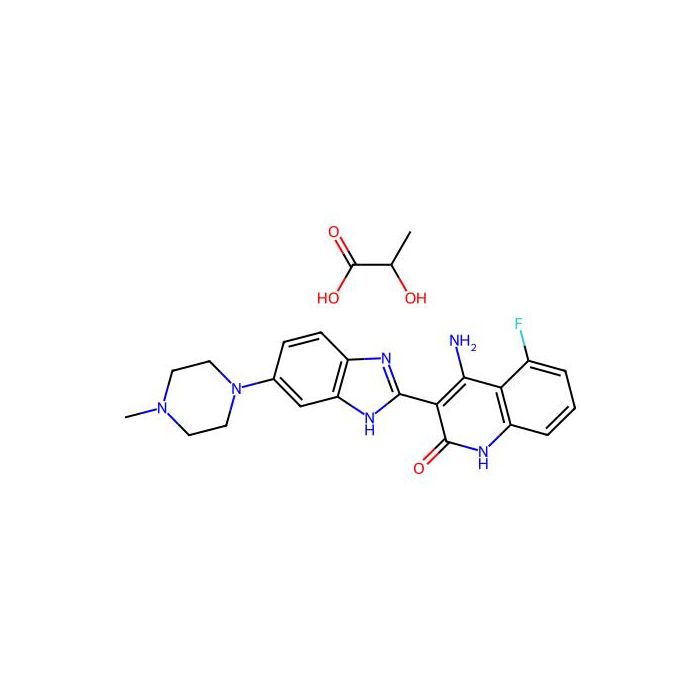
Dovitinib lactate (TKI258 lactate) is a multi-targeted tyrosine kinase inhibitor with IC 50 s of 1, 2, 8/9, 10/13/8, 27/210 nM for FLT3 , c-Kit , FGFR1/3 , VEGFR1/2/3 and PDGFRα/β , respectively
In Vitro
Dovitinib potently inhibits the FGF-stimulated growth of WT and F384L-FGFR3-expressing B9 cells with IC 50 values of 25 nM. B9-MINV cells are resistant to the inhibitory activity of Dovitinib at concentrations up to 1 μM. Dovitinib inhibits cell proliferation of KMS11 (FGFR3-Y373C), OPM2 (FGFR3-K650E), and KMS18 (FGFR3-G384D) cells with IC 50 of values of 90 nM (KMS11 and OPM2) and 550 nM, respectively. Treatment of SK-HEP1 cells with dovitinib results in G2/M cell cycle arrest, inhibition of colony formation in soft agar and blockade of bFGF-induced cell migration. Dovitinib inhibits basal expression and FGF-induced phosphorylation of FGFR-1, FRS2-α and ERK1/2. MCE has not independently confirmed the accuracy of these methods. They are for reference only.
In Vivo
Dovitinib (10 mg/kg, 30 mg/kg, 60 mg/kg, p.o.) shows significant antitumor effect in the KMS11-bearing mice model, and the growth inhibition is 48%, 78.5%, and 94% in the 10 mg/kg, 30 mg/kg, and 60 mg/kg treatment arms, respectively, compared with the placebo-treated mice . Dovitinib demonstrates significant antitumor and antimetastatic activities in HCC xenograft models. Dovitinib potently inhibits tumor growth of six HCC lines. Inhibition of angiogenesis correlates with inactivation of FGFR/PDGFR-β/VEGFR-2 signaling pathways. Dovitinib also causes dephosphorylation of retinoblastoma, upregulation of p-histone H2A-X and p27, and downregulation of p-cdk-2 and cyclin B1, which results in a reduction in cellular proliferation and the induction of tumor cell apoptosis. MCE has not independently confirmed the accuracy of these methods. They are for reference only.
Cell Assay
To determine IC 50 for SK-HEP1 cells, cells are plated at a density of 2×10 4 cells per dish. After 48 h, cells are treated with 0, 0.01, 0.1, 1, 5, 10, 50, 100 μM dovitinib in DMEM containing 1% FBS for 24 h. Cell viability is determined with Cell Proliferation Assay. IC 50 is calculated by nonlinear regression analysis using GraphPad Prism software. MCE has not independently confirmed the accuracy of these methods. They are for reference only.
Animal administration
Mice: Six HCC lines (06-0606, 26-0808A, 26-1004, 25-0705A, 5-1318, 21-0208) are used to establish tumors in male SCID mice. or dose-esponse experiments, mice bearing the 06-0606 xenografts re orally given vehicle (5% dextrose) or two doses of dovitinib (50 and 75 mg/kg) daily for 14 days. For time-dependent inhibition of dovitinib targets, mice bearing 06-0606 tumors are given orally 200 μL of either vehicle (n=6) or 50 mg/kg/day of dovitinib (n=10) . aladdin has not independently confirmed the accuracy of these methods. They are for reference only.
Form:Solid
IC50& Target:FLT3 1 nM (IC 50 ) c-Kit 2 nM (IC 50 ) FGFR1 8 nM (IC 50 ) FGFR3 9 nM (IC 50 ) VEGFR1 1 nM (IC 50 ) VEGFR3 8 nM (IC 50 ) VEGFR2 13 nM (IC 50 ) PDGFRα 27 nM (IC 50 ) PDGFRβ 210 nM (IC 50 )
| Canonical Smiles | CC(C(=O)O)O.CN1CCN(CC1)C2=CC3=C(C=C2)N=C(N3)C4=C(C5=C(C=CC=C5F)NC4=O)N |
|---|---|
| IUPAC Name | 4-amino-5-fluoro-3-[6-(4-methylpiperazin-1-yl)-1H-benzimidazol-2-yl]-1H-quinolin-2-one;2-hydroxypropanoic acid |
| InChIKey | ZRHDKBOBHHFLBW-UHFFFAOYSA-N |
| INCHI | 1S/C21H21FN6O.C3H6O3/c1-27-7-9-28(10-8-27)12-5-6-14-16(11-12)25-20(24-14)18-19(23)17-13(22)3-2-4-15(17)26-21(18)29;1-2(4)3(5)6/h2-6,11H,7-10H2,1H3,(H,24,25)(H3,23,26,29);2,4H,1H3,(H,5,6) |
| Isomeric SMILES | CC(C(=O)O)O.CN1CCN(CC1)C2=CC3=C(C=C2)N=C(N3)C4=C(C5=C(C=CC=C5F)NC4=O)N |
| PubChem CID | 135431668 |
| Molecular Weight | 482.52 |
Comprehensive hazard, handling, storage, and regulatory compliance document.
Download SDS →Lot-specific quality data. Enter your lot number to retrieve the exact COA.
Look up COA →Full quality attributes and acceptance criteria for this grade.
View spec sheet →Taxonomy Tree
| Kingdom | Organic compounds |
|---|---|
| Superclass | Organoheterocyclic compounds |
| Class | Diazinanes |
| Subclass | Piperazines |
| Intermediate Tree Nodes | Not available |
| Direct Parent | N-arylpiperazines |
| Alternative Parents | Hydroquinolones Haloquinolines 4-aminoquinolines Hydroquinolines Benzimidazoles Dialkylarylamines Pyridinones N-methylpiperazines Aminopyridines and derivatives Benzenoids Aryl fluorides Alpha hydroxy acids and derivatives Vinylogous amides Imidazoles Heteroaromatic compounds Trialkylamines Secondary alcohols Lactams Monocarboxylic acids and derivatives Carboxylic acids Azacyclic compounds Primary amines Organopnictogen compounds Organofluorides Organic oxides Hydrocarbon derivatives Carbonyl compounds |
| Molecular Framework | Not available |
| Substituents | N-arylpiperazine - 4-aminoquinoline - Haloquinoline - Dihydroquinolone - Aminoquinoline - Quinoline - Dihydroquinoline - Benzimidazole - Dialkylarylamine - Tertiary aliphatic/aromatic amine - N-alkylpiperazine - N-methylpiperazine - Pyridinone - Aminopyridine - Benzenoid - Pyridine - Hydroxy acid - Aryl halide - Aryl fluoride - Alpha-hydroxy acid - Heteroaromatic compound - Vinylogous amide - Imidazole - Azole - Tertiary aliphatic amine - Tertiary amine - Secondary alcohol - Lactam - Azacycle - Monocarboxylic acid or derivatives - Carboxylic acid - Carboxylic acid derivative - Organic nitrogen compound - Organic oxygen compound - Organopnictogen compound - Organic oxide - Hydrocarbon derivative - Primary amine - Organooxygen compound - Organonitrogen compound - Organofluoride - Organohalogen compound - Carbonyl group - Amine - Alcohol - Aromatic heteropolycyclic compound |
| Description | This compound belongs to the class of organic compounds known as n-arylpiperazines. These are organic compounds containing a piperazine ring where the nitrogen ring atom carries an aryl group. |
| External Descriptors | Not available |
| Solubility | DMSO : ≥ 30 mg/mL (62.17 mM) |
|---|---|
| Molecular Weight | 482.500 g/mol |
| XLogP3 | |
| Hydrogen Bond Donor Count | 5 |
| Hydrogen Bond Acceptor Count | 9 |
| Rotatable Bond Count | 3 |
| Exact Mass | 482.208 Da |
| Monoisotopic Mass | 482.208 Da |
| Topological Polar Surface Area | 148.000 Ų |
| Heavy Atom Count | 35 |
| Formal Charge | 0 |
| Complexity | 737.000 |
| Isotope Atom Count | 0 |
| Defined Atom Stereocenter Count | 0 |
| Undefined Atom Stereocenter Count | 1 |
| Defined Bond Stereocenter Count | 0 |
| Undefined Bond Stereocenter Count | 0 |
| The total count of all stereochemical bonds | 0 |
| Covalently-Bonded Unit Count | 2 |