
Determine the necessary mass, volume, or concentration for preparing a solution.
| Activity Type | Activity Value -log(M) | Mechanism of Action | Activity Reference | Publications (PubMed IDs) |
|---|
Moligand™, ≥97% Moligand™ for sensitive chromatographic and analytical workflows requiring minimal baseline interference.
Store at -20°C Ships Ice chest + Ice pads Check lot-specific COA for exact specifications.
SDS, COA, datasheet, and spec sheet available for download. Lot-specific COA accessible via lot number lookup.
Cited in 0 peer-reviewed publications across chromatography, organic synthesis, and cross-coupling reactions.
Information
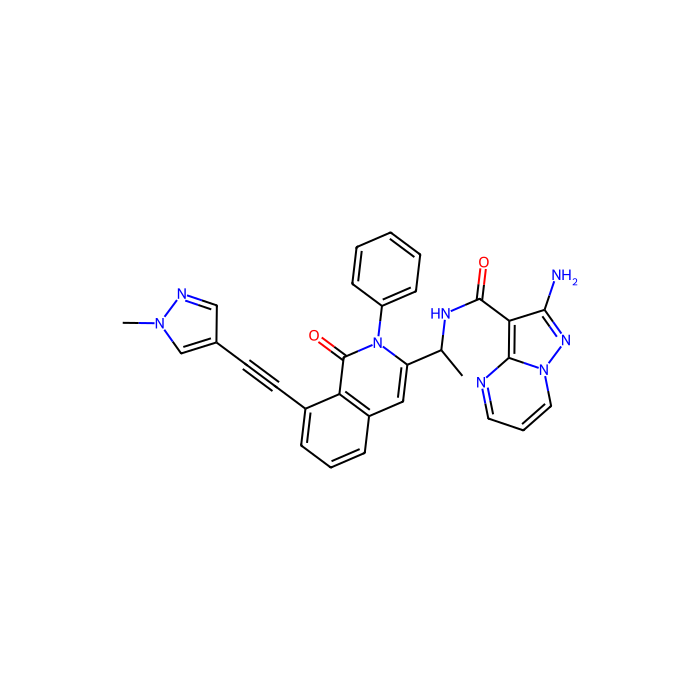
Eganelisib (IPI-549) is a potent inhibitor ofPI3K-γwith >100-fold selectivity over other lipid and protein kinases. The biochemicalIC50for PI3K-γ is 16 nM.
Targets
PI3Kγ (Cell-free assay) 16 nM
In vitro
IPI-549 is found to be a remarkably tight binder to PI3K-γ with a Kd of 290 pM and >58-fold weaker affinity for other Class I PI3K isoforms. It does not significantly inhibit a panel of 468 mutant and nonmutant protein and lipid kinases (including Class II PI3K isoforms) at 1 μM. In PI3K-α, -β, -γ, and -δ dependent cellular phospho-AKT assays, IPI-549 demonstrates excellent PI3K-γ potency (IC50 = 1.2 nM) and selectivity against other Class I PI3K isoforms (>146-fold). Furthermore, IPI-549 dose dependently inhibits PI3K-γ-dependent bone marrow-derived macrophage (BMDM) migration in vitro. IPI-549 is also found to be selective against a panel of 80 GPCRs, ion channels, and transporters at 10 μM. IPI-549 shows moderate to high cell permeability across Caco-2 cell monolayers, is slowly metabolized in cultured hepatocytes (t1/2 > 360 min), and demonstrates IC50s greater than 20 μM for the CYP isoforms tested (1A2, 2B6, 2C8, 2C9, 2C19, 2D6, 3A4).
In vivo
In vivo (mice, rats, dog, and monkeys), IPI-549 has excellent oral bioavailability, low clearance, and distributes into tissues with a mean volume of distribution of 1.2 L/kg. It has a favorable pharmacokinetic profile to allow potent and selective inhibition of PI3K-γ in vivo. IPI-549 can significantly reduce neutrophil migration in a dose-dependent manner in mouse model when administered orally at all of the tested doses. In addition, IPI-54 has been shown to inhibit tumor growth in murine syngeneic models through alteration of immune cells in the tumor microenvironment.
Cell Research(from reference)
Cell lines:SKOV-3 cells
Incubation Time:30 min
| ALogP | 2.732 |
|---|---|
| hba_count | 5 |
| HBD Count | 2 |
| Rotatable Bond | 6 |
| Pubchem Sid | 504772702 |
|---|---|
| Pubchem Sid Url | https://pubchem.ncbi.nlm.nih.gov/substance/504772702 |
| Canonical Smiles | CC(C1=CC2=C(C(=CC=C2)C#CC3=CN(N=C3)C)C(=O)N1C4=CC=CC=C4)NC(=O)C5=C6N=CC=CN6N=C5N |
| IUPAC Name | 2-amino-N-[(1S)-1-[8-[2-(1-methylpyrazol-4-yl)ethynyl]-1-oxo-2-phenylisoquinolin-3-yl]ethyl]pyrazolo[1,5-a]pyrimidine-3-carboxamide |
| InChIKey | XUMALORDVCFWKV-IBGZPJMESA-N |
| INCHI | 1S/C30H24N8O2/c1-19(34-29(39)26-27(31)35-37-15-7-14-32-28(26)37)24-16-22-9-6-8-21(13-12-20-17-33-36(2)18-20)25(22)30(40)38(24)23-10-4-3-5-11-23/h3-11,14-19H,1-2H3,(H2,31,35)(H,34,39)/t19-/m0/s1 |
| Isomeric SMILES | C[C@@H](C1=CC2=C(C(=CC=C2)C#CC3=CN(N=C3)C)C(=O)N1C4=CC=CC=C4)NC(=O)C5=C6N=CC=CN6N=C5N |
| Molecular Weight | 528.56 |
| Reaxy-Rn | 28088877 |
| Reaxys-RN_link_address | https://www.reaxys.com/reaxys/secured/hopinto.do?context=S&query=IDE.XRN=28088877&ln= |
Comprehensive hazard, handling, storage, and regulatory compliance document.
Download SDS →Lot-specific quality data. Enter your lot number to retrieve the exact COA.
Look up COA →Full quality attributes and acceptance criteria for this grade.
View spec sheet →Taxonomy Tree
| Kingdom | Organic compounds |
|---|---|
| Superclass | Organoheterocyclic compounds |
| Class | Isoquinolines and derivatives |
| Subclass | Isoquinolones and derivatives |
| Intermediate Tree Nodes | Not available |
| Direct Parent | Isoquinolones and derivatives |
| Alternative Parents | Pyrimidinecarboxamides Pyrazolo[1,5-a]pyrimidines Pyrazole-4-carboxamides Pyridinones Benzene and substituted derivatives Imidolactams Vinylogous amides Heteroaromatic compounds Secondary carboxylic acid amides Amino acids and derivatives Lactams Azacyclic compounds Hydrocarbon derivatives Organic oxides Organooxygen compounds Primary amines |
| Molecular Framework | Aromatic heteropolycyclic compounds |
| Substituents | Isoquinolone - Pyrazolopyrimidine - Pyrazolo[1,5-a]pyrimidine - Pyrimidinecarboxamide - Pyrazole-4-carboxamide - Pyridinone - Imidolactam - Benzenoid - Monocyclic benzene moiety - Pyrimidine - Pyridine - Heteroaromatic compound - Azole - Vinylogous amide - Pyrazole - Amino acid or derivatives - Secondary carboxylic acid amide - Carboxamide group - Lactam - Azacycle - Carboxylic acid derivative - Organooxygen compound - Organonitrogen compound - Organic nitrogen compound - Hydrocarbon derivative - Primary amine - Organic oxide - Organic oxygen compound - Amine - Aromatic heteropolycyclic compound |
| Description | This compound belongs to the class of organic compounds known as isoquinolones and derivatives. These are aromatic polycyclic compounds containing a ketone bearing isoquinoline moiety. |
| External Descriptors | Not available |
| Activity Type | Activity Value -log(M) | Mechanism of Action | Activity Reference | Publications (PubMed IDs) |
|---|
| Activity Type | Activity Value -log(M) | Mechanism of Action | Activity Reference | Publications (PubMed IDs) |
|---|
| Activity Type | Activity Value -log(M) | Mechanism of Action | Activity Reference | Publications (PubMed IDs) |
|---|
| Activity Type | Activity Value -log(M) | Mechanism of Action | Activity Reference | Publications (PubMed IDs) |
|---|
| Activity Type | Relation | Activity value | Units | Action Type | Journal | PubMed Id | doi | Assay Aladdin ID |
|---|
| Activity Type | Relation | Activity value | Units | Action Type | Journal | PubMed Id | doi | Assay Aladdin ID |
|---|
| Activity Type | Relation | Activity value | Units | Action Type | Journal | PubMed Id | doi | Assay Aladdin ID |
|---|
| Activity Type | Relation | Activity value | Units | Action Type | Journal | PubMed Id | doi | Assay Aladdin ID |
|---|
| Activity Type | Relation | Activity value | Units | Action Type | Journal | PubMed Id | doi | Assay Aladdin ID |
|---|
| Activity Type | Relation | Activity value | Units | Action Type | Journal | PubMed Id | doi | Assay Aladdin ID |
|---|
| Activity Type | Relation | Activity value | Units | Action Type | Journal | PubMed Id | doi | Assay Aladdin ID |
|---|
| Activity Type | Relation | Activity value | Units | Action Type | Journal | PubMed Id | doi | Assay Aladdin ID |
|---|
| Activity Type | Relation | Activity value | Units | Action Type | Journal | PubMed Id | doi | Assay Aladdin ID |
|---|
| Activity Type | Relation | Activity value | Units | Action Type | Journal | PubMed Id | doi | Assay Aladdin ID |
|---|
| Activity Type | Relation | Activity value | Units | Action Type | Journal | PubMed Id | doi | Assay Aladdin ID |
|---|
| Activity Type | Relation | Activity value | Units | Action Type | Journal | PubMed Id | doi | Assay Aladdin ID |
|---|
| Activity Type | Relation | Activity value | Units | Action Type | Journal | PubMed Id | doi | Assay Aladdin ID |
|---|
| Activity Type | Relation | Activity value | Units | Action Type | Journal | PubMed Id | doi | Assay Aladdin ID |
|---|
| Activity Type | Relation | Activity value | Units | Action Type | Journal | PubMed Id | doi | Assay Aladdin ID |
|---|
| Activity Type | Relation | Activity value | Units | Action Type | Journal | PubMed Id | doi | Assay Aladdin ID |
|---|
| Activity Type | Relation | Activity value | Units | Action Type | Journal | PubMed Id | doi | Assay Aladdin ID |
|---|
| Activity Type | Relation | Activity value | Units | Action Type | Journal | PubMed Id | doi | Assay Aladdin ID |
|---|
| Activity Type | Relation | Activity value | Units | Action Type | Journal | PubMed Id | doi | Assay Aladdin ID |
|---|
| Activity Type | Relation | Activity value | Units | Action Type | Journal | PubMed Id | doi | Assay Aladdin ID |
|---|
| Activity Type | Relation | Activity value | Units | Action Type | Journal | PubMed Id | doi | Assay Aladdin ID |
|---|
| Activity Type | Relation | Activity value | Units | Action Type | Journal | PubMed Id | doi | Assay Aladdin ID |
|---|
Find and download the COA for your product by matching the lot number on the packaging.
| Lot Number | Certificate Type | Date | Item |
|---|---|---|---|
 I2208955 I2208955 | Certificate of Analysis | Jun 16, 2025 | E413975 |
| I2208954 | Certificate of Analysis | Jun 16, 2025 | E413975 |
| I2208953 | Certificate of Analysis | Jun 16, 2025 | E413975 |
| C2507176 | Certificate of Analysis | May 23, 2022 | E413975 |
| Solubility | Solubility (25°C) In vitro DMSO: 100 mg/mL (189.19 mM); Water: Insoluble; Ethanol: Insoluble; |
|---|---|
| DMSO(mg / mL) Max Solubility | 100 |
| DMSO(mM) Max Solubility | 189.1932799 |
| Water(mg / mL) Max Solubility | <1 |
| Molecular Weight | 528.600 g/mol |
| XLogP3 | 3.200 |
| Hydrogen Bond Donor Count | 2 |
| Hydrogen Bond Acceptor Count | 6 |
| Rotatable Bond Count | 6 |
| Exact Mass | 528.202 Da |
| Monoisotopic Mass | 528.202 Da |
| Topological Polar Surface Area | 123.000 Ų |
| Heavy Atom Count | 40 |
| Formal Charge | 0 |
| Complexity | 1060.000 |
| Isotope Atom Count | 0 |
| Defined Atom Stereocenter Count | 1 |
| Undefined Atom Stereocenter Count | 0 |
| Defined Bond Stereocenter Count | 0 |
| Undefined Bond Stereocenter Count | 0 |
| The total count of all stereochemical bonds | 0 |
| Covalently-Bonded Unit Count | 1 |
Our grade selection guide covers purity, stabilizer status, and application suitability for all variants in our catalog.
View Moligand™ grade guide →