Determine the necessary mass, volume, or concentration for preparing a solution.
2mM in DMSO for sensitive chromatographic and analytical workflows requiring minimal baseline interference.
Store at -80°C Ships Dry ice packs + Cold packs Check lot-specific COA for exact specifications.
SDS, COA, datasheet, and spec sheet available for download. Lot-specific COA accessible via lot number lookup.
Cited in 0 peer-reviewed publications across chromatography, organic synthesis, and cross-coupling reactions.
Information
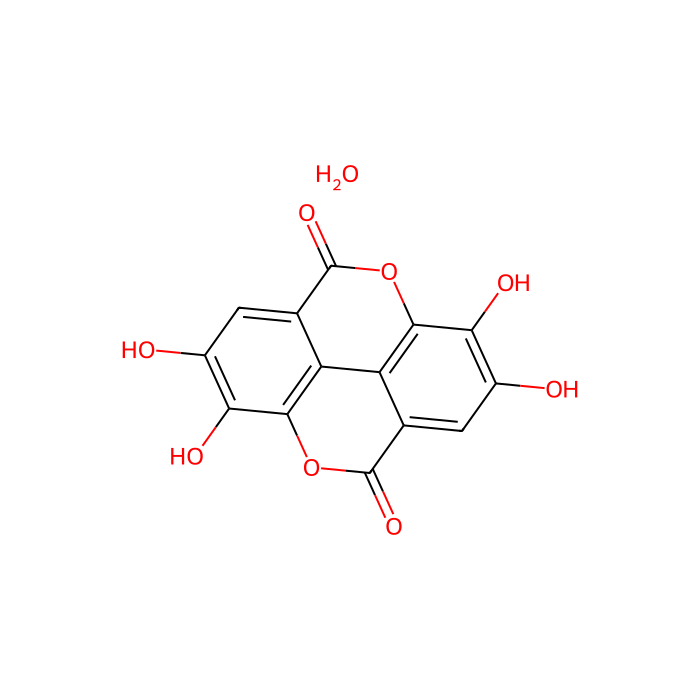
Ellagic Acid hydrate Ellagic acid is a potent inhibitor of protein kinase CK2 with IC50s of 0.04, 2.9 and 3.5 μM for CK2, Lyn and PKA respectively. It shows potent antioxidant, anti-mutagenic and antidepressant properties.
Targets
CK2 (Cell-free assay); Lyn (Cell-free assay); PKA (Cell-free assay) 0.04 μM; 2.9 μM; 3.5 μM
In vitro
Ellagic acid (EA) is able to inhibit the growth of several cancer cells. EA inhibited cell proliferation in a dose- and time-dependent manner by arresting both cell lines at the G1 phase of the cell cycle, which were from elevating p53 and Cip1/p21 and decreasing cyclin D1 and E levels. EA also induced caspase-3-mediated apoptosis by increasing the Bax\u2009:\u2009Bcl-2 ratio and restored anoikis in ES-2 and PA-1 cells. It is well known to have a free radical scavenging activity. EA reversed epithelial to mesenchymal transition by up-regulating E-cadherin and down-regulating Vimentin.
In vivo
A 90-day subchronic toxicity study further demonstrated that orally feeding EA (9.4, 19.1, 39.1\u2009g/kg b.w., resp.) could not induce mortality or treatment-related clinical signs throughout the experimental period on F344 rats, indicating the low toxicity of EA to mammalians. Furthermore, EA exhibits potent anticancer and anticarcinogenesis activities towards breast, colorectal, oral, prostate, pancreatic, bladder, neuroblastoma, melanoma, and lymphoma cells. Treatment of PANC-1 xenografted mice with EA resulted in significant inhibition in tumor growth and prolong mice survival rate.
Cell Research(from reference)
Cell lines:Ovarian carcinoma ES-2 and PA-1 cells
Concentrations:10~100\u2009μM
Incubation Time:12, 24, 48 h
| Canonical Smiles | C1=C2C3=C(C(=C1O)O)OC(=O)C4=CC(=C(C(=C43)OC2=O)O)O.O |
|---|---|
| IUPAC Name | 6,7,13,14-tetrahydroxy-2,9-dioxatetracyclo[6.6.2.04,16.011,15]hexadeca-1(15),4,6,8(16),11,13-hexaene-3,10-dione;hydrate |
| InChIKey | UOZZJRXBNGVIKO-UHFFFAOYSA-N |
| INCHI | 1S/C14H6O8.H2O/c15-5-1-3-7-8-4(14(20)22-11(7)9(5)17)2-6(16)10(18)12(8)21-13(3)19;/h1-2,15-18H;1H2 |
| Isomeric SMILES | C1=C2C3=C(C(=C1O)O)OC(=O)C4=CC(=C(C(=C43)OC2=O)O)O.O |
| Molecular Weight | 320.21 |
| Reaxy-Rn | 24929816 |
| Reaxys-RN_link_address | https://www.reaxys.com/reaxys/secured/hopinto.do?context=S&query=IDE.XRN=24929816&ln= |
Comprehensive hazard, handling, storage, and regulatory compliance document.
Download SDS →Lot-specific quality data. Enter your lot number to retrieve the exact COA.
Look up COA →Full quality attributes and acceptance criteria for this grade.
View spec sheet →Taxonomy Tree
| Kingdom | Organic compounds |
|---|---|
| Superclass | Phenylpropanoids and polyketides |
| Class | Tannins |
| Subclass | Hydrolyzable tannins |
| Intermediate Tree Nodes | Not available |
| Direct Parent | Hydrolyzable tannins |
| Alternative Parents | Ellagic acids and derivatives 7,8-dihydroxycoumarins Isocoumarins and derivatives 2-benzopyrans 1-benzopyrans Pyranones and derivatives 1-hydroxy-2-unsubstituted benzenoids Heteroaromatic compounds Lactones Polyols Oxacyclic compounds Organic oxides Hydrocarbon derivatives |
| Molecular Framework | Aromatic heteropolycyclic compounds |
| Substituents | Hydrolyzable tannin - Ellagic_acid - 7,8-dihydroxycoumarin - Isocoumarin - Coumarin - 2-benzopyran - 1-benzopyran - Benzopyran - 1-hydroxy-2-unsubstituted benzenoid - Pyranone - Benzenoid - Pyran - Heteroaromatic compound - Lactone - Oxacycle - Organoheterocyclic compound - Polyol - Organic oxygen compound - Organic oxide - Hydrocarbon derivative - Organooxygen compound - Aromatic heteropolycyclic compound |
| Description | This compound belongs to the class of organic compounds known as hydrolyzable tannins. These are tannins with a structure characterized by either of the following models. In model 1, the structure contains galloyl units (in some cases, shikimic acid units) that are linked to diverse polyol carbohydrate-, catechin-, or triterpenoid units. In model 2, contains at least two galloyl units C-C coupled to each other, and do not contain a glycosidically linked catechin unit. |
| External Descriptors | Not available |
| Molecular Weight | 320.210 g/mol |
|---|---|
| XLogP3 | |
| Hydrogen Bond Donor Count | 5 |
| Hydrogen Bond Acceptor Count | 9 |
| Rotatable Bond Count | 0 |
| Exact Mass | 320.017 Da |
| Monoisotopic Mass | 320.017 Da |
| Topological Polar Surface Area | 135.000 Ų |
| Heavy Atom Count | 23 |
| Formal Charge | 0 |
| Complexity | 475.000 |
| Isotope Atom Count | 0 |
| Defined Atom Stereocenter Count | 0 |
| Undefined Atom Stereocenter Count | 0 |
| Defined Bond Stereocenter Count | 0 |
| Undefined Bond Stereocenter Count | 0 |
| The total count of all stereochemical bonds | 0 |
| Covalently-Bonded Unit Count | 2 |