
Determine the necessary mass, volume, or concentration for preparing a solution.
| Activity Type | Activity Value -log(M) | Mechanism of Action | Activity Reference | Publications (PubMed IDs) |
|---|
Moligand™, 10mM in DMSO Moligand™ for sensitive chromatographic and analytical workflows requiring minimal baseline interference.
Store at -80°C Ships Dry ice packs + Cold packs Check lot-specific COA for exact specifications.
SDS, COA, datasheet, and spec sheet available for download. Lot-specific COA accessible via lot number lookup.
Cited in 12 peer-reviewed publications across chromatography, organic synthesis, and cross-coupling reactions.
Information
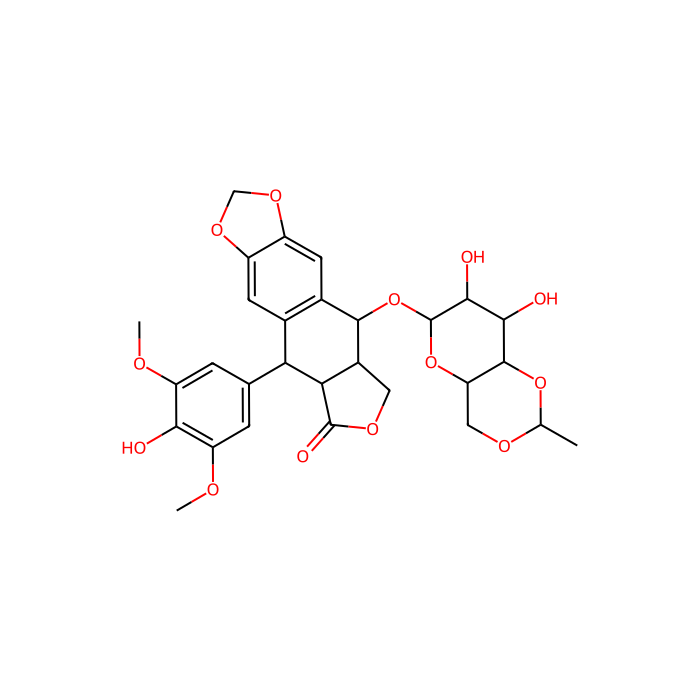
Etoposide (VP-16, VP-16213) is a semisynthetic derivative of podophyllotoxin, which inhibits DNA synthesis viatopoisomerase IIinhibition activity. Etoposide inducesautophagy,mitophagyandapoptosis.
In vitro
Etoposide inhibits DNA synthesis by forming a complex with topoisomerase II and DNA, which induces breaks in double stranded DNA and prevents repair by topoisomerase II binding. Accumulated breaks in DNA prevent entry into the mitotic phase of cell division, and lead to cell death. Etoposide acts primarily in the G2 and S phases of the cell cycle. Etoposide inhibits the growth of murine angiosarcoma cell line (ISOS-1) in a 5 days-period with IC50 of 0.25 μg/mL. Cell growth of normal murine microvascular endothelial cells (mECs) is less sensitive to Etoposide with IC50 of 10 μg/mL). Etoposide treated for 6 hr inhibits colonies of tetraploid variant of the human leukemic lymphoblast line CCRF-CEM with IC50 of 0.6 μM. Etoposide treated for 2 hr inhibits growth of human pancreatic cancer cell line Y1, Y3, Y5, Y19, YM. YS, and YT with IC50s of 300 μg/mL, 300 μg/mL, 300 μg/mL, 91 μg/mL, 0.68 μg/mL, 300 μg/mL, 300 μg/mL, and 260 μg/mL, respectively. Etoposide exposed for 1 hr inhibits growth of human glioma cell lines CL5, G142, G152, G111, and G5 with IC50 of 8, 9, 9.8, 10, and 15.8 μg/mL respectively for 12 days. Under same condition, the IC90 value is attained in cell lines CL5, G152, G142, and G111 at 26, 27, 32, and 33 μg/mL. Etoposide inhibition of topoisomerase II is homogeneous for each cell. The average inhibition rates are 15%, 21.8%, 31.8%, 41.5%, and 49.5% for 1, 2, 4, 8, and 16 μg Etoposide, respectively.
In vivo
Etoposide administrated as a single agent is found to been ineffective in many xenografts growth, such as Heterotransplanted Hepatoblastoma NMHB1, and NMHB 2, human neuroblastoma xenograft, and human gastrointestinal cancer xenograft, while the dose of 10 mg/kg i.p. Etoposide inhibits murine angiosarcoma cell ISOS-1 tumors in 36% of controls. Etoposide induces tumor immunity in Lewis lung cancer. A single administration of 50 mg/kg Etoposide i.p., induces a 60% survival of C57B1/6 mice injected with Lewis lung cancer cell (3LL) over 60 days. About 40% of these surviving mice reject a subsequent challenge with 3LL, while none of control mice survive beyond 30 days. 3LL cells which have survived an 90% lethal concentration of Etoposide in vitro kill 75% of recipient mice, but 60% surviving mice reject challenge with 3LL. Splenocytes harvested from tumor rejecting mice protect naive mice injected with 3LL.
Cell Data
cell lines:
Concentrations:80 μg/mL
Incubation Time:1 hour
Powder Purity:≥99%
| ALogP | 0.6 |
|---|
| Isomeric SMILES | C[C@@H]1OC[C@@H]2[C@@H](O1)[C@@H]([C@H]([C@@H](O2)O[C@H]3[C@H]4COC(=O)[C@@H]4[C@@H](C5=CC6=C(C=C35)OCO6)C7=CC(=C(C(=C7)OC)O)OC)O)O |
|---|---|
| WGK Germany | 3 |
| RTECS | KC0190000 |
| Alternate CAS | 33419-42-0 |
| Molecular Weight | 588.56 |
| Reaxy-Rn | 365969 |
Comprehensive hazard, handling, storage, and regulatory compliance document.
Download SDS →Lot-specific quality data. Enter your lot number to retrieve the exact COA.
Look up COA →Full quality attributes and acceptance criteria for this grade.
View spec sheet →| Activity Type | Activity Value -log(M) | Mechanism of Action | Activity Reference | Publications (PubMed IDs) |
|---|
| Activity Type | Activity Value -log(M) | Mechanism of Action | Activity Reference | Publications (PubMed IDs) |
|---|
| Activity Type | Activity Value -log(M) | Mechanism of Action | Activity Reference | Publications (PubMed IDs) |
|---|
| Solubility | Solubility (25°C) In vitro Ethanol: 15 mg/mL (64.91 mM); DMSO: 12 mg/mL (51.93 mM); Water: Insoluble; |
|---|---|
| Specific Rotation[α] | -110.5° (C=0.6,CHCl3) |
| Melt Point(°C) | 251°C |
| 1. Zhuangzhuang Li, Baoyan Ding, Mustafa R. K. Ali, Lizhen Zhao, Xiaoling Zang, Zhihua Lv. (2022) Dual Effect of Tryptamine on Prostate Cancer Cell Growth Regulation: A Pilot Study. INTERNATIONAL JOURNAL OF MOLECULAR SCIENCES, 23 (19): (11087). [PMID:36232383] [10.3390/ijms231911087] |
| 2. Ma Xiaojing, Wang Tong, Yu Zequan, Shao Junqian, Chu Jun, Zhu Huixia, Yao Risheng. (2022) Formulation and Physicochemical and Biological Characterization of Etoposide-Loaded Submicron Emulsions with Biosurfactant of Sophorolipids. AAPS PHARMSCITECH, 23 (6): (1-13). [PMID:35773548] [10.1208/s12249-022-02329-2] |
| 3. Wang Xiao, Xu Na, Li Qinglin, Chen Shengqi, Cheng Hui, Yang Mo, Jiang Ting, Chu Jun, Ma Xiaojing, Yin Dengke. (2021) Lactonic sophorolipid–induced apoptosis in human HepG2 cells through the Caspase-3 pathway. APPLIED MICROBIOLOGY AND BIOTECHNOLOGY, 105 (5): (2033-2042). [PMID:33582833] [10.1007/s00253-020-11045-5] |
| 4. Meifang Cai, Caiping Ding, Xuanyu Cao, Fangfang Wang, Cuiling Zhang, Yuezhong Xian. (2019) Label-free fluorometric assay for cytochrome c in apoptotic cells based on near infrared Ag2S quantum dots. ANALYTICA CHIMICA ACTA, [PMID:30797456] [10.1016/j.aca.2019.01.005] |
| 5. Jingwei Wang, Zhiheng Guo, Jianxin Xiong, Datong Wu, Shan Li, Yongxin Tao, Yong Qin, Yong Kong. (2018) Facile synthesis of chitosan-grafted beta-cyclodextrin for stimuli-responsive drug delivery. INTERNATIONAL JOURNAL OF BIOLOGICAL MACROMOLECULES, [PMID:30572042] [10.1016/j.ijbiomac.2018.12.150] |
| 6. Xiaolin Liu, Yongxin Tao, Huihui Mao, Yong Kong, Jian Shen, Linhong Deng, Linsong Yang. (2017) Construction of magnetic-targeted and NIR irradiation-controlled drug delivery platform with Fe3O4@Au@SiO2 nanospheres. CERAMICS INTERNATIONAL, [PMID:] [10.1016/j.ceramint.2017.01.017] |
| 7. Junling Wang, Ran Wang, Fangrong Zhang, Yajun Yin, Leixia Mei, Fengjuan Song, Mingtao Tao, Wanqing Yue, Wenying Zhong. (2016) Overcoming multidrug resistance by a combination of chemotherapy and photothermal therapy mediated by carbon nanohorns. Journal of Materials Chemistry B, 4 (36): (6043-6051). [PMID:32263493] [10.1039/C6TB01469K] |
| 8. Lian Chen, Hengmin Cui, Jing Fang, Huidan Deng, Ping Kuang, Hongrui Guo, Xun Wang, Ling Zhao. (2016) Glutamine deprivation plus BPTES alters etoposide- and cisplatin-induced apoptosis in triple negative breast cancer cells. Oncotarget, [PMID:27419628] [10.18632/oncotarget.10579] |
| 9. Xiaolan Zhou, Xiaofeng Zhu, Weixu Wang, Jing Wang, Haimei Wen, Yuqi Zhao, Jiayu Zhang, Qiushi Xu, Zhaozhao Zhao, Ting Ni. (2025) Comprehensive Cellular Senescence Evaluation to Aid Targeted Therapies. Research, [PMID:39822281] [10.34133/research.0576] |
| 10. Yadong Tang, Boxin Huang, Yuqin Dong, Wenlong Wang, Xi Zheng, Wei Zhou, Kun Zhang, Zhiyun Du. (2017) Three-dimensional prostate tumor model based on a hyaluronic acid-alginate hydrogel for evaluation of anti-cancer drug efficacy. JOURNAL OF BIOMATERIALS SCIENCE-POLYMER EDITION, [PMID:28583017] [10.1080/09205063.2017.1338502] |
| 11. Tian Liu, Fengli Xia, Yi Zheng, Hongying Xiao, Yuanhao Yu, Jianbin Shi, Shuo Wang, Xianbao Shi, Zhonggui He, Jin Sun, Bingjun Sun. (2025) Steric Hindrance-Engineered Redox-Responsive Disulfide-Bridged Homodimeric Prodrug Nanoassemblies for Spatiotemporally Balanced Cancer Chemotherapy. JOURNAL OF MEDICINAL CHEMISTRY, [PMID:40402193] [10.1021/acs.jmedchem.5c00810] |
| 12. Sai-Nan Qin, Yi-Xue Zhang, Yi-Jie Cao, Ting Wan, Yi-Yang Zhou, Shan-Shan Su, Yu-Qiong Guo, Jian-Jun Sun, Kalle Salminen. (2026) A self-assembled electrochemical aptasensor for one-step rapid detection of cisplatin in blood via aptamer conformational change. MICROCHEMICAL JOURNAL, [PMID:] [10.1016/j.microc.2026.116962] |
Our grade selection guide covers purity, stabilizer status, and application suitability for all variants in our catalog.
View Moligand™ grade guide →