
Differences Between Cast CPU and Thermoplastic TPU in Structure, Processing, Performance, and Applications
Differences Between Cast CPU and Thermoplastic TPU in Structure, Processing, Performance, and Applications
Introduction
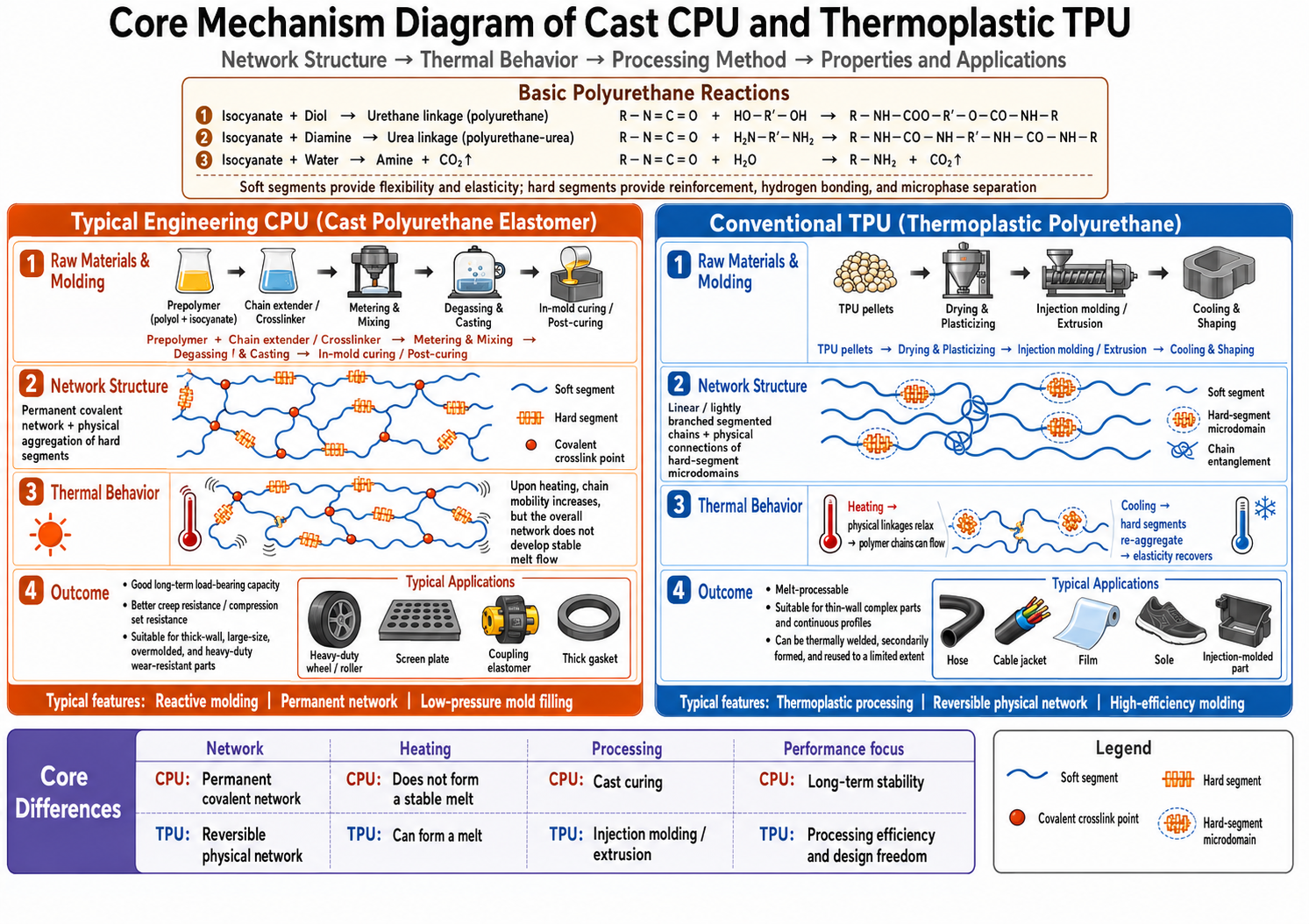
Cast polyurethane elastomers (Cast Polyurethane Elastomer, CPU) and thermoplastic polyurethane (Thermoplastic Polyurethane, TPU) are both polyurethane elastomers. Both can achieve elasticity, strength, abrasion resistance, and tear resistance through soft segments, hard segments, hydrogen bonding, and microphase separation. However, they differ significantly in thermal behavior, processing methods, long-term load-bearing capability, and the types of products for which they are suited.
These differences mainly arise from the way the molecular chains are connected:
① Thermosetting CPUs commonly used in engineering form permanent covalent networks during casting and curing, while also containing physically aggregated hard-segment structures;
② Conventional TPUs are mainly composed of linear or lightly branched segmented polymer chains and rely primarily on hard-segment microdomains and molecular-chain entanglements to form reversible physical networks.
Permanent covalent networks continuously restrict large-scale molecular-chain migration, giving CPU advantages in long-term load bearing, creep resistance, and thick-walled reactive molding. Reversible physical networks can relax upon heating, enabling TPU to undergo melt flow, continuous extrusion, and rapid injection molding.
1 Structural Basis of CPU and TPU Materials
1.1 Scope of Materials Discussed in This Article
CPU is first and foremost a processing-category designation, indicating that the material is cast into a mold as a liquid reactive system and cured within the mold. In this article, CPU mainly refers to cast polyurethane or polyurethane–urea elastomers commonly used in engineering that are not reprocessed by conventional melt-processing methods after curing. These materials generally have a certain degree of branching or chemical crosslinking. Among them, typical thermosetting systems form permanent covalent networks and are further reinforced by physical aggregation of hard segments and hydrogen bonding.
TPU is a thermoplastic elastomer generally composed of approximately linear or lightly branched segmented polymer chains. Soft and hard segments are covalently connected within the same main chain, while different macromolecular chains are constrained primarily by hard-segment aggregation regions and chain entanglements. Hard-segment aggregation regions act as physical crosslinking points at service temperatures and can gradually relax at processing temperatures.
1.2 Soft-Segment–Hard-Segment Structures Shared by Both Materials
CPU and TPU are generally composed of both soft and hard segments.
Soft segments mainly originate from relatively high-molecular-weight polyether polyols, polyester polyols, polycarbonate polyols, or other flexible oligomers. At service temperatures, soft segments have relatively high segmental mobility and mainly affect:
① Flexibility and elongation;
② Low-temperature performance;
③ Resilience and damping;
④ Resistance to hydrolysis, oils, and other media;
⑤ Dynamic heat buildup and fatigue performance.
Hard segments are mainly formed through reactions between isocyanates and low-molecular-weight chain extenders. Hard segments contain relatively large amounts of urethane or urea groups and have high polarity and cohesive energy. They can form hard-phase microdomains through hydrogen bonding, ordered arrangement, pseudo-crystallization, or local crystallization.
Hard segments mainly perform the following functions:
① Increasing modulus, strength, and hardness;
② Restricting extensive sliding of soft-segment chains;
③ Transferring stress between different molecular chains;
④ Dissipating energy during deformation and influencing crack propagation.
Differences between soft and hard segments in polarity, rigidity, and cohesive energy generally result in varying degrees of microphase separation. The content, size, continuity, and degree of ordering of the hard phase affect elastic recovery, energy dissipation, and large-deformation behavior.[4,6–8]
2 Main Chemical Reactions of Polyurethanes
2.1 Formation of Urethane Bonds
An isocyanate group undergoes an addition reaction with a hydroxyl group to form a urethane bond:
R–N=C=O + HO–R′ → R–NH–C(=O)–O–R′
Where:
① R–N=C=O represents the isocyanate component;
② HO–R′ represents a polyol or an alcohol-based chain extender;
③ R–NH–C(=O)–O–R′ represents the resulting urethane structure.
This reaction is a polyaddition reaction and does not normally eliminate small-molecule by-products during the reaction process.[1–5]
2.2 Formation of Urea Bonds
An isocyanate group reacts with an amino group to form a urea bond:
R–N=C=O + H₂N–R′ → R–NH–C(=O)–NH–R′
When a diamine chain extender is used, polyurea hard segments are formed in the material, and the resulting material is generally classified more strictly as a polyurethane–urea elastomer.
Urea groups generally have strong hydrogen-bonding capability and readily form hard-segment structures with high cohesive strength, significantly affecting modulus, tear strength, resistance to heat-induced deformation, and dynamic performance.[1–4]
2.3 Reaction Between Isocyanates and Water
When an isocyanate group reacts with water, an unstable carbamic acid is initially formed and subsequently decomposes into an amine and carbon dioxide:
R–N=C=O + H₂O → R–NH–COOH → R–NH₂ + CO₂↑
The resulting amine further reacts with an isocyanate to form a urea bond:
R–N=C=O + H₂N–R′ → R–NH–C(=O)–NH–R′
In solid CPU products, moisture consumes isocyanate and generates carbon dioxide, potentially causing bubbles, voids, local stoichiometric deviations, and network nonuniformity. Raw-material dehydration, sealed storage, and degassing before casting are therefore important aspects of CPU process control.
TPU pellets must also be thoroughly dried before melt processing. At elevated processing temperatures, residual moisture may cause hydrolysis of the polymer chains, reducing molecular weight and mechanical properties.[2,3,5]
3 Mechanism of Permanent Network Formation in CPU
3.1 Functionality Controls the Mode of Molecular-Chain Growth
Functionality refers to the number of effective functional groups in a molecule that can participate in a reaction.
When a system is composed mainly of difunctional isocyanates, difunctional polyols, and difunctional chain extenders and is close to the ideal stoichiometric ratio, the reaction tends to generate linear or lightly branched polymers.
When the system contains components with an effective functionality greater than 2, one molecule can simultaneously connect three or more molecular chains. As the extent of reaction increases, branched molecules connect with one another and gradually form a permanent covalent network extending throughout the product.
Permanent branching or crosslinked structures in CPU may originate from the following pathways:
① Multifunctional hydroxyl- or amino-containing components
Triols, polyols, and multifunctional amines can directly form branching or crosslinking points.
② Multifunctional isocyanate components
Isocyanates with an average functionality greater than 2 can simultaneously connect multiple molecular chains containing hydroxyl or amino groups.
③ Prepolymers with an average functionality greater than 2
The actual structures of industrial prepolymers are affected by the functionality distribution of the raw materials, stoichiometric ratios, and minor branching side reactions. Their average effective functionality may therefore deviate from the ideal difunctional structure.
④ Further reactions involving isocyanates
When isocyanate is present in excess, the temperature is relatively high, or specific catalysts are present, isocyanates may react further with urethane or urea groups to form allophanate or biuret structures.
⑤ Isocyanate trimerization
Under suitable catalytic conditions, isocyanate groups can form isocyanurate rings, increasing the degree of branching and resistance to heat-induced deformation.
Whether the reactions described in items ④ and ⑤ contribute significantly to network formation depends on the raw-material composition, isocyanate index, catalyst, and curing temperature. They should not be regarded as the principal sources of crosslinking in all CPU systems.[1–5]
3.2 Gelation and Post-Curing
During the early stage of the reaction, the system remains flowable. As molecular weight and the degree of branching increase, the material reaches the gel point and forms an infinite network extending throughout the system.
After gelation, the material gradually loses stable macroscopic viscous-flow capability, but unreacted functional groups can continue to undergo chain extension and crosslinking. Subsequent thermal curing and post-curing mainly perform the following functions:
① Increasing the degree of completion of functional-group reactions;
② Improving the effective load-bearing network;
③ Promoting hard-segment rearrangement and stabilization of hydrogen-bonded structures;
④ Reducing dimensional and property changes during the initial period of product use.
The actual network may also contain dangling chains, closed loops, locally highly crosslinked regions, unreacted components, and soluble fractions. Nominal functionality or theoretical crosslink density cannot fully represent the actual density of the effective load-bearing network.
3.3 Permanent Network Structure of CPU
A typical thermosetting CPU can be represented schematically as follows:
Soft segment—Hard segment—●—Soft segment—Hard segment
▐
Soft segment—Hard segment—●—Soft segment—Hard segment
▐
Soft segment—Hard segment—●—Soft segment—Hard segment
Where:
• ● represents a permanent covalent junction between different macromolecular chains;
• Physical interactions formed through hydrogen bonding, ordered aggregation, or local crystallization also exist between hard segments;
• Soft segments are located between network junctions and are responsible for large deformation and elastic recovery.
The dimensional stability of CPU results from the combined effects of the covalent network, hard-segment microdomains, and chain entanglements. Some cast systems with relatively low degrees of chemical crosslinking may also be unsuitable for conventional melt processing because of strong hard-segment cohesion, high molecular weight, and the close proximity of their melting and decomposition temperature ranges.
4 Mechanism of Physical Network Formation in TPU
4.1 Linear Segmented Chains Provide the Basis for Thermoplastic Processing
Conventional TPU is mainly synthesized from difunctional raw materials, and its molecular structure consists primarily of linear or lightly branched segmented polymer chains.
Soft and hard segments are covalently connected within the same main chain. Different macromolecular chains generally do not form a dominant permanent covalent network; instead, they are constrained by hard-segment microdomains and molecular-chain entanglements.
4.2 Hard-Segment Microdomains Form Reversible Physical Junctions
Hard-segment aggregation regions may simultaneously contain hard segments from multiple molecular chains. Through hydrogen bonding, dipole interactions, ordered arrangement, and local crystallization, the hard segments form microdomains with relatively strong cohesive interactions.
Hard-segment microdomains perform the following functions:
① Restricting molecular-chain sliding at service temperatures;
② Transferring loads when the material is subjected to stress;
③ Assisting soft segments in returning to their coiled conformations after unloading;
④ Dissipating energy through orientation and structural reorganization during large deformation.
Molecular-chain entanglements provide additional topological constraints. Together, hard-segment microdomains and chain entanglements cause TPU to behave as an elastic solid at service temperatures.
4.3 Network Changes During Heating and Cooling
As temperature increases, hydrogen bonds and ordered structures between hard segments gradually relax, reducing the ability of hard-segment microdomains to constrain the molecular chains.
Under suitable processing temperatures and shear conditions, different molecular chains can move relative to one another, allowing TPU to form a processable viscoelastic melt. After cooling, the hard segments reaggregate and restore their physical junction function, enabling the material to recover its modulus, strength, and elasticity.
The physical network of conventional TPU can be represented schematically as follows:
Soft segment—Hard segment╲
[Hard-segment microdomain]—Soft segment—Hard segment
Soft segment—Hard segment╱
[Hard-segment microdomain] represents a physical junction region jointly formed by hard segments from multiple molecular chains. These regions constrain molecular-chain movement at service temperatures and gradually relax at processing temperatures.
Some TPUs undergo hard-segment orientation, fragmentation, and reorganization under large deformation or cyclic loading. These changes may affect stiffness, hysteresis loss, and crack-propagation behavior in subsequent cycles.[7–10] Some studies have proposed that fragmentation of hard-segment microdomains may produce a larger number of smaller structural units that act as new physical junctions and contribute to strain-induced strengthening. This mechanism is currently based mainly on observations in certain soft TPU systems and should not be regarded as a universal behavior of all TPUs.[9]
5 Fundamental Structural Differences Between CPU and TPU
Comparison Item | Typical Thermosetting CPU | Conventional TPU |
Basic macromolecular form | Permanent covalent networks play an important role, and the system may contain varying degrees of branching | Primarily linear or lightly branched segmented chains |
Main interchain connections | Permanent covalent junctions, physical hard-segment interactions, and chain entanglements | Mainly hard-segment microdomains and chain entanglements |
Network stabilization mechanism | The covalent network fixes the overall topology | Physical aggregation of hard segments provides reversible constraints |
Changes upon heating | Segmental mobility increases, but the covalent network continues to restrict long-range migration | Hard-segment constraints gradually relax, allowing molecular chains to move relative to one another |
Changes upon cooling | Hard segments rearrange, and residual reactions may continue | Hard segments reaggregate and the physical network is restored |
Conventional melt reprocessing | After curing, it is generally not reprocessed by conventional melt-processing methods | It can be remelted and reshaped within a suitable processing window |
Structural stability under long-term loading | Covalent junctions help restrict continuous chain slippage | Physical junctions are relatively sensitive to time, temperature, and stress |
The fundamental difference between CPU and TPU lies in the topology of their molecular networks and the thermal reversibility of those networks.
Permanent covalent junctions in CPU make it difficult for entire molecular chains to leave their original positions within the network. Heating can increase segmental mobility and reduce material modulus, but the material generally does not form a stable melt suitable for reinjection molding or extrusion without breaking chemical bonds within the network.
Interchain constraints in TPU arise mainly from physical aggregation of hard segments and chain entanglements. Upon heating, these physical constraints weaken, allowing long-chain molecules to move relative to one another and causing the material to transition from an elastic solid to a processable melt.
6 How Network Structure Determines Processing Methods
6.1 CPU Uses Reactive Casting
After curing, CPU generally cannot recover stable flowability through conventional melt-processing methods. The mold must therefore be filled before substantial gelation occurs.
A typical processing sequence is:
Raw-material preheating and dehydration → Metering → Mixing → Degassing → Casting and mold filling → Gelation and curing → Demolding → Post-curing
CPU enters the mold as a reactive liquid. The processes occurring in the mold involve not only cooling and shape setting, but also molecular-weight growth, chain extension, branching, crosslinking, and the evolution of hard-segment structures.
The main process-control factors include:
① The stoichiometric relationship between NCO groups and active-hydrogen groups;
② Raw-material moisture content;
③ Temperatures of the prepolymer, chain extender, and mold;
④ Mixing uniformity and degassing effectiveness;
⑤ Pot life, gel time, and demolding time;
⑥ Post-curing temperature and duration.
The initial viscosity of liquid CPU materials is generally lower than that of thermoplastic polymer melts, and the required molding pressure is relatively low. CPU is therefore suited to large, thick-walled products, complex cavities, and products involving the encapsulation of metal frameworks.[1–3]
6.2 TPU Uses Melt Processing
The primary polymerization reaction of TPU has already been completed during resin manufacture. During product processing, the material is reshaped mainly by utilizing the thermal reversibility of its physical network.
A typical processing sequence is:
Pellet drying → Heating and plasticization → Melt conveying → Injection molding or extrusion → Holding pressure or shape setting → Cooling → Reconstruction of the physical hard-segment structure
The main process-control factors include:
① Residual moisture in the pellets;
② Barrel, die, and mold temperatures;
③ Screw shear and back pressure;
④ Residence time of the melt in the equipment;
⑤ Cooling rate and product thickness;
⑥ Regrind content and cumulative thermal history.
TPU can be processed by injection molding, extrusion, blow molding, calendering, thermoforming, melt spinning, and fused-deposition modeling. Repeated heating may cause hydrolysis, thermo-oxidation, molecular-chain scission, and changes in hard-segment morphology. The permissible number of reprocessing cycles and the proportion of recycled material must therefore be determined according to the specific grade and performance requirements.
6.3 Comparison of Processing Methods
Processing Item | CPU | TPU |
State upon entering the molding equipment | Reactive liquid or oligomeric system | Fully polymerized pellets or melt |
Main changes during molding | Chain extension, branching, crosslinking, gelation, and curing | Physical-network relaxation, melt flow, and reconstruction during cooling |
Shape-fixing mechanism | Gradual formation of a permanent network | Restoration of the physical network after cooling |
Common processes | Atmospheric-pressure casting, vacuum casting, centrifugal casting, and machine casting | Injection molding, extrusion, blow molding, calendering, and thermoforming |
Production cycle | Affected by gelation, curing, and post-curing time | Mainly determined by plasticization, mold filling, and cooling time |
Large, thick-walled products | Low-pressure liquid mold filling offers advantages | Cooling time, sink marks, and equipment capacity have greater influence |
Thin-walled, complex products | Affected by reaction time and liquid-metering processes | Suitable for high-speed injection molding and complex thin-walled molding |
Continuous profiles | Unsuitable for conventional continuous thermoplastic melt processing | Suitable for extrusion of hoses, films, cables, and profiles |
7 How Network Structure Determines Performance Priorities
7.1 Elastic Recovery
The elastic recovery of both CPU and TPU is based on changes in the conformational entropy of their soft segments.
When the material is subjected to stress, the coiled soft segments gradually extend and orient. After unloading, the molecular chains tend to return to coiled states with a greater number of possible conformations.
The two materials differ in their modes of constraint:
① Covalent crosslinking points in CPU fix the network topology and continuously restrict overall molecular-chain displacement;
② Hard-segment microdomains and chain entanglements in TPU provide reversible constraints that restrict chain slippage over short periods.
Physical junctions in TPU may relax or reorganize during deformation, which can dissipate energy but may also produce residual deformation. The permanent network in CPU provides relatively stable recovery constraints, although excessive crosslinking may reduce segmental extensibility and crack resistance.
7.2 Creep and Compression Set
Creep is the continued deformation of a material over time under constant stress. Its microscopic causes include soft-segment relaxation, hard-segment structural rearrangement, chain-entanglement relaxation, and molecular-chain slippage.
The permanent covalent network in CPU continuously restricts large-scale molecular-chain migration. Even when hydrogen bonds and soft segments undergo relaxation, the network topology still suppresses long-term flow. Therefore, when hardness, basic chemical composition, service temperature, and loading level are similar, moderately chemically crosslinked CPU is generally more effective in reducing long-term creep and maintaining product dimensions.
The physical junctions in TPU are relatively sensitive to temperature and loading duration. As loading time increases or temperature rises, hard-segment microdomains and chain entanglements may gradually relax, and time-dependent deformation generally becomes more pronounced.
Compression set has a similar mechanism. The permanent network in CPU retains the original connectivity and facilitates dimensional recovery after unloading. During compression, TPU may undergo hard-segment rearrangement and chain slippage. When the temperature approaches the range in which the hard segments soften significantly, compression recovery can readily decline.
7.3 Shape Retention at Elevated Temperatures
High-temperature performance includes two distinct aspects:
① The ability to retain shape under load;
② Chemical stability during long-term exposure to elevated temperatures.
The permanent network in CPU helps restrict macroscopic flow and creep at elevated temperatures and therefore generally provides advantages in high-temperature load bearing and dimensional retention.
As TPU is heated, its physical hard-segment junctions gradually relax, its modulus decreases, and its creep rate increases. Once the temperature enters the processing range, the material can form a melt.
The long-term thermal-aging life of a material is also affected by the polyol, isocyanate, chain extender, antioxidant system, and environmental media. Permanent crosslinking improves shape retention at elevated temperatures but does not directly imply a higher thermal-decomposition temperature or a longer thermo-oxidative aging life.
7.4 Toughness, Tear Resistance, and Abrasion Resistance
Hard-segment microdomains in TPU can undergo orientation and limited reorganization during large deformation. These structural changes can dissipate energy and may reduce local stress concentration at crack tips, giving some TPUs favorable toughness, tear resistance, and resistance to fatigue-crack propagation.[7–10]
The covalent network in CPU restricts long-term chain slippage and transfers loads together with the hard-segment structure. Under conditions involving thick-walled products, high contact pressure, particle impact, and sustained loading, CPU generally provides favorable combined abrasion resistance and dimensional stability.
Abrasion resistance cannot be determined solely according to whether a material is CPU or TPU. Sliding wear, rolling fatigue, cutting wear, and particle erosion involve different failure mechanisms and are also affected by hardness, resilience, tear strength, frictional heat buildup, contact pressure, and surface condition.
7.5 Dynamic Heat Buildup and Fatigue
Both CPU and TPU undergo viscoelastic energy loss during cyclic deformation. Internal friction within the soft segments, changes in hard-segment microdomains, and movement at phase interfaces convert part of the mechanical energy into heat.
The physical network of TPU has a relatively strong capacity for structural adjustment, which facilitates impact-energy absorption and crack blunting. However, TPU may also exhibit substantial heat buildup under high-frequency, large-strain conditions. As temperature rises, the physical junctions relax further, potentially accelerating fatigue and creep.
The permanent network in CPU can reduce large-scale chain slippage, but viscoelastic losses in the soft segments, hard-segment rearrangement, and network nonuniformity can still cause dynamic heat buildup.
Dynamic components should be selected by considering operating frequency, strain amplitude, heat-dissipation conditions, dynamic modulus, and fatigue-crack-propagation performance. Selection should not be based solely on comparisons of static hardness or tensile strength.
8 Manufacturing Methods and Application Selection
8.1 Comparison of Manufacturing Models
CPU is commonly used for customized products, whereas TPU is commonly used for large-scale production. This difference arises from the way material design and product manufacturing are organized.
Manufacturing Factor | CPU | TPU |
Position of material design | Formulation design is closely integrated with product molding | Resin manufacturing and product processing are relatively separate |
Adjustable parameters | Prepolymer, chain extender, crosslinker, isocyanate index, catalyst, and curing schedule | Mainly adjusted through resin grade, processing temperature, cooling conditions, and regrind ratio |
Chemical reactions at the product-manufacturing stage | Chain extension and crosslinking continue during molding | Normal processing is dominated by changes in physical state |
Equipment characteristics | Metering, mixing, degassing, and low-pressure casting equipment | Thermoplastic-processing equipment such as injection-molding machines, extruders, and calenders |
Mold and product size | Suitable for large, thick-walled products and large metal inserts | Suitable for thin-walled, complex products requiring high dimensional repeatability |
Production cycle | Includes gelation, curing, and possible post-curing | Mainly consists of plasticization, mold filling, and cooling cycles |
Formulation-customization capability | The network and hard-segment structure can be adjusted for specific service conditions | Usually selected from standardized or customized resin grades |
Batch characteristics | Suitable for small- and medium-volume production and large products; output can also be increased through automated equipment | Suitable for high-throughput and continuous production and can also be used for small-batch processing |
Unit-cost characteristics | Favorable for product size, low mold pressure, and formulation customization | The advantages of automation and short production cycles become more pronounced as production volume increases |
8.2 Comparison of Application Conditions
Application Condition | CPU Is More Suitable for Priority Evaluation | TPU Is More Suitable for Priority Evaluation |
Main loading conditions | Long-term static loading, sustained compression, high contact stress, and thick-walled dynamic loading | Repeated bending, impact, and products under low-to-moderate static loads that require thermoplastic processing |
Dimensional stability | Applications requiring strong control of long-term creep and compression deformation | Applications in which the service temperature and load remain below the range where the physical network undergoes significant relaxation |
Product size | Large, thick-walled, and heavy-duty products | Small, thin-walled, precision, or complex structures |
Metal encapsulation | Large metal frameworks, thick-layer encapsulation, and low-pressure mold filling | Small inserts, thin-layer encapsulation, and high-volume insert injection molding |
Molding method | Liquid casting can simplify mold filling and mold design | Injection molding, extrusion, blow molding, or thermoforming provides higher efficiency |
Continuous production | Conventional continuous melt processing is generally not used | Suitable for films, hoses, cables, and long profiles |
Thermal welding and secondary molding | Not suitable for conventional melt welding after curing | Can be thermally welded, heat-laminated, and overmolded |
Formulation requirements | Crosslinking and hard-segment structures need to be adjusted for specific service conditions | Required properties can be obtained from standard resin grades |
Reprocessing requirements | Remelting and reshaping are not required | Edge trim recycling or a certain degree of melt reprocessing is required |
8.3 Comparison of Typical Applications
Application Type | CPU Application Characteristics | TPU Application Characteristics |
Heavy-duty wheels and industrial rollers | Permanent networks support long-term load bearing and dimensional retention, while liquid casting facilitates thick-layer encapsulation | Can be used for small, thin-layer, and high-volume rollers, but creep and heat buildup require particular evaluation |
Mining screens, scrapers, and liners | Suitable for service conditions involving thick walls, particle impact, and sustained loading | Can be used for thinner wear-resistant components requiring toughness and flexible processing |
Buffer blocks and coupling elastomers | Formulations can be adjusted according to resilience, damping, and load-bearing requirements | Suitable for standardized, miniaturized, and high-throughput molding |
Seals and pressure-bearing components | Suitable for thick-walled products requiring long-term compression resistance and dimensional retention | Suitable for complex thin-walled seals and batch injection molding, but compression set at the service temperature must be verified |
Hoses, films, and cables | Reactive casting is unsuitable for conventional continuous melt extrusion | Can be continuously extruded and is suitable for long, thin-walled, and thermally weldable products |
Footwear materials and consumer products | Can be used for specially cast soles and small-batch customized products | Suitable for high-volume injection molding, extrusion, and complex appearance design |
Electronic protective components and automotive flexible parts | Suitable for thick-layer potting or specialized cushioning structures | Suitable for thin-walled complex structures, multicolor processing, and automated production |
Additive manufacturing | Can be used in reactive casting or specialized printing systems | Suitable for thermoplastic-processing methods such as fused deposition modeling and powder sintering |
9 Chemicals Related to the Preparation and Performance Study of Cast CPU and Thermoplastic TPU
Table 1. Products Related to Isocyanates and Hard-Segment Structure Studies
Classification | CAS No. | Aladdin Catalog No. | Name | Specification or Purity | Product Features and Applications |
Aliphatic diisocyanate | 822-06-0 | Hexamethylene diisocyanate (HDI) | Moligand™, ≥99% | Used to construct aliphatic polyurethane hard segments and to study light-aging resistance, color stability, and structure–property relationships in CPU and TPU. | |
Asymmetric cycloaliphatic diisocyanate | 4098-71-9 | Isophorone diisocyanate (mixture of isomers) (IPDI) | ≥99% | Used to construct cycloaliphatic hard segments and to study differences in isocyanate-group reactivity, microphase separation, and weather-resistant polyurethanes. | |
Cycloaliphatic diisocyanate | 5124-30-1 | 4,4′-Dicyclohexylmethane diisocyanate (mixture of isomers) (HMDI) | ≥90% (GC) | Used in the synthesis of light-resistant CPU and TPU and in studies of cycloaliphatic hard-segment morphology, transparency, elastic recovery, and thermal aging. | |
Aromatic diisocyanate | 101-68-8 | 4,4′-Methylenebis(phenyl isocyanate) (MDI) | ≥98% | Used in CPU prepolymer and TPU segmented-chain synthesis to study hard-segment content, hydrogen bonding, microphase separation, modulus, and melt-processing behavior. | |
Aromatic diisocyanate mixture | 26471-62-5 | Toluene diisocyanate (2,4- and 2,6-isomers) (TDI) | ≥98% (GC) | Used in the preparation of TDI-based CPU prepolymers and to study the effects of isomer composition on reaction rate, pot life, curing, and elastomer properties. | |
Aromatic diisocyanate isomer | 91-08-7 | Toluene 2,6-diisocyanate | ≥98% | Used as a reference for studies of TDI-isomer reactivity, steric effects, prepolymer structure, and CPU casting and curing kinetics. | |
Fused-ring aromatic diisocyanate | 3173-72-6 | Naphthalene-1,5-diisocyanate | ≥98% (GC) | Used in the synthesis of CPU with highly cohesive hard segments and in studies of dynamic load bearing, compression deformation, abrasion resistance, heat buildup, and heat-deformation performance. | |
Biphenyl-type aromatic diisocyanate | 91-97-4 | 4,4′-Diisocyanato-3,3′-dimethylbiphenyl (TODI) | ≥98% | Used to construct rigid aromatic hard segments and to study CPU resistance to heat-induced deformation, dynamic fatigue, long-term load bearing, and hard-segment aggregation. | |
Symmetrical aromatic diisocyanate | 104-49-4 | p-Phenylene diisocyanate (PPDI) | ≥98% | Used to prepare polyurethanes with regular hard segments and pronounced phase separation and to study hard-segment ordering, crystallization, modulus, resilience, and high-temperature dimensional retention. |
Table 2. Products Related to Soft-Segment Polyols and Polyester Precursors
Classification | CAS No. | Aladdin Catalog No. | Name | Specification or Purity | Product Features and Applications |
Hydrophilic polyether reference material | 25322-68-3 | Polyethylene oxide | Viscosity: 65–115 cps | Used to study polyether-segment hydrophilicity, moisture absorption, chain entanglement, compatibility, and the rheological behavior of polyurethane blends. | |
Polyether soft-segment raw material | 25322-69-4 | Polypropylene glycol (PPG) | Average molecular weight 4000 | Used in the design of polyether-based CPU and TPU soft segments and to study flexibility, low-temperature segmental motion, resilience, damping, and microphase separation. | |
Polyether soft-segment raw material | 25190-06-1 | Polytetrahydrofuran (PTHF) | Average Mₙ ~2900 | Used to construct polyether soft segments in CPU and TPU and to study abrasion resistance, resilience, low-temperature flexibility, dynamic fatigue, and soft-segment–hard-segment phase separation. | |
Polyester soft-segment raw material | 24938-37-2 | Poly(ethylene adipate) | Molecular weight: ~1000 | Used in polyester polyurethane soft-segment synthesis and to study oil resistance, hard-segment compatibility, crystallization tendency, strength, and hydrolytic aging. | |
Polycaprolactone soft-segment raw material | 36890-68-3 | Polycaprolactone diol | Average Mₙ 10000 | Used in studies of polycaprolactone-based CPU and TPU soft segments to investigate molecular weight, soft-segment crystallization, toughness, abrasion resistance, and hydrolytic stability. | |
Natural polyhydroxy soft-segment and crosslinking raw material | 8001-79-4 | Castor oil | Chemically pure (CP) | Used in bio-based cast polyurethanes and in studies of branching networks formed by natural hydroxyl groups, flexibility, hydrophobicity, and curing behavior. | |
Dicarboxylic-acid raw material for polyester polyols | 124-04-9 | Adipic acid | Suitable for synthesis | Used in the synthesis of adipate polyester polyols and to study the effects of soft-segment composition on the oil resistance, hydrolysis behavior, crystallization, and mechanical properties of CPU and TPU. | |
Monomer for polycaprolactone polyols | 502-44-3 | ε-Caprolactone | ≥99% | Used in ring-opening polymerization to prepare polycaprolactone polyols and in studies of soft-segment molecular weight, crystallization, and polyurethane durability. |
Table 3. Products Related to Chain Extenders, Crosslinkers, and Reaction Catalysts
Classification | CAS No. | Aladdin Catalog No. | Name | Specification or Purity | Product Features and Applications |
Short-chain diol chain extender | 107-21-1 | Ethylene glycol | Anhydrous grade, ≥99.8% | Used to construct urethane hard segments and to study the effects of short-chain extension on hard-segment density, hydrogen bonding, phase separation, modulus, and thermal behavior. | |
Aliphatic diol chain extender | 504-63-2 | 1,3-Propanediol | Suitable for synthesis | Used in CPU and TPU chain-extension studies to adjust hard-segment spacing, chain regularity, crystallization tendency, and elastomer mechanical properties. | |
Aliphatic diol chain extender | 110-63-4 | 1,4-Butanediol (BDO) | Anhydrous grade, ≥99% | Used to construct hard segments in TPU and some CPU systems and to study linear chain extension, hard-segment ordering, microphase separation, melt processing, and elastic recovery. | |
Long-chain aliphatic diol chain extender | 629-11-8 | 1,6-Hexanediol | ≥98% | Used to adjust methylene-sequence length between hard segments, flexibility, crystallization behavior, degree of phase separation, and polyurethane hydrolysis resistance. | |
Branched diol chain extender | 126-30-7 | Neopentyl glycol (NPG) | ≥99% | Used to construct hard segments with branched diols and to study chain regularity, crystallization suppression, hydrolysis resistance, dimensional stability, and processing performance. | |
Cycloaliphatic diol chain extender | 105-08-8 | 1,4-Cyclohexanedimethanol (CHDM) | ≥99%, mixture of cis and trans isomers | Used to construct cycloaliphatic hard segments and to study the effects of cis/trans isomer composition on rigidity, phase morphology, resistance to heat-induced deformation, and transparency. | |
Aromatic ether diol chain extender | 104-38-1 | 1,4-Bis(2-hydroxyethoxy)benzene | ≥95% (GC) | Used for aromatic-diol chain extension in CPU and to study regular hard segments, hydrogen bonding, resistance to heat-induced deformation, resilience, abrasion resistance, and long-term load-bearing performance. | |
Aromatic diamine chain extender | 101-14-4 | 4,4′-Methylenebis(2-chloroaniline) | ≥98% | Used to cure isocyanate prepolymers and construct polyurethane–urea hard segments and to study gelation, post-curing, abrasion resistance, and dynamic load-bearing performance. | |
Liquid aromatic diamine chain extender | 68479-98-1 | Diethyltoluenediamine (DETDA) | ≥98%, mixture of isomers | Used for chain extension and curing in CPU and polyurethane–urea systems and to study rapid gelation, demolding cycles, urea hard segments, and impact-abrasion resistance. | |
Aromatic diamine chain extender | 106246-33-7 | 4,4′-Methylenebis(3-chloro-2,6-diethylaniline) | ≥98% | Used to cure high-performance CPU prepolymers and to study the reaction window, urea hard-segment structure, resistance to heat-induced deformation, dynamic fatigue, and long-term load bearing. | |
Trifunctional alcohol crosslinker | 56-81-5 | Glycerol | AR, ≥99% | Used in CPU branching and chemical-crosslinking studies to adjust network density, gelation rate, hardness, elastic recovery, and compression deformation. | |
Trifunctional alcohol crosslinker | 77-99-6 | Trimethylolpropane (TMP) | ≥98% | Used to construct permanent CPU networks and to study the effects of crosslink density on modulus, creep resistance, compression recovery, elongation, and resistance to heat-induced deformation. | |
Tetrafunctional alcohol crosslinker | 115-77-5 | P103696 | Pentaerythritol (explosive precursor) | AR, ≥98% | Used to increase the average functionality of polyurethane systems and to study highly crosslinked networks, gelation, dimensional stability, and network defects. |
Tertiary-amine-containing polyhydroxy crosslinking component | 102-71-6 | Triethanolamine | Reagent grade, ≥98% | Used in polyurethane branching, crosslinking, and autocatalytic-effect studies to adjust gel time, crosslink density, hard-segment structure, and curing efficiency. | |
Bicyclic tertiary-amine catalyst | 280-57-9 | 1,4-Diazabicyclo[2.2.2]octane (DABCO) | Moligand™, ≥98% | Used to catalyze reactions between isocyanates and hydroxyl groups and to study CPU gelation and curing, TPU polymerization rate, and the effects of catalyst loading on network structure. | |
Morpholine-type tertiary-amine catalyst | 6425-39-4 | Bis(2-morpholinoethyl) ether (DMDEE) | ≥97% | Used to catalyze isocyanate reactions and adjust pot life and to study reaction selectivity, curing windows, and the effects of moisture. | |
Organotin gel catalyst | 77-58-7 | Dibutyltin dilaurate (DBTDL) | ≥95% | Used to catalyze isocyanate–hydroxyl reactions and to study CPU casting pot life, gelation rate, post-curing, and network uniformity. | |
Stannous catalyst | 301-10-0 | Stannous octoate | ≥95% | Used to catalyze polyurethane synthesis and curing reactions and to study the effects of catalyst concentration on reaction kinetics, molecular-weight growth, and material properties. |
Table 4. Products Related to Hydrolytic, Thermo-Oxidative, and Photoaging Stabilization
Classification | CAS No. | Aladdin Catalog No. | Name | Specification or Purity | Product Features and Applications |
Carbodiimide anti-hydrolysis agent | 2162-74-5 | Monomeric carbodiimide | Viscosity at 50°C: 16–24 mPa·s | Used in anti-hydrolysis studies of polyester-based CPU and TPU, including carboxylic-acid end-group scavenging, hygrothermal aging, and retention of mechanical properties. | |
Hindered-phenol primary antioxidant | 6683-19-8 | Pentaerythritol tetrakis(3,5-di-tert-butyl-4-hydroxyhydrocinnamate) | ≥98% | Used for thermo-oxidative stabilization of CPU and TPU and to study free-radical inhibition, long-term thermal aging, color retention, and retention of mechanical properties. | |
Hindered-phenol primary antioxidant | 2082-79-3 | Antioxidant 1076 | ≥98% | Used in studies of polyurethane thermo-oxidative stabilization and formulation compatibility and to evaluate oxidative degradation during processing and long-term use. | |
Phosphite secondary antioxidant | 31570-04-4 | Tris(2,4-di-tert-butylphenyl) phosphite | ≥98% | Used to decompose peroxides formed during polyurethane processing and thermal aging and to study thermal stabilization in combination with hindered phenols. | |
Benzotriazole ultraviolet absorber | 70321-86-7 | 2-(2H-Benzotriazol-2-yl)-4,6-bis(1-methyl-1-phenylethyl)phenol | ≥98% (HPLC) | Used in studies of ultraviolet absorption, photoaging, color change, surface cracking, and retention of mechanical properties in CPU and TPU. | |
Hindered-amine light stabilizer | 52829-07-9 | Bis(2,2,6,6-tetramethyl-4-piperidyl) sebacate | ≥98% | Used to inhibit photo-oxidative radicals in polyurethanes and to study weathering resistance, yellowing, surface aging, and combinations with ultraviolet absorbers. |
Note: The products listed above are representative Aladdin products related to scientific research and formulation studies. Additional product specifications, grades, and COA information can be searched on the Aladdin website using the product name, CAS number, or catalog number.
References
[1] Hepburn C. Polyurethane Elastomers. 2nd ed. London: Elsevier Applied Science, 1992.
[2] Clemitson I R. Castable Polyurethane Elastomers. Boca Raton: CRC Press, 2008.
[3] Oertel G, ed. Polyurethane Handbook. 2nd ed. Munich: Hanser Publishers, 1994.
[4] Prisacariu C. Polyurethane Elastomers: From Morphology to Mechanical Aspects. Vienna: Springer, 2011.
[5] Sonnenschein M F. Polyurethanes: Science, Technology, Markets, and Trends. Hoboken: John Wiley & Sons, 2014.
[6] Seymour R W, Cooper S L. Thermal analysis of polyurethane block polymers. Macromolecules, 1973, 6(1): 48–53.
[7] Korley L T J, Pate B D, Thomas E L, Hammond P T. Effect of the degree of soft and hard segment ordering on the morphology and mechanical behavior of semicrystalline segmented polyurethanes. Polymer, 2006, 47(9): 3073–3082. DOI: 10.1016/j.polymer.2006.02.093.
[8] Waletzko R S, Korley L T J, Pate B D, Thomas E L, Hammond P T. Role of increased crystallinity in deformation-induced structure of segmented thermoplastic polyurethane elastomers with PEO and PEO-PPO-PEO soft segments and HDI hard segments. Macromolecules, 2009, 42(6): 2041–2053. DOI: 10.1021/ma8022052.
[9] Scetta G, Ju J, Selles N, Heuillet P, Ciccotti M, Creton C. Strain induced strengthening of soft thermoplastic polyurethanes under cyclic deformation. Journal of Polymer Science, 2021. DOI: 10.1002/pol.20210060.
[10] Cho H, Lee J, Moon J, Pöselt E, in ’t Veld P J, Rutledge G C, Boyce M C. Large strain micromechanics of thermoplastic elastomers with random microstructures. Journal of the Mechanics and Physics of Solids, 2024, 187: 105615. DOI: 10.1016/j.jmps.2024.105615.
For more related articles, see below:
Understanding Amine Curing Agents: Structure, Types, and Application Selection
Epoxy Resin: From Reactive Resin to High-Performance Material System
Key Control Points in Polyurethane Coating Formulation Design and Application
Waterborne Resin Technology Explained: Waterborne Forms, Performance Balance, and a Technology Map
Diagnosis of Coating Performance Issues and Selection of Resin Modification Routes