
PEGylation in Drug Modification and Delivery: Applications to Proteins, Peptides, Small Molecules and Liposomes
PEGylation in Drug Modification and Delivery: Applications to Proteins, Peptides, Small Molecules and Liposomes
Poly(ethylene glycol) (PEG) is a widely used hydrophilic polymer that is commonly employed for the covalent modification of proteins, peptides and small-molecule drugs. By introducing PEG chains onto drug molecules or the surfaces of delivery carriers (PEGylation), their physicochemical properties—including conformation, electrostatic interactions and hydrophobicity—can be modulated. These changes help to prolong systemic circulation time, increase plasma half-life, slow enzymatic degradation and renal clearance, and, under appropriate conditions, exploit the enhanced permeability and retention (EPR) effect to improve passive targeting to tumors and other diseased tissues.
PEG is generally regarded as having low toxicity, overall low immunogenicity and antigenicity, as well as good water solubility and biocompatibility. These features contribute to improved drug stability and formulation controllability, reduced dosing frequency and better patient compliance, making PEG one of the most important polymers used in drug modification and delivery. Nevertheless, with increasing clinical use, anti-PEG antibodies and associated immune responses have been observed in some subjects and patients, highlighting the need to balance therapeutic benefits against potential immunological risks when designing next-generation PEGylated drugs. This review provides a concise overview of PEGylated protein drugs, PEGylated peptide-based compounds, PEGylated small-molecule drugs and PEGylated liposomes, and briefly discusses the extended applications of PEGylation technology in other biomedical fields.
PEGylated Protein Drugs
Strategies for PEGylating protein therapeutics primarily involve modification of amino, carboxyl or thiol groups. Amino-group PEGylation includes acylation of N-terminal amino groups, acylation of lysine side-chain amino groups, and alkylation of N-terminal amino groups. By selecting different conjugation sites and linkage chemistries, it is possible to achieve different balances among half-life, biological activity and immunogenicity. In recent years, the application of site-specific PEGylation technologies has further facilitated extension of half-life while preserving as much as possible the biological activity of protein drugs.
Both in China and worldwide, research on PEGylated protein drugs has mainly focused on enzymes such as adenosine deaminase and asparaginase, and on cytokines such as interferons, granulocyte colony-stimulating factor (G-CSF) and interleukins. At present, PEGylated macromolecular drugs are used primarily in the treatment of cancer, chronic kidney disease, hepatitis, multiple sclerosis, hemophilia and certain gastrointestinal diseases, making this one of the most mature and widely applied areas of PEGylation technology.
PEGylated Peptide-Based Compounds
Chemical modification of peptides with PEG can markedly improve multiple physicochemical and pharmacokinetic properties of peptides while only modestly increasing manufacturing costs. For peptide drugs, unmodified molecules are typically subject to rapid glomerular filtration and clearance and are readily degraded by various proteases in vivo, resulting in short half-lives and limited bioavailability. PEGylation increases molecular weight and alters spatial conformation and the hydration shell, thereby reducing renal filtration and enzymatic degradation rates and, to some extent, lowering immunogenicity. As a result, the in vivo half-life of peptides can be significantly prolonged, indirectly improving their bioavailability.
It should be noted that the introduction of PEG chains may partially reduce peptide–receptor or peptide–ligand binding affinity and in vitro activity due to steric hindrance. Therefore, in practical design it is usually necessary to consider PEG molecular weight, conjugation site and degree of substitution in an integrated manner, aiming to achieve an optimal overall therapeutic balance between “activity” and “half-life/stability,” rather than simply maximizing any single parameter.
Representative examples of PEGylated peptide-based compounds include salmon calcitonin and epidermal growth factor (EGF). Compared with their parent drugs, these PEGylated peptides exhibit longer in vivo half-lives and more favorable exposure profiles, resulting in more sustained biological effects. In particular, for site-specific PEGylation, the relatively simple structures of peptide chains and the ability to introduce functional sites precisely by solid-phase synthesis make peptides more amenable to site-specific PEGylation design than large proteins. Among PEGylated peptide compounds, methoxy poly(ethylene glycol) (mPEG) is the most commonly used PEG moiety.
PEGylated Small-Molecule Drugs
A large number of small-molecule drugs, particularly anticancer agents, can be engineered using PEGylation either in the form of prodrugs or as components of nanodelivery systems. Conjugation of small molecules to PEG allows many of the favorable properties of PEG to be “translated” to the resulting conjugates, endowing them with improved biocompatibility and aqueous solubility. PEGylation not only enhances the solubility and biodistribution of the parent drugs, but can also reduce their metabolism and systemic toxicity by modulating their exposure to metabolizing enzymes and critical organs.
Many anticancer drugs, such as irinotecan, camptothecin, doxorubicin and paclitaxel, have been extensively investigated as PEGylated prodrugs or in PEG-based nanomedicines in both preclinical and clinical studies. Through conjugation with high–molecular-weight PEG and the use of prodrug strategies, various properties of these agents—including solubility, systemic circulation half-life and certain adverse-event profiles—have been improved to varying degrees. At the same time, the enhanced permeability and retention (EPR) effect characteristic of tumor tissues can be exploited to achieve higher levels of passive accumulation at tumor sites, thereby increasing tumor-targeting efficiency to some extent.
It should be emphasized that the specific formulation type varies from drug to drug. Some products are genuine PEGylated prodrugs, whereas others are nanocarrier systems in which PEG is one component of the carrier (such as micelles or nanoparticles). These formulations are at different stages of research and translational development, and their actual clinical use must be evaluated individually for each specific compound.
PEGylated Liposomes
Lipid molecules are typically amphiphilic, possessing both hydrophilic and hydrophobic segments. When lipids come into contact with water, unfavorable interactions between the hydrophobic segments and the aqueous environment drive self-assembly, often leading to the formation of liposomes. Liposomes are spherical, self-closed structures composed of one or more concentric lipid bilayers. The aqueous core and the aqueous compartments between bilayers can encapsulate hydrophilic drugs, whereas the lipid bilayers can dissolve or embed hydrophobic or amphiphilic drugs. Liposomes can be prepared from either natural or synthetic lipids.
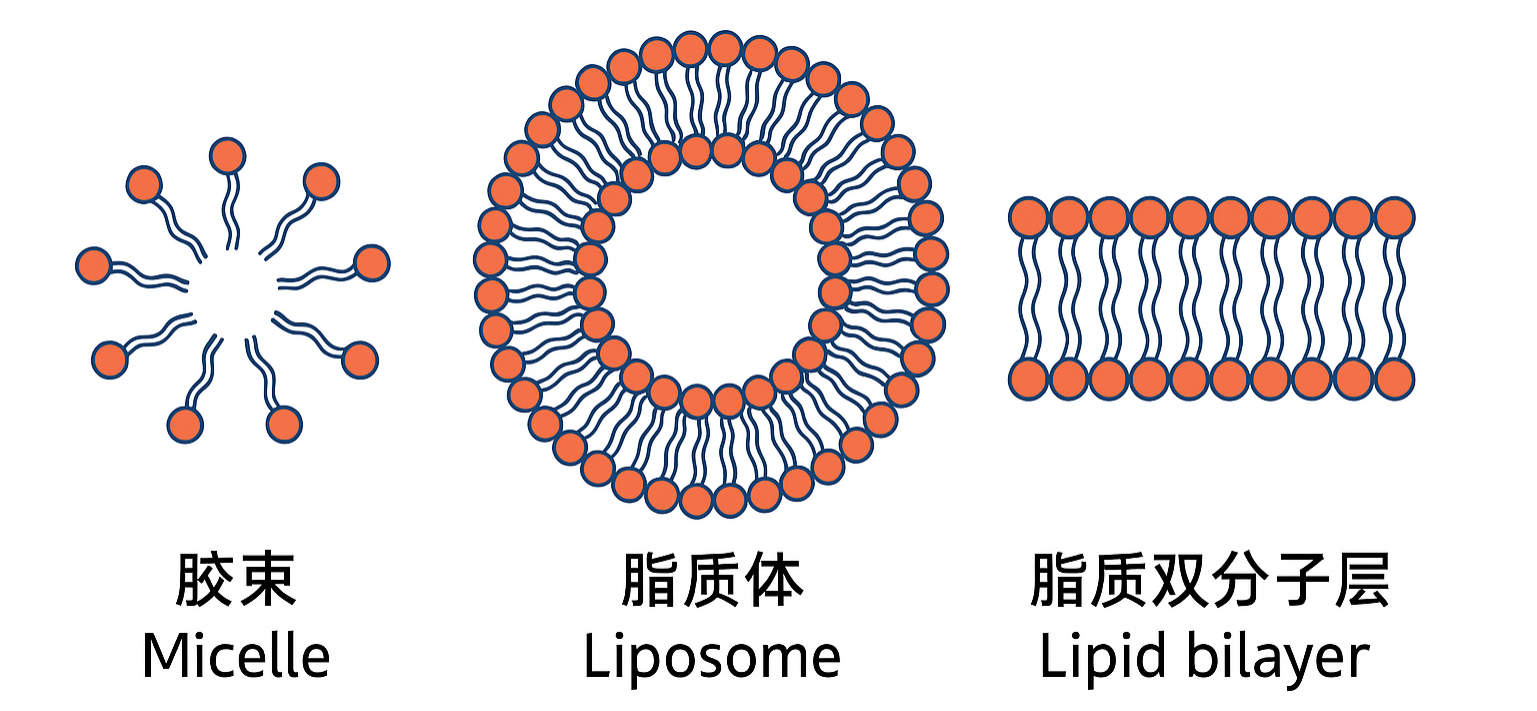
In the 1960s, Alec D. Bangham at the Babraham Institute, University of Cambridge, first systematically described the structure of liposomes and proposed the concept of using them as drug delivery carriers. Owing to their tunable size, coexistence of hydrophobic and hydrophilic domains, and excellent biocompatibility, liposomes are regarded as highly promising drug delivery systems. Liposomal formulations can improve the therapeutic index of new or marketed drugs by altering absorption, reducing metabolism, prolonging in vivo half-life and/or lowering systemic toxicity. In liposomal drug products, the in vivo distribution of the drug is governed primarily by the properties of the carrier itself, rather than solely by the physicochemical properties of the active pharmaceutical ingredient.
However, liposomes also have several drawbacks. Production costs can be relatively high; encapsulated drugs/active molecules are prone to leakage and fusion; and phospholipid components can undergo oxidation and hydrolysis. One of the most prominent limitations is rapid recognition and clearance by the reticuloendothelial system (RES), which results in short circulation half-life, limited dispersion stability and a relatively short shelf life. PEGylated liposomes (PEGylated long-circulating liposomes) alleviate these problems to a large extent.
After PEGylation, PEG chains on the liposomal surface form a highly hydrophilic protective layer, increasing surface hydrophilicity and reducing nonspecific interactions with the mononuclear phagocyte system. This allows liposomes to partially evade RES recognition, decreases liposome uptake and prevents excessive interactions with other molecules such as serum proteins. As a result, PEGylated liposomes are also referred to as “stealth liposomes.” A classic example of this technology is Doxil®, a PEGylated liposomal doxorubicin formulation developed by Sequus Pharmaceuticals in the United States. Doxil® was the first liposomal drug approved by the U.S. FDA and the first approved nanomedicine.
Despite their many advantages, PEGylated liposomes have revealed a series of new issues as research has progressed. The steric hindrance imposed by PEG chains may inhibit uptake of liposomes by target cells. For pH-sensitive liposomes (PSL) used to deliver genes and protein drugs, PEG chains may interfere with endosomal/lysosomal escape, causing drug-loaded liposomes to be trafficked more readily to lysosomes for degradation and thereby reducing delivery efficiency. In addition, repeated administration of PEGylated liposomes in the same animal can induce the accelerated blood clearance (ABC) phenomenon, whereby subsequently administered liposomes are cleared more rapidly. These negative effects are collectively referred to as the “PEG dilemma.” They pose significant challenges to the further development of PEGylated liposomes and related nanomedicines, and have spurred exploration of cleavable PEG, degradable PEG alternatives and other novel materials and strategies.
Other Applications of PEGylation
In addition to the drug and carrier systems described above, PEGylation has also found wide application in other biomedical and process-related contexts:
1. PEGylated Affinity Ligands and Cofactors
- PEGylated ligands and cofactors are commonly used in aqueous two-phase systems for the separation, purification and analysis of biomacromolecules and cells. By introducing PEG chains, the partitioning behavior of ligands between the two phases can be finely tuned, thereby enabling efficient separations.
2. PEGylated Carbohydrates
- PEGylated carbohydrates can serve as materials and carriers in novel drug or vaccine delivery systems. PEGylation helps improve the solubility and stability of carbohydrate molecules and allows modulation of their in vivo distribution and immunorecognition properties.
3. PEGylated Oligonucleotides
- PEG modification can enhance the aqueous solubility of oligonucleotides, increase their resistance to nuclease degradation and, to some extent, improve their ability to cross cell membranes. In addition, rational design of PEGylated oligonucleotides can be used to tailor their in vivo distribution and pharmacokinetic behavior.
4. PEGylated Biomaterials
- Introducing PEG chains onto the surfaces of biomaterials can reduce the risk of thrombosis and decrease nonspecific protein and cell adhesion, thereby improving the biocompatibility of blood-contacting materials, implantable devices and tissue-engineering scaffolds.
Overall, PEGylation is a well-established and continuously evolving modification strategy that plays a crucial role in the development of protein, peptide, small-molecule and liposomal drugs, as well as a wide range of biomaterials. Looking ahead, achieving a better balance between prolonged circulation and maintained or enhanced efficacy, while minimizing immunological risks and addressing the “PEG dilemma,” will be key directions for the further advancement of PEGylation technologies.
Classification Table of PEG Derivatives
Primary Category | Subclass / Functional End Group | Example Product (English Abbreviation) | Common Applications / Description |
Basic PEG Backbones | Hydroxyl-terminated PEG | The most fundamental PEG backbone; used as the parent structure for introducing various functional groups (NH₂, COOH, SH, etc.), and can also be used directly as a hydrophilic surface modifier. | |
| Monomethoxy PEG | One end capped with a methoxy group and the other with a hydroxyl group; commonly used as a basic raw material for PEGylation of proteins/drugs and as the backbone for mPEG-XXX derivatives. | |
| Benzyl-terminated PEG | Used in organic synthesis and the design of special structures; serves as an intermediate for subsequent functionalization or stability modification. | |
| Alkyl PEG | Hydrocarbons PEG | Alkyl–PEG structures that function as nonionic surfactants and emulsifiers, and as modifiers at interfaces between hydrophobic and aqueous phases. |
| Sulfonic acid-terminated PEG | Terminated with sulfonic acid/sulfonate groups to enhance water solubility and anionic charge; used in ionic polymers and antifouling surface coatings. | |
General Coupling / Crosslinking PEG | Thiol PEG | Selectively couples with metal surfaces, gold nanoparticles and maleimide groups; commonly used in surface modification, self-assembly and reversible crosslinking. | |
| Carboxyl PEG | Activated by reagents such as EDC/NHS to couple with primary amines; fundamental for carboxylation and further crosslinking of proteins, peptides and nanoparticles. | |
| Amine PEG | Bears terminal primary amino groups that readily form amide bonds with carboxylic acids or active esters; widely used for amination of proteins, peptides and material surfaces. | |
| Aldehyde PEG | Forms Schiff bases, hydrazone bonds or oxime linkages with amino, hydrazide or aminooxy groups; used for conjugation of polysaccharides, glycoproteins and aldehyde-functionalized carriers. | |
| Epoxy PEG | Epoxide rings undergo ring-opening reactions with amines, carboxylic acids and hydroxyls; used for surface activation, coatings and resin modification. | |
| Halogenated PEG | Serves as an intermediate for nucleophilic substitution and quaternary ammonium formation, enabling further conversion to NH₂, SH and other functional end groups. | |
| Acrylate PEG | Free-radical or photoinitiated polymerizable monomer; commonly used for hydrogels, tissue-engineering scaffolds and 3D-printed biomaterials. | |
| Acrylamide PEG | Acrylamide-type crosslinking monomer used to prepare soft hydrogels and cell culture matrices. | |
| Methacrylate PEG | Methacrylate-type photocurable monomer suitable for photocurable coatings and bioinks. | |
| NHS ester PEG | Highly efficient coupling reagent for primary amines; the classic “amine-reactive PEG,” used in modification of proteins, peptides, oligonucleotides and surfaces. | |
| PFP ester PEG | Pentafluorophenyl active ester that is more stable and reactive than NHS; suitable for applications requiring organic solvents or longer shelf life. | |
| TFP ester PEG | Tetrafluorophenyl active ester similar to PFP/NHS, used for amine coupling with a balance between stability and reactivity. | |
| NPC-activated PEG | p-Nitrophenyl carbonate–activated PEG that reacts with amines or hydroxyls to form carbamate or carbonate linkages under mild reaction conditions. | |
| Hydrazide PEG | Forms hydrazone bonds with aldehydes/ketones; commonly used for reversible or controllable conjugation to oxidized polysaccharides, glycoproteins and aldehyde-modified surfaces. | |
| Aminooxy PEG | Forms oxime linkages with aldehydes/ketones; offers high selectivity under mild conditions and is suitable for biological systems. | |
| Disulfide PEG | Contains a pyridyl disulfide group that undergoes disulfide exchange with thiols; often used for reversible PEGylation and detachable coatings. | |
| Protected amine PEG | Contains Boc- or Fmoc-protected amino groups; used in organic/solid-phase synthesis, with deprotection at later stages to obtain NH₂-PEG. | |
Bioorthogonal / Click PEG | Azide PEG | Reacts with alkynes or DBCO via CuAAC/SPAAC click chemistry; a common end group for constructing bioorthogonal conjugates and nanoprobes. | |
| DBCO PEG | Rapidly undergoes copper-free click reactions with azide groups; suitable for cellular and in vivo applications, avoiding Cu(I) toxicity. | |
| DNP-labeled PEG | Contains 2,4-dinitrophenyl groups that are specifically recognized by anti-DNP antibodies; used in immunotargeting and signal amplification. | |
Surface / Interface PEG | Silane PEG | Condenses with glass, SiO₂ and metal-oxide surfaces to create highly hydrophilic, protein-repellent and low-adhesion surfaces. | |
| Dopamine PEG | Dopamine (DA) PEG | Uses catechol groups of dopamine for strong adsorption onto metal oxides and carbon materials, enabling “universal adhesion layers” and antifouling coatings. |
| Lipoic acid PEG | Binds to metal or nanoparticle surfaces via disulfide linkages; can function as a reducible PEG shell or stabilizing layer. | |
| Cholesterol PEG | Cholesterol inserts into lipid or cell membranes, while PEG provides hydrophilic protection; used for stabilizing liposomes and lipid nanoparticles (LNPs) and for membrane anchoring. | |
| Lipid PEG (general) | Other Lipid PEG | Various lipid headgroup–PEG conjugates used to construct liposomes, micelles and other lipid nanocarriers, improving circulation time and colloidal stability. |
| DSPE-PEG | A prototypical phospholipid–PEG conjugate used in stealth liposomes, LNPs and mPEG-DSPE micelles; one of the most common building blocks in nanomedicine formulations. | |
Ligand / Fluorescent PEG | Biotin PEG | PEG linkers bearing biotin; leverage the ultra-high affinity of the biotin–avidin/streptavidin system for immobilization, enrichment and targeted delivery. | |
| Folic acid PEG | Achieves targeting of certain tumor cells via folate receptor–mediated endocytosis; commonly used in folate-modified nanoparticles and liposomes. | |
| FITC-labeled PEG | PEG conjugates bearing FITC fluorophores; used to visualize cellular uptake, in vivo distribution and carrier release behavior. | |
| Rhodamine PEG | Rhodamine-based fluorescent labels suitable for confocal microscopy, flow cytometry and carrier tracking; commonly used in fluorescently labeled nanoparticles and liposomes. | |
| Cyanine PEG | Near-infrared fluorophores (e.g., Cy5/Cy7) suitable for in vivo imaging, photoacoustic imaging and fluorescence-guided tumor navigation. | |
Block Copolymer / Lipid Carrier PEG | PLGA–PEG copolymers | Biodegradable amphiphilic block copolymers that self-assemble into nanoparticles or micelles; used for controlled and targeted delivery of small molecules, proteins, peptides and nucleic acids. | |
| PCL–PEG copolymers | PCL provides a hydrophobic, biodegradable backbone; suitable for nanomicelles loading hydrophobic drugs and for long-acting release formulations. | |
| PLA–PEG copolymers | Similar to PLGA–PEG; widely used in controlled-release formulations, implantable materials and biodegradable carriers. | |
| DSPE-PEG (also a lipid carrier) | Functions both as a surface-modifying unit and a key component of lipid nanocarriers; can be combined with cholesterol and other lipids to construct liposomes and LNPs. |
References
1. Veronese FM, Pasut G. PEGylation, successful approach to drug delivery. Drug Discov Today. 2005;10(21):1451–1458.
2. Knop K, Hoogenboom R, Fischer D, Schubert US. Poly(ethylene glycol) in drug delivery: Pros and cons as well as potential alternatives. Angew Chem Int Ed. 2010;49(36):6288–6308.
3. Garay RP, El-Gewely R, Armstrong JK, Garratty G, Richette P. Antibodies against polyethylene glycol in healthy subjects and in patients treated with PEG-conjugated agents: A review of the literature. J Pharm Sci. 2012;101(6):1887–1898.
4. Bailey LC, et al. PEGylation of biopharmaceuticals: A review of chemistry and nonclinical safety. J Pharm Sci. 2015;104(2):441–458.
5. Coelho JFJ, et al. Poly(ethylene glycol) in drug delivery: why does it work, and can we do better? Prog Polym Sci. 2010;35(9):1111–1124.
6. Tekade RK, et al. PEGylation of therapeutic proteins and peptides. In: PEGylated Nanocarriers in Medicine and Pharmacy. Springer; 2025:317–343.
7. Veronese FM. Peptide and protein PEGylation: A review of problems and solutions. Biomaterials. 2001;22(5):405–417.
8. Yang Y, et al. Research progress on the PEGylation of therapeutic proteins and peptides. Front Pharmacol. 2023;14:1353626.
9. Campora S, et al. The art of PEGylation: from simple polymer to sophisticated drug delivery systems. Int J Mol Sci. 2023;26(7):3102.
10. Immordino ML, Dosio F, Cattel L. Stealth liposomes: review of the basic science, rationale, and clinical applications, existing and potential. Int J Nanomedicine. 2006;1(3):297–315.
11. Hanafy NAN, El-Kemary M, Leporatti S. PEGylated liposomes enhance the effect of cytotoxic drug: A review. Heliyon. 2023;9(1):e13007.
12. Li J, et al. Thirty years from FDA approval of pegylated liposomal doxorubicin (Doxil®): Lessons learned and future directions. BMJ Oncol. 2024;4(1):e000573.
13. Ishida T, Kiwada H. The accelerated blood clearance (ABC) phenomenon: Clinical challenge for PEGylated liposomes and other nanoparticles. Adv Drug Deliv Rev. 2013;65(10):1296–1304.
14. Xu H, et al. “PEG dilemma” for liposomes and its solving approaches. Yao Xue Xue Bao (Acta Pharm Sin). 2015;50(4):442–450.
15. García KP, et al. PEGylated liposomes: immunological responses. Beilstein J Nanotechnol. 2019;10:1703–1729.
16. Wang X, et al. The importance of poly(ethylene glycol) alternatives for nanoparticle-mediated drug delivery and bioconjugation. Polymers (Basel). 2020;12(2):298.
Aladdin: https://www.aladdinsci.com/