Galactose Oxidase from Dactylium dendroides, CAS No.9028-79-9

CAS: 9028-79-9 Cat. No.: G128460 EC Number: 232-843-7 PubChem CID: 135318662
AVAILABLE TO ORDER
GRADE & PURITY EnzymoPure™ ? EnzymoPure™ — Aladdin's line of high-quality enzymatic solutions. Use when enzyme purity and defined activity drive assay or process performance. ≥30 units/mg dry weight
Accession #
P0CS93
 ·  off list, applied to all prices below.
Size
Status
Price
Qty
150U
G128460-150UN
2
$413.90
450U
G128460-450UN
8-12 wks(?) Production requires sourcing of materials. We appreciate your patience and understanding.

$750.90

$877.90
Save $127.00 (14.47%)
1000U
G128460-1000UN
8-12 wks(?) Production requires sourcing of materials. We appreciate your patience and understanding.

$1,328.90

$1,552.90
Save $224.00 (14.42%)
Enter a quantity for the sizes you want to add.
🧪

Why this grade

EnzymoPure™, ≥30 units/mg dry weight EnzymoPure™ for sensitive chromatographic and analytical workflows requiring minimal baseline interference.

🌡

Storage & shipping

Store at -20°C Ships Ice chest + Ice pads Check lot-specific COA for exact specifications.

📋

Quality documents

SDS, COA, datasheet, and spec sheet available for download. Lot-specific COA accessible via lot number lookup.

📚

Literature proof

Cited in 5 peer-reviewed publications across chromatography, organic synthesis, and cross-coupling reactions.

Overview

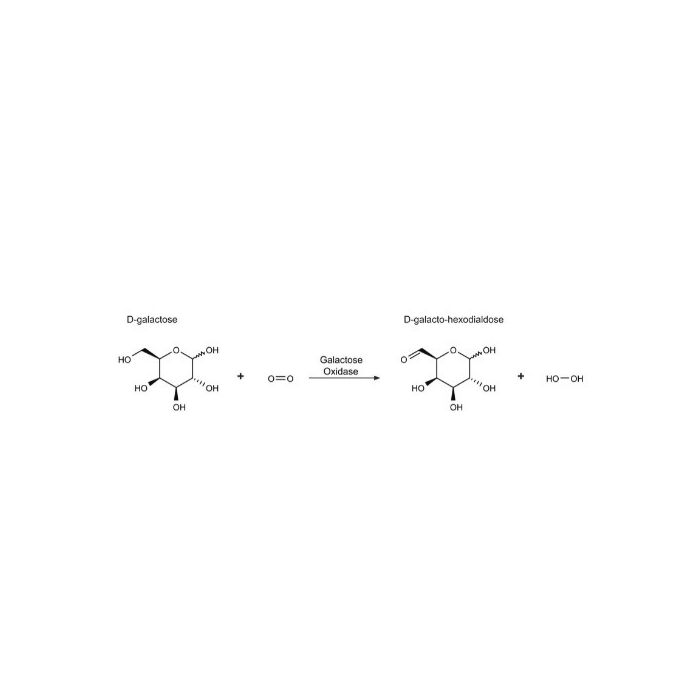
Galactose oxidase oxidizes galactose and some galactose derivatives in both free and polymeric forms. Oxidation occurs at the C6 position. The enzyme has a molecular weight of 68 ± 3 kDa, and the optimum pH is 7.0.
Useful in the determination of lactose.

Application

Galactose Oxidase from Dactylium dendroides has been used as a component for galactose oxidase treatment of arabinogalactan. It has also been used to co-immobilise with peroxidase for the preparation of a biosensor for galactose detection. Galactose oxidase may be used as an analytical tool for the specific determination of D-galactose in blood plasma, plant extracts, and phospholipids. It could be used for the characterization of terminal D-galactoside units in several polymers. It may also be useful in the determination of lactose.

1、Specificity :GAO has a wide substrate specificity, but remarkable stereospecificity, only oxidizing D-isomers of substrates (McPherson et al. 1992). GAO will oxidize galactose and some galactose derivatives in both free and polymeric form. Oxidation occurs at the C6 position. 
2、Composition:GAO contains one Cu(II) atom yet catalyzes a two-electron transfer reaction (McPherson et al. 1992). The copper is bound by two tyrosines, and two histidines (Tyr272, Tyr495, His496, and His581). In a novel post-translational covalent modification, Tyr272 is linked by a thioether bond to cysteine (Cys228), suggesting the involvement of a tyrosine radical in the catalytic mechanism. Stabilization of the radical occurs because Tyr272 of the thioether bond is liganded to the copper, creating a stacking interaction with Trp290 (Whittaker et al. 1989, Ito et al. 1991, and Whittaker et al. 2005). The structure of the enzyme has revealed extensive beta-sheet secondary structure, consistent with the high stability of the enzyme (Kosman et al. 1974). 
Most extracellular proteins of eukaryotes are modified by glycosylation during passage through the ER and golgi, leading to greater glycosylation of extracellular than intracellular forms of a protein. Unusually, the intracellular form of GAO is more highly glycosylated (9% carbohydrate) and exhibits greater stability than the extracellular form (2% carbohydrate) (Medonca and Zancan 1988). Additionally, most proteins are modified by O- and/or N-glycosylation while GAO is only modified only by O-glycosylation (Kornfield and Kornfield 1985, and McPherson et al. 1992)
3、Molecular Characteristics:The gaoA gene contains a long open reading frame from +324 to +2507, including the mature protein-coding sequence (+521 to +2507). It also contains a long untranslated upstream region and a putative pro-sequence with a monobasic cleavage site (McPherson et al. 1992).
4、Characteristics of Galactose Oxidase:
Protein Accession Number:P0CS93;
Isoelectric point:7.75 (Theoretical)
CATH Classification:Three domains:
Class: Mainly Beta
Architecture: Sandwich, 7 Propellor
Topology: Jelly Rolls, Methylamind Dehydrogenase; Chain H, Immunoglobulin-like
Molecular Weight
68.5 kDa (calculated from translated DNA sequence and SDS-polyacrylamide gel electrophoresis, McPherson et al. 1992)
68.0 ± 3.0 kDa (determined from physical measurements, Cooper et al. 1959) 
Optimal pH:7.0 (Cooper et al. 1959)  
Extinction Coefficient:
122,480 cm-1M-1 (Theoretical)
E1%, 280 = 17.87 (Theoretical)
Inhibitors
Cyanide
Diethyldithiocarbamate
Azide
Hydroxylamine
EDTA
Applications
Quantitative determination of galactose in blood and other biological fluids (Frings and Pardue 1964, Hankin 1966, and Roth et al. 1965)
Locating galactose histochemically (Roberts and Gupta 1965)
Detecting and distinguishing glycoproteins (Itaya et al. 1975)
5、Galactose Oxidase Assay:Method
The reaction velocity is measured in a peroxidase/o-tolidine coupled system as an increase in A425 resulting from the oxidation of galactose. One unit results in a change in A425 of 1.0 per minute at 25°C and pH 6.0 under the defined conditions.
Reagents
0.1 M Potassium phosphate buffer, pH 6.0
0.5% o-tolidine. Note: o-tolidine has been reported to be carcinogenic. Handle with care.
Peroxidase. Dissolve Worthington peroxidase (Code: HPOD) at a concentration of approximately 60 u/ml in reagent grade water.
10% galactose. Allow to come to equilibrium of mutarotation by allowing to stand overnight.
Enzyme
Dissolve at a concentration of 1 mg/ml in reagent grade water. Dilute further for assay to a concentration of 0.2 - 0.5 units/ml.
Procedure
Adjust spectrophotometer to 425 nm and 25°C.
Prepare tolidine-buffer mixture by adding 0.1 ml tolidine to 12 ml 0.1 M potassium phosphate buffer pH 6.0.
Pipette into each cuvette as follows:
Tolidine-buffer solution 1.7 ml
10% Galactose 1.5 ml
Peroxidase 0.1 ml
Incubate in spectrophotometer at 25°C for 3 - 4 mintues to achieve temperature equilibration and establish blank rate, if any. Add 0.1 ml of appropriately diluted enzyme and record increase in A425/min. from initial linear portion of the curve. 

Specifications

Product Name
Galactose Oxidase from Dactylium dendroides, CAS No.9028-79-9
Synonyms
D-Galactose:oxygen 6-oxidoreductase
Grade
EnzymoPure™
Specifications & Purity
EnzymoPure™, ≥30 units/mg dry weight
Biochemical and Physiological Mechanisms
Galactose oxidase catalyzes the coversion of D-galactose to D-galacto-hexodialdose. 2-Deoxy-D-galactose, lactose, melibiose, raffinose and stachyose react with galactose oxidase in the peroxidase:o-tolidine system. Essentially no oxidation of D-glucose,
Accession #
CAS
9028-79-9
Enzyme Commission Number
1.1.3.9
Molecule Type
Enzyme
Storage and Shipping
Concentration
≥30 units/mg dry weight
Storage
Store at -20°C
Shipped In
Ice chest + Ice pads
Unit definition
One Unit equals a change in absorbance at 425 nm of 1.000 per minute at 25°C, pH 6.0 using a peroxidase/o-tolidine coupled assay with galactose as the substrate.

Documentation

📋 Safety Data Sheet (SDS)

Comprehensive hazard, handling, storage, and regulatory compliance document.

Download SDS →

✅ Certificate of Analysis (COA)

Lot-specific quality data. Enter your lot number to retrieve the exact COA.

Look up COA →

📊 Datasheet

Quick-reference summary of product specifications and applications.

View datasheet →

🔬 Specification Sheet

Full quality attributes and acceptance criteria for this grade.

View spec sheet →

Advanced Data

Certificates(CoA,COO,BSE/TSE and Analysis Chart)
C of A & Other Certificates(BSE/TSE, COO):
Analytical Chart:

Find and download the COA for your product by matching the lot number on the packaging.

17 results found

Lot NumberCertificate TypeDateItem
H2504304Certificate of AnalysisApr 09, 2025 G128460
H2504303Certificate of AnalysisApr 09, 2025 G128460
C2507426Certificate of AnalysisFeb 27, 2025 G128460
K2408585Certificate of AnalysisOct 29, 2024 G128460
K2408584Certificate of AnalysisOct 29, 2024 G128460
J2408372Certificate of AnalysisSep 24, 2024 G128460
L2326186Certificate of AnalysisDec 19, 2023 G128460
L2326187Certificate of AnalysisDec 19, 2023 G128460
L2326101Certificate of AnalysisDec 19, 2023 G128460
H2303170Certificate of AnalysisJul 10, 2023 G128460
H2303018Certificate of AnalysisJul 10, 2023 G128460
B2324573Certificate of AnalysisFeb 16, 2023 G128460
B2324594Certificate of AnalysisFeb 16, 2023 G128460
B2324586Certificate of AnalysisFeb 16, 2023 G128460
H2203476Certificate of AnalysisJul 08, 2022 G128460
H2203472Certificate of AnalysisJul 08, 2022 G128460
H2203467Certificate of AnalysisJul 08, 2022 G128460

Show more ⌵

Documents & Articles
Citations of This Product
References
1. Jiajia Li, Shuang Yue, Ziyuan Gao, Wenhua Hu, Zhaoliang Liu, Guoqiang Xu, Zhen Wu, Xumin Zhang, Guolin Zhang, Fuliang Qian, Junhong Jiang, Shuang Yang.  (2023)  Novel Approach to Enriching Glycosylated RNAs: Specific Capture of GlycoRNAs via Solid-Phase Chemistry.  ANALYTICAL CHEMISTRY,      [PMID:37524653] [10.1021/acs.analchem.3c01630]
2. Ziyi Tong, Shengyan Hou, Zhenkun Zhang, Zhen Liu, Yifei Zhang.  (2024)  Biochemical approaches for decoding the information stored with metabolites.  SENSORS AND ACTUATORS B-CHEMICAL,      [PMID:] [10.1016/j.snb.2024.136618]
3. Tong Xing, Yaxin Lv, Gongqing Wu, Zhou Zhang, Wanqing Zhang, Xinping Wang, Zhuolang Chen, Weining Zhao, Felipe Conzuelo, Fangyuan Zhao.  (2025)  A novel biofuel cell based on galactose oxidase and bilirubin oxidase for efficient glycerol conversion and electricity generation.  CHEMICAL ENGINEERING JOURNAL,      [PMID:] [10.1016/j.cej.2025.163474]
4. Wanqing Zhang, Xiaodong Su, Yaxin Lv, Xuelin Zhao, Zhou Zhang, Yuntong Du, Mengyu Fan, Heshan Zhao, Matthias Rögner, Felipe Conzuelo, Weining Zhao, Mei Li, Fangyuan Zhao.  (2026)  A Biophotocathode Based on Photosystem I with Record-High Photocurrent Density Coupled with Bioelectrochemical Glycerol Oxidation.  ACS Sustainable Chemistry & Engineering,      [PMID:] [10.1021/acssuschemeng.5c13204]
5. Hongxu Zhang, Mingyuan Liu, Wenjia Tian, Ke Liu, Mengyao Hao, Hairong Yu, Weikang Sun, Leilei Guo, Xiaoxu Tan, Kaiyu Gao, Tianyi Jiang, Chuanjuan Lü, Qianjin Kang, Cuiqing Ma, Longyang Dian, Ping Xu, Chao Gao.  (2026)  Enzymatic Synthesis of 3-Hydroxypyruvate and Pyruvate from CO2-Derived C1 Compounds.  ACS Catalysis,      [PMID:] [10.1021/acscatal.5c08729]
Solution Calculators
Reviews

Customer Reviews

Need help choosing the grade?

Our grade selection guide covers purity, stabilizer status, and application suitability for all variants in our catalog.

View EnzymoPure™ grade guide →

Shall we send you a message when we have discounts available?

Remind me later

Thank you! Please check your email inbox to confirm.

Oops! Notifications are disabled.