≥98% for sensitive chromatographic and analytical workflows requiring minimal baseline interference.
🌡
Storage & shipping
Store at 2-8°C,Desiccated Ships Wet ice Check lot-specific COA for exact specifications.
📋
Quality documents
SDS, COA, datasheet, and spec sheet available for download. Lot-specific COA accessible via lot number lookup.
📚
Literature proof
Cited in 0 peer-reviewed publications across chromatography, organic synthesis, and cross-coupling reactions.
Overview
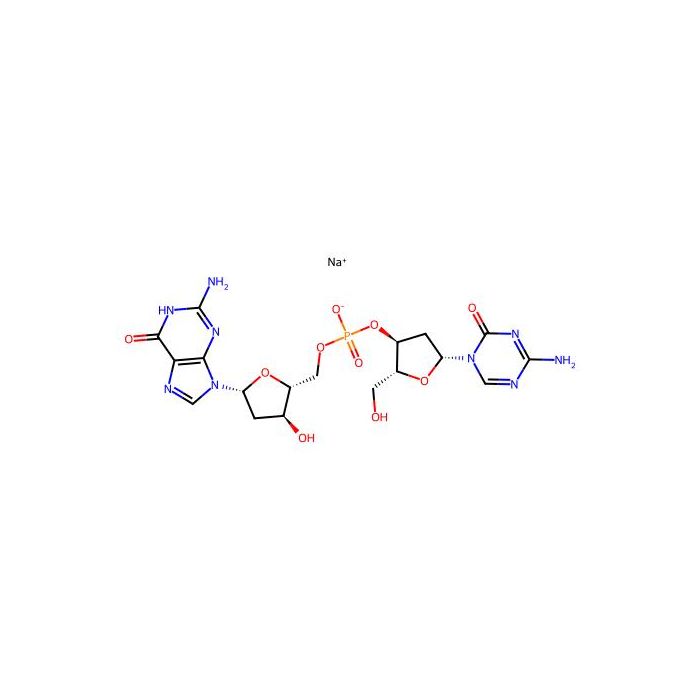
Guadecitabine sodium (SGI-110 sodium) is a second-generation DNA methyltransferases ( DNMT ) inhibitor for research of acute myeloid leukemia (AML) and myelodysplastic syndromes (MDS)
In Vitro
After HCT116 colorectal carcinoma cells are treated for 6 days, a dose-dependent increase in p16expression is observed with Guadecitabine sodium (SGI-110 sodium). In addition, T24 and HCT116 cells treated with Guadecitabine sodium or 5-aza-CdR for 3 days show a dose-dependent increase in the level of p16 protein, showing the competence of Guadecitabine sodium to inhibit DNA methylation and induce p16 at both mRNA and protein levels as well as 5-aza-CdR. Thus, Guadecitabine sodium is able to inhibit DNA methylation at 5′-region and induce the expression of the p16 gene in T24 and HCT116 cells at concentrations comparable to 5-aza-CdR, and the induction of p16 expression by both agents correlates with the demethylation at the 5′-end region of the gene in both cell lines. Guadecitabine sodium is slightly less toxic than 5-aza-CdR at the doses tested up to 1 μM concentration but displaying similar toxicity at 10 μM concentration. MCE has not independently confirmed the accuracy of these methods. They are for reference only.
In Vivo
Guadecitabine sodium (SGI-110 sodium) at 10mg/kg is an effective dose at reducing DNA methylation and retarding tumor growth, and caused roughly the same level of toxicity as 5-Aza-CdR. Guadecitabine sodium is effective in vivo at reactivating the expression of the p16 gene, which is heavily methylated in the parent EJ6 cells. Guadecitabine sodium is effective in reducing the level of DNA methylation in vivo at the p16 promoter region. Guadecitabine sodium is better tolerated than 5-Aza-CdR in vivo , suggesting that it can be an attractive alternative for potential clinical use. MCE has not independently confirmed the accuracy of these methods. They are for reference only.
Animal administration
Mouse: Athymic nu/nu mice are inoculated subcutaneously in the right hind flank with 10 7 EJ6 bladder cancer cells. After tumors reach 0.5 cm in diameter, animals are stratified into three groups with eight animals per group to begin treatments. Doses and dosing schedules are designed so that each group received molar equivalents of either S-110 or 5-Aza-CdR. The agents are administered SQ once weekly at a dose of 12.2 mg/kg for S-110 and 5.0 mg/kg for 5-Aza-CdR for three weeks. The study includes an appropriate PBS control group. Tumor sizes by caliper and body weight measurements are taken twice weekly to monitor tumor growth inhibition and tolerability . aladdin has not independently confirmed the accuracy of these methods. They are for reference only.
Guadecitabine sodium (SGI-110 sodium) is a second-generation DNA methyltransferases ( DNMT ) inhibitor for research of acute myeloid leukemia (AML) and myelodysplastic syndromes (MDS).
Storage
Store at 2-8°C, Desiccated
Shipped In
Wet ice
This product requires cold chain shipping. Ground and other economy services are not available.
This compound belongs to the class of organic compounds known as purine 2'-deoxyribonucleoside monophosphates. These are purine nucleotides with monophosphate group linked to the ribose moiety lacking a hydroxyl group at position 2.
External Descriptors
Not available
1. Djoumbou Feunang Y, Eisner R, Knox C, Chepelev L, Hastings J, Owen G, Fahy E, Steinbeck C, Subramanian S, Bolton E, Greiner R, and Wishart DS. ClassyFire: Automated Chemical Classification With A Comprehensive, Computable Taxonomy. Journal of Cheminformatics, 2016, 8:61.
We use cookies to ensure the website functions properly and, where permitted, to improve your experience. You can manage your preferences at any time in Settings. Learn more in our Cookie Policy.
Shall we send you a message when we have discounts available?
Remind me later
Thank you! Please check your email inbox to confirm.
Products are supplied to verified businesses, institutions, and qualified professionals for research and development use only. Not for use in humans, animals, diagnosis, or therapy.