
Determine the necessary mass, volume, or concentration for preparing a solution.
| Activity Type | Relation | Activity value | Units | Action Type | Journal | PubMed Id | doi | Assay Aladdin ID |
|---|
≥99% for sensitive chromatographic and analytical workflows requiring minimal baseline interference.
Store at -20°C Ships Ice chest + Ice pads Check lot-specific COA for exact specifications.
SDS, COA, datasheet, and spec sheet available for download. Lot-specific COA accessible via lot number lookup.
Cited in 0 peer-reviewed publications across chromatography, organic synthesis, and cross-coupling reactions.
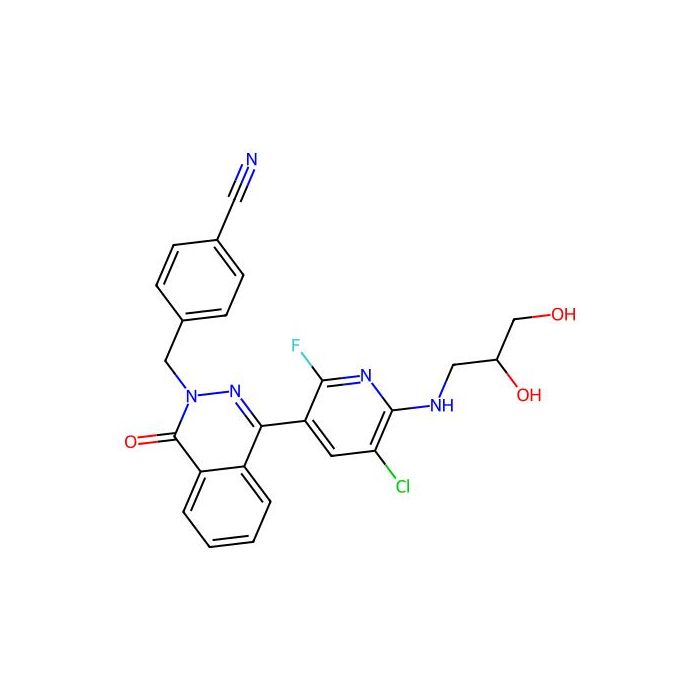
HBV-IN-4, a phthalazinone derivative, is a potent and orally active HBV DNA replication inhibitor with an IC 50 of 14 nM. HBV-IN-4 induces the formation of genome-free capsids and has potent anti- HBV potencies
In Vitro
HBV-IN-4 (compound 19f; 0-1 μM; 8 days) treatment inhibits the various forms (relaxed circular [rc] and single-stranded [ss] HBV DNA) in a dose-dependent manner in HepG2.2.15 cells. HBV-IN-4 treatment could also reduce capsidassociated DNAs dose-dependently. HBV-IN-4 could induce the formation of genome-free capsids, including a phenotype of faster-migrating ones. MCE has not independently confirmed the accuracy of these methods. They are for reference only.
In Vivo
HBV-IN-4 (Compound 19f; 50-150 mg/kg; oral administration; twice a day; for 4 weeks; Balb/c male mice) treatment achieves 2.67 log viral load reduction in AAV-HBV/mouse model . HBV-IN-4 (compound 19f) exhibits favorable drug characteristics with low plasma clearance (CL=4.1 mL/min/kg), excellent drug exposure (AUC 0-t =49 744 h•ng/L), T 1/2 (2.15 hours) and oral bioavailability (F=60.4%) using 20 mg/kg oral administration in mice. HBV-IN-4 also shows good distribution in liver exposure . MCE has not independently confirmed the accuracy of these methods. They are for reference only. Animal Model: Balb/c male mice (8-week-old) injected with a recombinant adenoassociated virus (AAV Dosage: 50 mg/kg, 150 mg/kg Administration: Oral administration; twice a day; for 4 weeks Result: Resulted in a 2.67 log reduction of the HBV DNA viral load during a 4-week treatment.
Form:Solid
IC50& Target:IC50: 14 nM (HBV DNA replication)
| Canonical Smiles | C1=CC=C2C(=C1)C(=NN(C2=O)CC3=CC=C(C=C3)C#N)C4=CC(=C(N=C4F)NCC(CO)O)Cl |
|---|---|
| IUPAC Name | 4-[[4-[5-chloro-6-(2,3-dihydroxypropylamino)-2-fluoropyridin-3-yl]-1-oxophthalazin-2-yl]methyl]benzonitrile |
| InChIKey | WTCNPITUIDRZKR-UHFFFAOYSA-N |
| INCHI | 1S/C24H19ClFN5O3/c25-20-9-19(22(26)29-23(20)28-11-16(33)13-32)21-17-3-1-2-4-18(17)24(34)31(30-21)12-15-7-5-14(10-27)6-8-15/h1-9,16,32-33H,11-13H2,(H,28,29) |
| Isomeric SMILES | C1=CC=C2C(=C1)C(=NN(C2=O)CC3=CC=C(C=C3)C#N)C4=CC(=C(N=C4F)NCC(CO)O)Cl |
| PubChem CID | 146653485 |
| Molecular Weight | 479.89 |
Comprehensive hazard, handling, storage, and regulatory compliance document.
Download SDS →Lot-specific quality data. Enter your lot number to retrieve the exact COA.
Look up COA →Full quality attributes and acceptance criteria for this grade.
View spec sheet →Taxonomy Tree
| Kingdom | Organic compounds |
|---|---|
| Superclass | Organoheterocyclic compounds |
| Class | Diazanaphthalenes |
| Subclass | Benzodiazines |
| Intermediate Tree Nodes | Phthalazines |
| Direct Parent | Phthalazinones |
| Alternative Parents | Polyhalopyridines Benzonitriles Secondary alkylarylamines Hydroxypyridines 2-halopyridines Pyridazines and derivatives Imidolactams Heteroaromatic compounds Secondary alcohols Lactams Nitriles Azacyclic compounds Organopnictogen compounds Organofluorides Organochlorides Organic oxides Hydrocarbon derivatives |
| Molecular Framework | Aromatic heteropolycyclic compounds |
| Substituents | Phthalazinone - Polyhalopyridine - Benzonitrile - 2-halopyridine - Hydroxypyridine - Secondary aliphatic/aromatic amine - Imidolactam - Benzenoid - Pyridine - Pyridazine - Monocyclic benzene moiety - Heteroaromatic compound - Secondary alcohol - Lactam - Azacycle - Secondary amine - Nitrile - Organic nitrogen compound - Organic oxygen compound - Organopnictogen compound - Organic oxide - Hydrocarbon derivative - Organooxygen compound - Organonitrogen compound - Organofluoride - Organochloride - Organohalogen compound - Amine - Alcohol - Aromatic heteropolycyclic compound |
| Description | This compound belongs to the class of organic compounds known as phthalazinones. These are compounds containing a phthalazine bearing a ketone group. |
| External Descriptors | Not available |
| Activity Type | Relation | Activity value | Units | Action Type | Journal | PubMed Id | doi | Assay Aladdin ID |
|---|
| Solubility | DMSO : 100 mg/mL (208.38 mM; Need ultrasonic) |
|---|