The store will not work correctly when cookies are disabled.
JavaScript seems to be disabled in your browser. For the best experience on our site, be sure to turn on Javascript in your browser.
· · COA & SDS available for every product · Same-day shipping on in-stock items Karacoline - Moligand™, ≥98% , CAS No.39089-30-0
GRADE & PURITY Moligand™ ? Moligand™ — Aladdin's line of ligands and bioactive small molecules. Use for receptor, pathway, and binding studies needing defined small-molecule tools. ≥98% Synonyms
20-ethyl-16beta-methoxy-4-methylaconitane-1alpha,8,14alpha-triol | Aconitane-1,8,14-triol, 20-ethyl-16-methoxy-4-methyl-, (1-alpha,14-alpha,16-beta)- | Carmicheline | CHEBI:6113 | Karakoline | (1S,2R,3R,4S,5S,6S,8S,9S,13R,16S,17R)-11-ethyl-6-methoxy-13-me
Storage
Protected from light,Store at -20°C,Desiccated
Shipped In
Ice chest + Ice pads
Specifications Synonyms
20-ethyl-16beta-methoxy-4-methylaconitane-1alpha,8,14alpha-triol | Aconitane-1,8,14-triol, 20-ethyl-16-methoxy-4-methyl-, (1-alpha,14-alpha,16-beta)- | Carmicheline | CHEBI:6113 | Karakoline | (1S,2R,3R,4S,5S,6S,8S,9S,13R,16S,17R)-11-ethyl-6-methoxy-13-me
Specifications & Purity
Moligand™, ≥98%
Biochemical and Physiological Mechanisms
Karacoline is PPARγ activator and ERK/JNK MAPK inhibitor. Karacoline restricts ROS production, maintains mitochondrial membrane potential, and inhibits pulmonary cell apoptosis. Karacoline inhibits NF-κB pathway activation, reduces acetylation levels of p
Storage
Protected from light,Store at -20°C,Desiccated
Shipped In
Ice chest + Ice pads
This product requires cold chain shipping. Ground and other economy services are not available.
Names and Identifiers Canonical Smiles
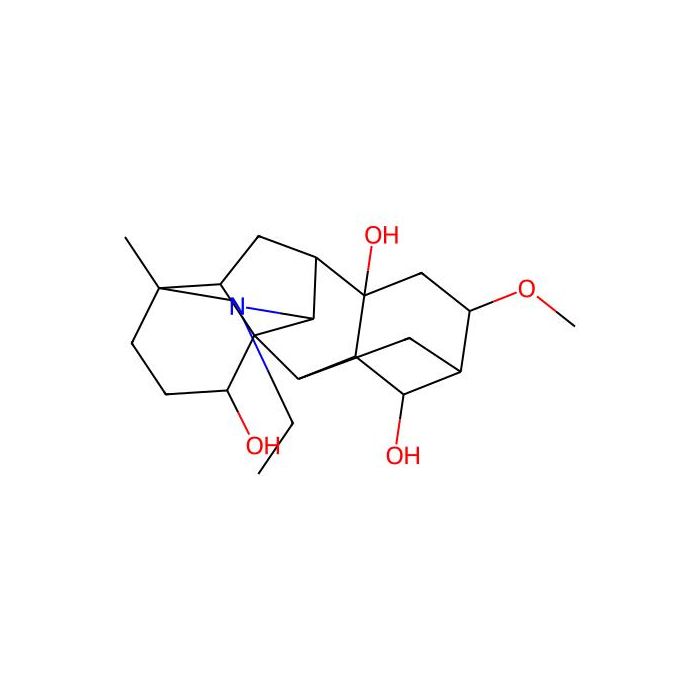
CCN1CC2(CCC(C34C2CC(C31)C5(CC(C6CC4C5C6O)OC)O)O)C
IUPAC Name
(1S,2R,3R,4S,5S,6S,8S,9S,13R,16S,17R)-11-ethyl-6-methoxy-13-methyl-11-azahexacyclo[7.7.2.12,5.01,10.03,8.013,17]nonadecane-4,8,16-triol
InChIKey
HKQZUYOVMYOFIT-VHNBHZRZSA-N
INCHI
1S/C22H35NO4/c1-4-23-10-20(2)6-5-16(24)22-12-7-11-14(27-3)9-21(26,17(12)18(11)25)13(19(22)23)8-15(20)22/h11-19,24-26H,4-10H2,1-3H3/t11-,12-,13+,14+,15-,16+,17-,18+,19?,20+,21+,22-/m1/s1
Isomeric SMILES
CCN1C[C@@]2(CC[C@@H]([C@@]34[C@@H]2C[C@@H](C31)[C@]5(C[C@@H]([C@H]6C[C@@H]4[C@@H]5[C@H]6O)OC)O)O)C
Advanced Data Taxonomic Classification Kingdom Organic compounds Superclass Lipids and lipid-like molecules Class Prenol lipids Subclass Diterpenoids Intermediate Tree Nodes Not available Direct Parent Aconitane-type diterpenoid alkaloids Alternative Parents Quinolidines Alkaloids and derivatives Azepanes Piperidines Tertiary alcohols Trialkylamines Secondary alcohols Cyclic alcohols and derivatives Polyols Dialkyl ethers Azacyclic compounds Organopnictogen compounds Hydrocarbon derivatives Molecular Framework Aliphatic heteropolycyclic compounds Substituents Aconitane-type diterpenoid alkaloid - Quinolidine - Alkaloid or derivatives - Azepane - Piperidine - Cyclic alcohol - Tertiary alcohol - Tertiary aliphatic amine - Tertiary amine - Secondary alcohol - Azacycle - Organoheterocyclic compound - Dialkyl ether - Polyol - Ether - Hydrocarbon derivative - Organooxygen compound - Organonitrogen compound - Organic oxygen compound - Alcohol - Organic nitrogen compound - Amine - Organopnictogen compound - Aliphatic heteropolycyclic compound Description This compound belongs to the class of organic compounds known as aconitane-type diterpenoid alkaloids. These are alkaloid diterpenoids with a structure based on the hexacyclic aconitane skeleton. These compounds have no oxygen functionality at the C7 atom. External Descriptors tertiary alcohol - tertiary amino compound - secondary alcohol - alkaloid - bridged compound - organonitrogen heterocyclic compound Data sources 1. Djoumbou Feunang Y, Eisner R, Knox C, Chepelev L, Hastings J, Owen G, Fahy E, Steinbeck C, Subramanian S, Bolton E, Greiner R, and Wishart DS. ClassyFire: Automated Chemical Classification With A Comprehensive, Computable Taxonomy. Journal of Cheminformatics, 2016, 8:61.
3D Structure Certificates (CoA,COO,BSE/TSE and Analysis Chart) Chemical and Physical Properties Solubility DMSO : 25 mg/mL (66.22 mM; Need ultrasonic) Sensitivity Light sensitive Molecular Weight 377.500 g/mol XLogP3 1.100 Hydrogen Bond Donor Count 3 Hydrogen Bond Acceptor Count 5 Rotatable Bond Count 2 Exact Mass 377.257 Da Monoisotopic Mass 377.257 Da Topological Polar Surface Area 73.200 Ų Heavy Atom Count 27 Formal Charge 0 Complexity 673.000 Isotope Atom Count 0 Defined Atom Stereocenter Count 11 Undefined Atom Stereocenter Count 1 Defined Bond Stereocenter Count 0 Undefined Bond Stereocenter Count 0 The total count of all stereochemical bonds 0 Covalently-Bonded Unit Count 1
Solution Calculators Molarity Calculator Determine the necessary mass, volume, or concentration for preparing a solution.
Dilution Calculator Determine the dilution needed to prepare a stock solution.
Reconstitution Calculator Reviews Need help choosing the grade? Our grade selection guide covers purity, stabilizer status, and application suitability for all variants in our catalog.
View Moligand™ grade guide →
We use cookies to ensure the website functions properly and, where permitted, to improve your experience. You can manage your preferences at any time in Settings. Learn more in our
Cookie Policy. Settings Accept All Decline
Shall we send you a message when we have discounts available?
Remind me later Allow
Thank you! Please check your email inbox to confirm.
Oops! Notifications are disabled.
Products are supplied to verified businesses, institutions, and qualified professionals for research and development use only. Not for use in humans, animals, diagnosis, or therapy.
Copyright © 2023–present Aladdin Scientific Corporation. All rights reserved.