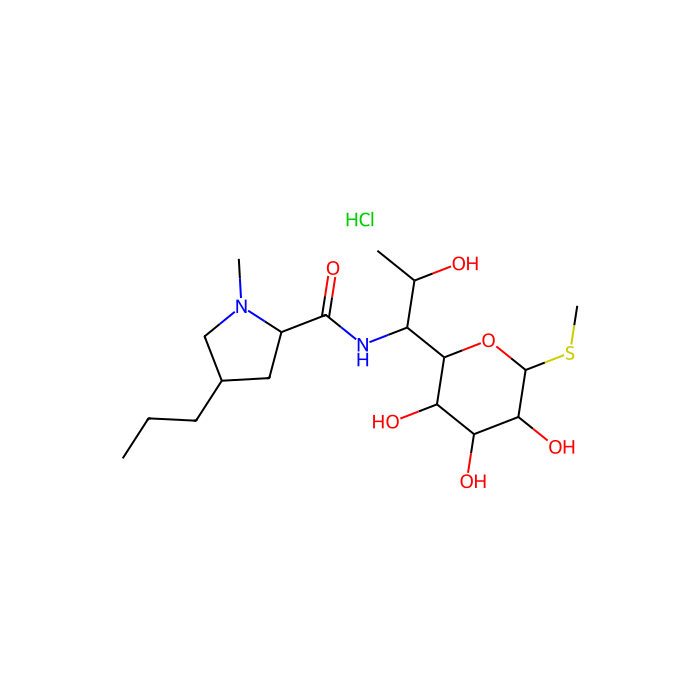
Lincomycin hydrochloride - BioReagent, for cell culture , CAS No.859-18-7

CAS: 859-18-7 Cat. No.: L434278 Molecular Weight: 443 EC Number: 212-726-7
AVAILABLE TO ORDER
GRADE & PURITY BioReagent ? BioReagent grade — tested suitable for life-science and molecular-biology use. Use for cell culture, assays, and biochemical work needing biological compatibility. for Cell culture ? Cell-culture grade — low endotoxin and contaminants to support viable cell growth. Use in mammalian/other cell culture media and supplements.
Synonyms
CCG-220302 | Lincomycin (hydrochloride) | Lincogap | NCGC00159326-02 | Lincomycin hydrochloride, >=95.0% (TLC) | Lincomycin hydrochloride, BioReagent, suitable for cell culture | DTXCID9027780 | Lincomycin HCl (Lincocin) | POUMFISTNHIPTI-BOMBIWCESA-N | D-
Storage
Store at 2-8°C
Shipped In
Wet ice
 ·  off list, applied to all prices below.
Size
Status
Price
Qty
1000000Units
L434278-1000000Units
8-12 wks(?) Production requires sourcing of materials. We appreciate your patience and understanding.

$141.90

$165.90
Save $24.00 (14.47%)
5000000Units
L434278-5000000Units
8-12 wks(?) Production requires sourcing of materials. We appreciate your patience and understanding.

$491.90

$574.90
Save $83.00 (14.44%)
Enter a quantity for the sizes you want to add.
🧪

Why this grade

BioReagent, for cell culture BioReagent,for Cell culture for sensitive chromatographic and analytical workflows requiring minimal baseline interference.

🌡

Storage & shipping

Store at 2-8°C Ships Wet ice Check lot-specific COA for exact specifications.

📋

Quality documents

SDS, COA, datasheet, and spec sheet available for download. Lot-specific COA accessible via lot number lookup.

📚

Literature proof

Cited in 14 peer-reviewed publications across chromatography, organic synthesis, and cross-coupling reactions.

Overview

General Description

Chemical structure: macrolide


Application

Lincomycin hydrochloride is an antibiotic used to study the inhibition of protein synthesis, bacterial antibiotic resistance and protein and surfactant binding. It is produced by Streptomyces lincolnensis var. lincolnensis, and has been used in the treatment of Staphylococcal, Streptococcal, and Bacterioides fragilis infections.

Specifications

Synonyms
CCG-220302 | Lincomycin (hydrochloride) | Lincogap | NCGC00159326-02 | Lincomycin hydrochloride, >=95.0% (TLC) | Lincomycin hydrochloride, BioReagent, suitable for cell culture | DTXCID9027780 | Lincomycin HCl (Lincocin) | POUMFISTNHIPTI-BOMBIWCESA-N | D-
Specifications & Purity
BioReagent, for cell culture
Biochemical and Physiological Mechanisms
Mode of action: Lincomycin inhibits bacterial protein synthesis by forming cross-links within the peptidyl transferase loop region of the 23S rRNA.† Antimicrobial spectrum: Lincomycin hydrochloride is effective against gram-positive bacteria.
Storage
Store at 2-8°C
Shipped In
Wet ice
This product requires cold chain shipping. Ground and other economy services are not available.
Grade
BioReagent, for Cell culture
Names and Identifiers
Canonical SmilesCCCC1CC(N(C1)C)C(=O)NC(C2C(C(C(C(O2)SC)O)O)O)C(C)O.Cl
IUPAC Name(2S,4R)-N-[(1R,2R)-2-hydroxy-1-[(2R,3R,4S,5R,6R)-3,4,5-trihydroxy-6-methylsulfanyloxan-2-yl]propyl]-1-methyl-4-propylpyrrolidine-2-carboxamide;hydrochloride
InChIKeyPOUMFISTNHIPTI-BOMBIWCESA-N
INCHI1S/C18H34N2O6S.ClH/c1-5-6-10-7-11(20(3)8-10)17(25)19-12(9(2)21)16-14(23)13(22)15(24)18(26-16)27-4;/h9-16,18,21-24H,5-8H2,1-4H3,(H,19,25);1H/t9-,10-,11+,12-,13+,14-,15-,16-,18-;/m1./s1
Isomeric SMILES CCC[C@@H]1C[C@H](N(C1)C)C(=O)N[C@@H]([C@@H]2[C@@H]([C@@H]([C@H]([C@H](O2)SC)O)O)O)[C@@H](C)O.Cl
Alternate CAS 7179-49-9
Molecular Weight 443
Reaxy-Rn 24870211
Reaxys-RN_link_address https://www.reaxys.com/reaxys/secured/hopinto.do?context=S&query=IDE.XRN=24870211&ln=

Documentation

📋 Safety Data Sheet (SDS)

Comprehensive hazard, handling, storage, and regulatory compliance document.

Download SDS →

✅ Certificate of Analysis (COA)

Lot-specific quality data. Enter your lot number to retrieve the exact COA.

Look up COA →

📊 Datasheet

Quick-reference summary of product specifications and applications.

View datasheet →

🔬 Specification Sheet

Full quality attributes and acceptance criteria for this grade.

View spec sheet →

Advanced Data

Taxonomic Classification

Taxonomy Tree

KingdomOrganic compounds
SuperclassOrganic acids and derivatives
ClassCarboxylic acids and derivatives
SubclassAmino acids, peptides, and analogues
Intermediate Tree Nodes Amino acids and derivatives - Alpha amino acids and derivatives
Direct ParentProline and derivatives
Alternative Parents Alpha amino acid amides  Thioglycosides  Pyrrolidinecarboxamides  Oxanes  N-alkylpyrrolidines  Monosaccharides  Monothioacetals  Trialkylamines  Secondary carboxylic acid amides  Secondary alcohols  Sulfenyl compounds  Polyols  Oxacyclic compounds  Azacyclic compounds  Hydrochlorides  Hydrocarbon derivatives  Carbonyl compounds  Organic oxides  Organopnictogen compounds  
Molecular FrameworkAliphatic heteromonocyclic compounds
Substituents Proline or derivatives - Alpha-amino acid amide - Glycosyl compound - S-glycosyl compound - Pyrrolidine carboxylic acid or derivatives - Pyrrolidine-2-carboxamide - Monosaccharide - Oxane - N-alkylpyrrolidine - Monothioacetal - Pyrrolidine - Carboxamide group - Secondary alcohol - Secondary carboxylic acid amide - Tertiary amine - Tertiary aliphatic amine - Sulfenyl compound - Organoheterocyclic compound - Azacycle - Oxacycle - Polyol - Carbonyl group - Hydrocarbon derivative - Organosulfur compound - Organooxygen compound - Organonitrogen compound - Organic oxide - Organopnictogen compound - Organic oxygen compound - Alcohol - Organic nitrogen compound - Amine - Hydrochloride - Aliphatic heteromonocyclic compound
DescriptionThis compound belongs to the class of organic compounds known as proline and derivatives. These are compounds containing proline or a derivative thereof resulting from reaction of proline at the amino group or the carboxy group, or from the replacement of any hydrogen of glycine by a heteroatom.
External Descriptors Not available
3D Structure
Interactive Chemical Structure Model


Associated Targets(Human)
SLCO1B1 Tchem Solute carrier organic anion transporter family member 1B1 (2672 Activities)
Activity TypeRelationActivity valueUnitsAction TypeJournalPubMed IddoiAssay Aladdin ID
SLCO1B3 Tchem Solute carrier organic anion transporter family member 1B3 (2517 Activities)
Activity TypeRelationActivity valueUnitsAction TypeJournalPubMed IddoiAssay Aladdin ID
Associated Targets(non-human)
Galc Galactocerebrosidase (11 Activities)
Activity TypeRelationActivity valueUnitsAction TypeJournalPubMed IddoiAssay Aladdin ID
Plasmodium falciparum (966862 Activities)
Activity TypeRelationActivity valueUnitsAction TypeJournalPubMed IddoiAssay Aladdin ID
Mechanisms of Action
Certificates(CoA,COO,BSE/TSE and Analysis Chart)
C of A & Other Certificates(BSE/TSE, COO):
Analytical Chart:
Chemical and Physical Properties
SolubilityH2O: 4mL, clear, colorless to faintly yellow (200 mg + 4 mL H2O)
Molecular Weight443.000 g/mol
XLogP3
Hydrogen Bond Donor Count6
Hydrogen Bond Acceptor Count8
Rotatable Bond Count7
Exact Mass442.19 Da
Monoisotopic Mass442.19 Da
Topological Polar Surface Area148.000 Ų
Heavy Atom Count28
Formal Charge0
Complexity498.000
Isotope Atom Count0
Defined Atom Stereocenter Count9
Undefined Atom Stereocenter Count0
Defined Bond Stereocenter Count0
Undefined Bond Stereocenter Count0
The total count of all stereochemical bonds0
Covalently-Bonded Unit Count2
Documents & Articles
Citations of This Product
References
1. Yu-yu Guo, Yu-rui Hu, Shao-ke Chen, Ming-zhu Guo, Yi-ting Zhang, Xin-rui Han, Shen Zhang.  (2021)  Facile one-pot synthesis of tannic acid-stabilized fluorescent copper nanoclusters and its application as sensing probes for chlortetracycline based on inner filter effect.  COLLOIDS AND SURFACES A-PHYSICOCHEMICAL AND ENGINEERING ASPECTS,      [PMID:] [10.1016/j.colsurfa.2021.127962]
2. Gongxi Qiao, Gui Chen, Qin Wen, Wanqiang Liu, Jinwei Gao, Zhiqiang Yu, Qianming Wang.  (2020)  Rapid conversion from common precursors to carbon dots in large scale: Spectral controls, optical sensing, cellular imaging and LEDs application.  JOURNAL OF COLLOID AND INTERFACE SCIENCE,      [PMID:32682119] [10.1016/j.jcis.2020.07.034]
3. Yumin Leng, Fang Hu, Chunhua Ma, Chenxi Du, Linfeng Ma, Jiao Xu, Qiyuan Lin, Zhipei Sang, Zhiwen Lu.  (2019)  Simple, rapid, sensitive, selective and label-free lincomycin detection by using HAuCl4 and NaOH.  RSC Advances,  (48): (28248-28252).  [PMID:35530481] [10.1039/C9RA04095A]
4. Pengcheng Xing, Di Wu, Jingshuai Chen, Jiming Song, Changjie Mao, Yuanhao Gao, Helin Niu.  (2019)  A Cd-MOF as a fluorescent probe for highly selective, sensitive and stable detection of antibiotics in water.  ANALYST,  144  (8): (2656-2661).  [PMID:30843538] [10.1039/C8AN02442A]
5. Qiong Ouyang, Fangying Kou, Nuanqin Zhang, Jintao Lian, Guoquan Tu, Zhanqiang Fang.  (2019)  Tea polyphenols promote Fenton-like reaction: pH self-driving chelation and reduction mechanism.  CHEMICAL ENGINEERING JOURNAL,      [PMID:] [10.1016/j.cej.2019.02.078]
6. Bo Gao, Shaonan Dong, Jiadong Liu, Lifen Liu, Qiqi Feng, Na Tan, Tingting Liu, Longli Bo, Lei Wang.  (2016)  Identification of intermediates and transformation pathways derived from photocatalytic degradation of five antibiotics on ZnIn2S4.  CHEMICAL ENGINEERING JOURNAL,      [PMID:] [10.1016/j.cej.2016.07.029]
7. Xiuzhong Wang, Shanshan Dong, Panpan Gai, Rui Duan, Feng Li.  (2016)  Highly sensitive homogeneous electrochemical aptasensor for antibiotic residues detection based on dual recycling amplification strategy.  BIOSENSORS & BIOELECTRONICS,      [PMID:27040941] [10.1016/j.bios.2016.03.055]
8. Hui Zhao, Zhen Wei, Shuxin Xu, Minjie Tang, Liandong Deng, Jianhua Zhang, Anjie Dong.  (2015)  Retracted Article: Preparation and Properties of Polymer Micelle-embedded Nanofibrous Membranes for Dual-drug Co-delivery and Multistep Release.  RSC Advances,      [PMID:] [10.1039/C5RA03345D]
9. Yin-Xia Sun, Bo-Tao Ji, Jiang-Hai Chen, Li-Ping Liu, Lu-Lu Gao, Zhe-Peng Deng, Yu Sun, Jian-Jun Wang, Biao Zhao, Jin-Guo Li.  (2024)  A smartphone-integrated bimetallic ratiometric fluorescent probe for specific visual detection of tetracycline antibiotics in food samples and latent fingerprinting.  FOOD CHEMISTRY,      [PMID:39486281] [10.1016/j.foodchem.2024.141782]
10. Fan Yunfeng, Liu Zhimin, Wang Jie, Cui Chen, Hu Leqian.  (2022)  An “off–on” electrochemiluminescence aptasensor for determination of lincomycin based on CdS QDs/carboxylated g-C3N4.  MICROCHIMICA ACTA,  190  (1): (1-9).  [PMID:36477444] [10.1007/s00604-022-05587-w]
11. Zhi-feng Cai, Hao-yang Li, Xian-song Wang, Can Min, Jia-qi Wen, Rui-xin Fu, Zi-yue Dai, Jing Chen, Ming-zhu Guo, Hui-juan Yang, Ping-ping Bai, Xiao-mi Lu, Tao Wu, Ying Wu.  (2022)  Highly luminescent copper nanoclusters as temperature sensors and “turn off” detection of oxytetracycline.  COLLOIDS AND SURFACES A-PHYSICOCHEMICAL AND ENGINEERING ASPECTS,      [PMID:] [10.1016/j.colsurfa.2022.129202]
12. Yiyao Liu, Menglong Liu, Jingyi Xiao, Yi Ren, Jinyang Li, Jiayan Gao, Litao Chen, Xue Gao.  (2025)  A ratiometric fluorescence biosensor based on enzyme-cascade signal amplification technology for the detection of lincomycin.  FOOD CONTROL,      [PMID:] [10.1016/j.foodcont.2025.111344]
13. Qiaonan Wang, Mingyao Yu, Han Dong, Jingjing Duan, Yanxia Ding, Jinxiao Wang, Yujie Guo, Yaqian Huang, Tao Zhang, Xiaoxing Dong, Fengzhi Piao, Zhixin Guo.  (2026)  Abscisic acid confers antibiotic stress tolerance in cucumber by alleviating antibiotic phytotoxicity and decreasing the levels of antibiotic and antibiotic resistance genes.  JOURNAL OF HAZARDOUS MATERIALS,      [PMID:41506203] [10.1016/j.jhazmat.2026.141060]
14. Qinghua Wang, Dan Li, Yue Wu, Yang Zhang, Dongjing Wang, Xiuwu Lian, Zhongshun Huang, Huiying Li, Yunchong Ma, Yilin Li, Jiangyong Zeng, Lijing Cao, Honglei Ding.  (2026)  Characteristics of Mycoplasma synoviae Strains Isolated From Layer Eggs and Broiler Knee Joints or Foot Pads Mainly in Chongqing, China.  Transboundary and Emerging Diseases,  2026  (1): (2299833).  [PMID:] [10.1155/tbed/2299833]
Solution Calculators
Reviews

Customer Reviews

Need help choosing the grade?

Our grade selection guide covers purity, stabilizer status, and application suitability for all variants in our catalog.

View BioReagent grade guide → View for Cell culture grade guide →

Shall we send you a message when we have discounts available?

Remind me later

Thank you! Please check your email inbox to confirm.

Oops! Notifications are disabled.