
Determine the necessary mass, volume, or concentration for preparing a solution.
LysRs-IN-2 - ≥99% , CAS No.2170696-76-9
AVAILABLE TO ORDER
GRADE & PURITY ≥99%
Storage
Store at 2-8°C
Shipped In
Wet ice
≥99% for sensitive chromatographic and analytical workflows requiring minimal baseline interference.
Store at 2-8°C Ships Wet ice Check lot-specific COA for exact specifications.
SDS, COA, datasheet, and spec sheet available for download. Lot-specific COA accessible via lot number lookup.
Cited in 0 peer-reviewed publications across chromatography, organic synthesis, and cross-coupling reactions.
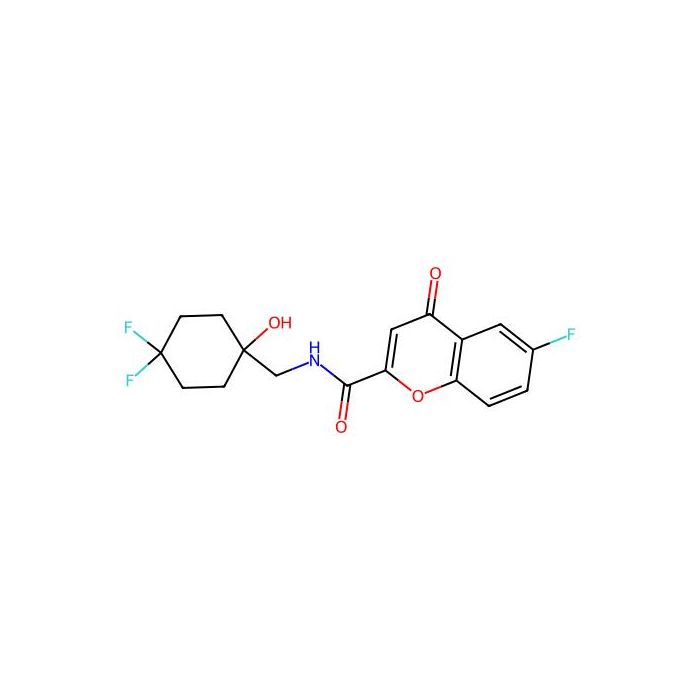
LysRs-IN-2 is a lysyl-tRNA synthetase (KRS) inhibitor with IC 50 s of 0.015 μM and 0.13 μM for Plasmodium falciparum lysyl-tRNA synthetase ( Pf KRS) and Cryptosporidium parvum lysyl-tRNA synthetase ( Cp KRS), respectively
In Vitro
LysRs-IN-2 is active against whole-cell bloodstream P. falciparum 3D7 (EC 50 =0.27 μM), Hs KRS (IC 50 =1.8 μM), HepG2 cells (EC 50 =49 μM), and Cryptosporidium parvum (EC 50 =2.5 µM). MCE has not independently confirmed the accuracy of these methods. They are for reference only.
In Vivo
LysRs-IN-2 (1.5 mg/kg; orally once a day for 4 days) reduces parasitemia by 90% in the murine P. falciparum SCID model. LysRs-IN-2 (20 mg/kg; orally once a day for 7 days) reduces parasite shedding in NOD SCID gamma mice and INF-γ-knockout mice ( Cryptosporidium mouse models) . MCE has not independently confirmed the accuracy of these methods. They are for reference only. Animal Model: Murine P. falciparum NODscidIL2Rγ (SCID) model Dosage: 1.5 mg/kg Administration: Orally once a day for 4 days Result: Reduced parasitemia by 90% in the malaria SCID mouse model. Animal Model: NOD SCID gamma and INF-γ–knockout mouse models ( Cryptosporidium mouse models) Dosage: 20 mg/kg Administration: Orally once a day for 7 days Result: Reduced parasite shedding below detection level, and this reduction was sustained for 3 wk after treatment had stopped in INF-γ-knockout mice.\nDosed orally at a concentration of 20 mg/kg once a day for 7 days showed 96% reduction of parasite shedding comparable to paromomycin in NOD SCID gamma mice.
Form:Solid
IC50& Target:IC50: 0.015 μM ( Pf KRS), 0.13 μM ( Cp KRS)
| Canonical Smiles | C1CC(CCC1(CNC(=O)C2=CC(=O)C3=C(O2)C=CC(=C3)F)O)(F)F |
|---|---|
| IUPAC Name | N-[(4,4-difluoro-1-hydroxycyclohexyl)methyl]-6-fluoro-4-oxochromene-2-carboxamide |
| InChIKey | PJBRCGHQNUWERQ-UHFFFAOYSA-N |
| INCHI | 1S/C17H16F3NO4/c18-10-1-2-13-11(7-10)12(22)8-14(25-13)15(23)21-9-16(24)3-5-17(19,20)6-4-16/h1-2,7-8,24H,3-6,9H2,(H,21,23) |
| Isomeric SMILES | C1CC(CCC1(CNC(=O)C2=CC(=O)C3=C(O2)C=CC(=C3)F)O)(F)F |
| PubChem CID | 134158252 |
| Molecular Weight | 355.31 |
Comprehensive hazard, handling, storage, and regulatory compliance document.
Download SDS →Lot-specific quality data. Enter your lot number to retrieve the exact COA.
Look up COA →Full quality attributes and acceptance criteria for this grade.
View spec sheet →Taxonomy Tree
| Kingdom | Organic compounds |
|---|---|
| Superclass | Organoheterocyclic compounds |
| Class | Benzopyrans |
| Subclass | 1-benzopyrans |
| Intermediate Tree Nodes | Not available |
| Direct Parent | Chromones |
| Alternative Parents | 2-heteroaryl carboxamides Pyranones and derivatives Cyclohexyl halides Cyclohexanols Benzenoids Aryl fluorides Tertiary alcohols Heteroaromatic compounds Secondary carboxylic acid amides Cyclic alcohols and derivatives Oxacyclic compounds Organopnictogen compounds Organonitrogen compounds Organofluorides Organic oxides Hydrocarbon derivatives Alkyl fluorides |
| Molecular Framework | Aromatic heteropolycyclic compounds |
| Substituents | Chromone - 2-heteroaryl carboxamide - Cyclohexyl halide - Pyranone - Cyclohexanol - Benzenoid - Pyran - Aryl halide - Aryl fluoride - Heteroaromatic compound - Tertiary alcohol - Cyclic alcohol - Secondary carboxylic acid amide - Carboxamide group - Oxacycle - Carboxylic acid derivative - Organic nitrogen compound - Organic oxygen compound - Organopnictogen compound - Organic oxide - Hydrocarbon derivative - Organooxygen compound - Organonitrogen compound - Organofluoride - Organohalogen compound - Alkyl halide - Alkyl fluoride - Alcohol - Aromatic heteropolycyclic compound |
| Description | This compound belongs to the class of organic compounds known as chromones. These are compounds containing a benzopyran-4-one moiety. |
| External Descriptors | Not available |
| Solubility | DMSO : ≥ 60 mg/mL (168.87 mM) |
|---|---|
| Molecular Weight | 355.310 g/mol |
| XLogP3 | 2.200 |
| Hydrogen Bond Donor Count | 2 |
| Hydrogen Bond Acceptor Count | 7 |
| Rotatable Bond Count | 3 |
| Exact Mass | 355.103 Da |
| Monoisotopic Mass | 355.103 Da |
| Topological Polar Surface Area | 75.600 Ų |
| Heavy Atom Count | 25 |
| Formal Charge | 0 |
| Complexity | 582.000 |
| Isotope Atom Count | 0 |
| Defined Atom Stereocenter Count | 0 |
| Undefined Atom Stereocenter Count | 0 |
| Defined Bond Stereocenter Count | 0 |
| Undefined Bond Stereocenter Count | 0 |
| The total count of all stereochemical bonds | 0 |
| Covalently-Bonded Unit Count | 1 |