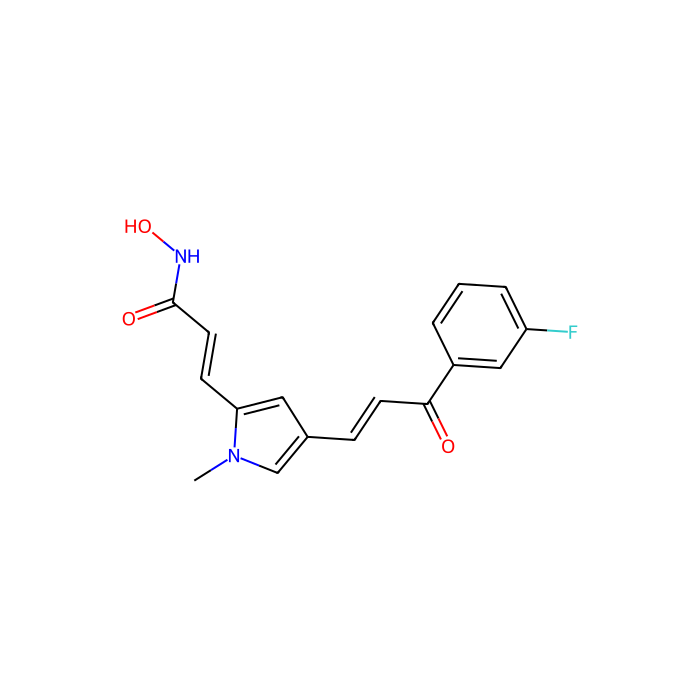
MC1568 - Moligand™, ≥97%(HPLC) , CAS No.852475-26-4

CAS: 852475-26-4 Cat. No.: M127417 Formula: C17H15FN2O3 Molecular Weight: 314.31 EC Number: 685-051-2
AVAILABLE TO ORDER
GRADE & PURITY Moligand™ ? Moligand™ — Aladdin's line of ligands and bioactive small molecules. Use for receptor, pathway, and binding studies needing defined small-molecule tools. ≥97%(HPLC)
Synonyms
3-(4-(3-(3-fluorophenyl)-3-oxoprop-1-enyl)-1-methyl-1H-pyrrol-2-yl)-N-hydroxyacrylamide|(2E)-3-[4-[(1E)-3-(3-Fluorophenyl)-3-oxo-1-propen-1-yl]-1-methyl-1H-pyrrol-2-yl]-N-hydroxy-2-propenamide|3-[5-(3-(3-Fluorophenyl)-3-oxopropen-1-yl)-1-methyl-1h-pyrrol-2-yl]-n-hydroxy-2-propenamide|HDAC-IN-1|(E)-3-{4-[3-(3-Fluoro-phenyl)-3-oxo-propenyl]-1-methyl-1H-pyrrol-2-yl}-N-hydroxy-acrylamide|3-[5-(3-(3-Fluorophenyl)-3-oxoprope n-1-yl)-1-methyl-1H-pyrrol-2-yl]-N-hydroxy-2-prope namide|MC-1568|Lithium bis-(trimethylsilyl)amide|(E)-3-[4-[(E)-3-(3-fluorophenyl)-3-oxoprop-1-enyl]-1-methylpyrrol-2-yl]-N-hydroxyprop-2-enamide|MC 1568|(R)-(-)-2-Acetoxy-2-phenylacetic acid|(E)-3-(4-((E)-3-(3-fluorophenyl)-3-oxoprop-1-enyl)-1-methyl-1H-pyrrol-2-yl)-N-hydroxyacrylamide|(E)-3-(4-((E)-3-(3-fluorophenyl)-3-oxoprop-1-enyl)-1-methyl-1Hpyrrol-2-yl)-N-hydroxyacrylamide|alpha-(Boc-amino)isobutyric acid
Storage
Store at -20°C
Shipped In
Ice chest + Ice pads
★
Size
Germany (EU)
USA*
Price
Qty
5mg
M127417-5mg
—
2 In stock
€40.70
10mg
M127417-10mg
—
2 In stock
€56.32
25mg
M127417-25mg
Made to order · 8–12 wks
€127.47
50mg
M127417-50mg
—
2 In stock
€203.83
100mg
M127417-100mg
—
1 In stock
€340.07
250mg
M127417-250mg
—
2 In stock
€714.93
Enter a quantity for the sizes you want to add.

Overview

MC1568

Specifications

Synonyms
3-(4-(3-(3-fluorophenyl)-3-oxoprop-1-enyl)-1-methyl-1H-pyrrol-2-yl)-N-hydroxyacrylamide | (2E)-3-[4-[(1E)-3-(3-Fluorophenyl)-3-oxo-1-propen-1-yl]-1-methyl-1H-pyrrol-2-yl]-N-hydroxy-2-propenamide | 3-[5-(3-(3-Fluorophenyl)-3-oxopropen-1-yl)-1-methyl-1h-pyrrol-2-yl]-n-hydroxy-2-propenamide | HDAC-IN-1 | (E)-3-{4-[3-(3-Fluoro-phenyl)-3-oxo-p Show more
Specifications & Purity
Moligand™, ≥97%(HPLC)
Biochemical and Physiological Mechanisms
Selective inhibitor of class IIa histone deacetylases (HDACs). Exhibits tissue-selective inhibition between members of class II deacetylasesin vivo; inhibits HDAC4 and HDAC5 in skeletal muscle and the heart without affecting HDAC3 activity. Arrests myogenesis through the stabilization of myocyte enhancer factor 2D (MEF2D)-HDAC3/4 complex. Displays no inhibition of class I HDAC activity or expression.
Storage
Store at -20°C
Shipped In
Ice chest + Ice pads
This product requires cold chain shipping. Ground and other economy services are not available.
Grade
Moligand™
Action Type
INHIBITOR
Purity
≥97%(HPLC)
Names and Identifiers
Pubchem Sid
Pubchem Sid Url
https://pubchem.ncbi.nlm.nih.gov/substance/504766360
SMILES
CN1C=C(C=C1C=CC(=O)NO)C=CC(=O)C2=CC(=CC=C2)F
IUPAC Name
(E)-3-[4-[(E)-3-(3-fluorophenyl)-3-oxoprop-1-enyl]-1-methylpyrrol-2-yl]-N-hydroxyprop-2-enamide
InChIKey
QRDAPCMJAOQZSU-KQQUZDAGSA-N
InChI
1S/C17H15FN2O3/c1-20-11-12(9-15(20)6-8-17(22)19-23)5-7-16(21)13-3-2-4-14(18)10-13/h2-11,23H,1H3,(H,19,22)/b7-5+,8-6+
Isomeric SMILES
CN1C=C(C=C1/C=C/C(=O)NO)/C=C/C(=O)C2=CC(=CC=C2)F
WGK Germany
3
Alternate CAS
852475-26-4
Molecular Weight
314.31
Reaxys
35762245
Reaxys-RN_link_address
https://www.reaxys.com/reaxys/secured/hopinto.do?context=S&query=IDE.XRN=35762245&ln=

Advanced Data

Taxonomic Classification

Taxonomy Tree

KingdomOrganic compounds
SuperclassBenzenoids
ClassBenzene and substituted derivatives
SubclassBenzoyl derivatives
Intermediate Tree Nodes Not available
Direct ParentBenzoyl derivatives
Alternative Parents Aryl ketones  Fluorobenzenes  N-methylpyrroles  Aryl fluorides  Heteroaromatic compounds  Enones  Acryloyl compounds  Hydroxamic acids  Azacyclic compounds  Organonitrogen compounds  Organofluorides  Organic oxides  Hydrocarbon derivatives  
Molecular FrameworkAromatic heteromonocyclic compounds
Substituents Benzoyl - Aryl ketone - Fluorobenzene - Halobenzene - Aryl fluoride - Aryl halide - Substituted pyrrole - N-methylpyrrole - Acryloyl-group - Heteroaromatic compound - Enone - Alpha,beta-unsaturated ketone - Pyrrole - Hydroxamic acid - Ketone - Carboxylic acid derivative - Azacycle - Organoheterocyclic compound - Organooxygen compound - Organic oxygen compound - Organic nitrogen compound - Carbonyl group - Hydrocarbon derivative - Organic oxide - Organonitrogen compound - Organofluoride - Organohalogen compound - Aromatic heteromonocyclic compound
DescriptionThis compound belongs to the class of organic compounds known as benzoyl derivatives. These are organic compounds containing an acyl moiety of benzoic acid with the formula (C6H5CO-).
External Descriptors Not available
3D Structure
Interactive Chemical Structure Model


Associated Targets(Human)
HDAC4 Tclin Histone deacetylase 4 (2328 Activities)
Activity TypeRelationActivity valueUnitsAction TypeJournalPubMed IddoiAssay Aladdin ID
Associated Targets(non-human)
Hdac1 Histone deacetylase 1 (93 Activities)
Activity TypeRelationActivity valueUnitsAction TypeJournalPubMed IddoiAssay Aladdin ID
hda106 Histone deacetylase HD2 (351 Activities)
Activity TypeRelationActivity valueUnitsAction TypeJournalPubMed IddoiAssay Aladdin ID
hd1b Histone deacetylase HD1B (86 Activities)
Activity TypeRelationActivity valueUnitsAction TypeJournalPubMed IddoiAssay Aladdin ID
Mechanisms of Action
Certificates (CoA,COO,BSE/TSE and Analysis Chart)
C of A & Other Certificates(BSE/TSE, COO):
Analytical Chart:

Find and download the COA for your product by matching the lot number on the packaging.

12 results found

Lot NumberCertificate TypeDateItem
I2607151I2607151Certificate of AnalysisSep 18, 2026 M127417
H2421016H2421016Certificate of AnalysisJun 09, 2026 M127417
L2215694L2215694Certificate of AnalysisJun 09, 2026 M127417
L2215697L2215697Certificate of AnalysisJun 09, 2026 M127417
L2215743L2215743Certificate of AnalysisJun 09, 2026 M127417
L2215821L2215821Certificate of AnalysisJun 09, 2026 M127417
L2215822L2215822Certificate of AnalysisJun 09, 2026 M127417
K2124280K2124280Certificate of AnalysisSep 19, 2023 M127417
K2124281K2124281Certificate of AnalysisSep 19, 2023 M127417
K2124282K2124282Certificate of AnalysisSep 19, 2023 M127417
K2124299K2124299Certificate of AnalysisSep 19, 2023 M127417
L2215690L2215690Certificate of AnalysisJul 27, 2022 M127417
Chemical and Physical Properties
SolubilitySolvent:DMSO, Max Conc. mg/mL: 31.43, Max Conc. mM: 100
Molecular Weight314.31
XLogP31.800
Hydrogen Bond Donor Count2
Hydrogen Bond Acceptor Count4
Rotatable Bond Count5
Exact Mass314.107 Da
Monoisotopic Mass314.107 Da
Topological Polar Surface Area71.300 Ų
Heavy Atom Count23
Formal Charge0
Complexity492.000
Isotope Atom Count0
Defined Atom Stereocenter Count0
Undefined Atom Stereocenter Count0
Defined Bond Stereocenter Count2
Undefined Bond Stereocenter Count0
The total count of all stereochemical bonds2
Covalently-Bonded Unit Count1
Safety and Hazards(GHS)
x_symbol
x_signal_word
Warning
x_hazard_statements

H319:Causes serious eye irritation

x_precautionary_statements

P280:Wear protective gloves/protective clothing/eye protection/face protection.

P305+P351+P338:IF IN EYES: Rinse cautiously with water for several minutes. Remove contact lenses if present and easy to do - continue rinsing.

P264+P265:Wash hands [and …] thoroughly after handling. Do not touch eyes.

P337+P317:If eye irritation persists: Get medical help.

x_wgk_germany
3
x_reaxy_rn
35762245
x_reaxys_rn_link_address
https://www.reaxys.com/reaxys/secured/hopinto.do?context=S&query=IDE.XRN=35762245&ln=
Solution Calculators
Reviews

Customer Reviews

Application Protocols

No tested application protocols are provided in the product data for this item.

General starting points for small-molecule probe use (adapt to your platform):

  • Preparation of 10 mM DMSO stock: Accurately weigh compound under dry conditions. Dissolve to 10 mM in anhydrous DMSO. Vortex/sonicate as needed. Aliquot into low-bind tubes, flush with inert gas if possible, and store at −20°C protected from light.
  • Enzyme inhibition assay (example framework):
    • Enzyme: Recombinant target enzyme in an optimized buffer (e.g., HEPES, pH 7.5, with co-factors/salts per vendor).
    • Substrate: Fluorogenic acetylated peptide (for HDAC assays) at Km-range concentration.
    • Dosing: 10-point 1:3 serial dilution of compound (final DMSO 0.5% v/v across all wells).
    • Incubation: Preincubate compound with enzyme 15–30 min at 25–37°C; initiate with substrate.
    • Readout: Measure fluorescence increase vs. time; fit concentration–response to a four-parameter model.
  • Cell-based assay (framework): Determine non-toxic DMSO levels for your cell line; dose across a concentration range with appropriate time courses; pair with target engagement or pathway biomarkers.

These are generic templates. Optimize all parameters (enzyme source, buffer, temperature, time) empirically. Refer to the item’s CoA/SDS and primary literature for any compound-specific nuances.

Biological Roles

Context from literature (not item-specific claims):

  • MC1568 is reported as a chemical probe used to study epigenetic regulation via histone deacetylases (HDACs), particularly class IIa isoforms. It has been employed to dissect acetylation-dependent modulation of chromatin structure and transcriptional control in cell-free and cellular systems.
  • Role in pathway studies: By modulating HDAC catalytic or scaffolding functions, such probes help map signaling networks, feedback regulation, and crosstalk with kinases and transcription factors. They are valuable for time-resolved perturbation studies and for benchmarking structure–activity relationships (SAR) within HDAC-focused libraries.
  • Selectivity considerations: Probe selection requires understanding isoform selectivity, off-target profiles, and concentration windows that separate on-target engagement from polypharmacology. Orthogonal probes and genetic tools (e.g., siRNA/CRISPR) are recommended to corroborate findings.

Practical biochemical notes:

  • Enzyme sources: Recombinant HDAC domains vs. multi-protein complexes can yield different pharmacology; define your biological system precisely.
  • Readouts: Pair activity assays with complementary methods (CETSA for target engagement, chemoproteomics for selectivity, or global acetyl-lysine profiling by MS) to contextualize outcomes.

Important: The above summarizes general literature use of MC1568-like probes for research only. No therapeutic, diagnostic, or clinical utility is claimed or implied for this catalog item.

Buffer Applications

This product is not a buffering agent. It does not define pH or ionic strength and is not typically used to prepare classical biological buffers.

Practical notes for assay buffers (general guidance when dosing small-molecule probes):

  • Use a biologically relevant buffer (e.g., HEPES, Tris, or phosphate) optimized for your enzyme/cell system.
  • Maintain constant DMSO percentage across controls and test wells to avoid solvent artifacts.
  • Consider adding 0.01–0.1% nonionic surfactant to reduce nonspecific adsorption when working at sub-micromolar concentrations.

For buffer recipes, pH ranges, and compatibility, refer to the documentation of your chosen buffer system. MC1568 itself provides no buffering capacity.

Green Alternatives

As a bioactive screening compound, the “green” considerations center on solvent selection, handling, and waste minimization rather than substituting the molecule itself.

Greener handling strategies:

  • Prefer aqueous assay buffers with minimal DMSO carryover (≤0.1–0.5% v/v) while preserving solubility.
  • Use microscale assay formats (384/1536-well) to reduce solvent usage and hazardous waste.
  • Choose lower-impact solvents for any ancillary processing (e.g., ethanol or isopropanol for rinse steps instead of chlorinated solvents where feasible).

Comparison of common vehicles (general):

| Vehicle | Greenness/Notes | Typical Use | | --- | --- | --- | | DMSO | Widely accepted; low volatility; biodegradable but high COD—minimize volumes | Primary stock solvent for screening compounds | | Ethanol | Renewable routes available; higher volatility; better EHS profile | Alternative vehicle at low % in biology | | DMF | Reprotoxic concerns; challenging waste profile | Reserve for synthetic steps only |

Operational best practices:

  • Consolidate shipments and maintain cold-chain to avoid re-synthesis and waste.
  • Aliquot to reduce discard from stability losses.
  • Use sealed plates/tubes to limit evaporative losses and VOC exposure.

Note: No greener “structural alternative” is proposed here because MC1568’s utility derives from its specific interaction profile. Selection of orthogonal probes should be guided by target validation needs and published probe quality criteria.

Pharmaceutical Uses

No pharmacopeial or excipient role is specified for this item. MC1568 is provided strictly for research use (e.g., target validation, chemical biology, screening) and not for human or veterinary use.

Context (general):

  • Probe compounds like MC1568 are frequently used in discovery research to explore target tractability and response phenotypes. They are not manufactured to GMP standards unless explicitly stated and are unsuitable for formulation development intended for clinical administration.
  • If used in preclinical laboratory experiments (e.g., in vitro ADME or biochemical assays), ensure appropriate documentation, analytical characterization (purity/identity), and chain-of-custody within your research QA framework.

Regulatory note:

  • No therapeutic claims are made. This product is not a drug substance, API, or excipient and has no stated pharmacopeial monograph.

For any work beyond basic research (e.g., regulated studies), consult your institutional QA and request detailed CoA/SDS, impurity profiles, and stability data. Absent explicit supplier certification, do not use for clinical or diagnostic purposes.

Physical Properties

Item-specific physicochemical specifications are not provided in this record.

  • Appearance: Not specified for this item; refer to CoA/Spec Sheet.
  • Molecular Weight: Not specified for this item; refer to CoA/Spec Sheet.
  • Molecular Formula: Not specified for this item; refer to CoA/Spec Sheet.
  • Melting point, boiling point, density, refractive index, water/peroxide/metal limits, UV cutoff: Not specified for this item; refer to CoA/Spec Sheet.

General/literature-based expectations for small-molecule screening probes (context only):

  • Aggregation/solubility: Many HDAC-targeted chemotypes are moderately lipophilic and are most reliably dissolved in anhydrous DMSO to prepare 10–50 mM stocks, then diluted into aqueous assay buffers (final DMSO ≤0.1–1% v/v depending on assay tolerance). Always confirm solubility and absence of precipitation upon dilution.
  • pKa/logP: HDAC ligands frequently possess neutral or weakly basic/acidic functional groups leading to modest ionization near physiological pH; exact values for MC1568 must be obtained from primary literature or computed specifically from its verified structure.
  • Stability: Aromatic amide/auxophore chemotypes are often stable as dry solids when protected from light, heat, and moisture. In solution (especially DMSO/water), long-term stability can vary; prepare aliquots and minimize freeze–thaw.

Important: Do not treat the above as item specifications. Use the item’s CoA/SDS and your own characterization to establish working properties for your lab.

Quality and Grades
  • Grade/Purity: Moligand™ (as provided). This designation indicates inclusion in a small-molecule/ligand library intended for research screening and chemical biology. It typically emphasizes identity, purity suitable for in vitro assays, and reproducibility of activity profiling rather than solvent-grade optical characteristics.

What Moligand™ typically implies (general guidance):

  • Intended use: High-value ligands for target validation, pathway interrogation, or phenotypic screening.
  • Purity: Optimized for biochemical/cellular assays (commonly ≥95% by HPLC/LC–MS in many libraries), but the exact minimum for this item is Not specified for this item; refer to CoA/Spec Sheet.
  • Authentication: Supplied with key identifiers (e.g., CAS/CID) and typically backed by analytical data (HPLC/LC–MS, NMR) in the CoA.

What is NOT implied:

  • Chromatography solvent grades (HPLC/GC/UV cutoff), elemental metal limits, water/peroxide levels, or pharmacopeial compliance are not indicated by the Moligand™ label unless explicitly stated.

Batch-to-batch considerations:

  • For screening campaigns, lock a single lot for primary/confirmatory assays when feasible.
  • Request and archive CoA/SDS for your LIMS, and record re-testing (purity, identity) upon receipt if your QA policy requires it.

Stabilizers/additives:

  • Any stabilizer content is Not specified for this item; refer to CoA/Spec Sheet.
Reaction and Applications

Primary use case: MC1568 is supplied as a research ligand for chemical biology and screening. It is not typically employed as a synthetic reagent.

Research applications (general):

  • Chemical probe for epigenetics: Widely used in vitro to interrogate histone deacetylase (HDAC) biology in enzymatic and cell-based assays (literature context). Enables target/pathway validation, SAR benchmarking, and chemogenomic profiling. No medical or clinical claims are implied.
  • Assay formats: Biochemical HDAC activity assays (fluorogenic peptide substrates), Alpha/HTRF binding assays, thermal shift (CETSA/DSF), and cellular target engagement readouts (literature). Optimize substrates, enzyme sources, and detection windows for your platform.

Practical considerations:

  • Stock preparation: Dissolve in dry DMSO; filter (0.22 µm PTFE) if needed. Store aliquots at −20°C; avoid repeated freeze–thaw.
  • Adsorption/aggregation: Use low-bind plastics and include detergent where appropriate to minimize nonspecific loss or false positives/negatives.
  • Controls: Include a well-characterized positive control inhibitor and multiple DMSO controls to define assay windows; perform concentration–response with at least 10–12 points, 1:2–1:3 serial dilutions.

Note: If using MC1568 in any chemical reaction (uncommon), validate compatibility as a neutral organic substrate; avoid conditions that could hydrolyze amide functions or oxidize sensitive motifs. No reaction-class-specific behavior is specified for this item.

Reaction Conditions

As sold, MC1568 is intended for biological assays rather than for use as a reagent in chemical synthesis. Therefore, no item-specific reaction conditions are provided.

General guidance for assay preparation and dosing (research context):

  • Stock preparation: Dissolve accurately weighed material in anhydrous DMSO to 10–50 mM. Sonication or gentle warming (≤37°C) can help dissolution; avoid prolonged heating.
  • Dilution into assay: Add DMSO stocks to buffered systems to reach the desired final concentration while keeping DMSO constant across wells (commonly 0.1–1% v/v). Mix thoroughly; check for precipitation or turbidity.
  • Incubation: For enzyme inhibition assays, preincubate compound with enzyme for 10–30 min at assay temperature to reach equilibrium (optimize empirically). For cellular assays, consider time-course experiments to understand onset and reversibility.
  • Controls: Include vehicle controls, positive control inhibitors, and non-specific controls to monitor assay performance (Z′ factor) and compound interference with detection (fluorescence, absorbance, luminescence).

If performing chemical transformations on MC1568 (uncommon):

  • Choose neutral to mildly basic conditions for amide-containing scaffolds; avoid strong acids/bases or oxidants unless stability is known.
  • Typical organic solvents (DCM, MeCN, THF, DMF) may be used depending on the step; purge oxygen/moisture if sensitive moieties are present.

All conditions above are general literature practices; they are not specifications for this item.

Safety and Handling

Hazard classification details are not provided in the product data and may vary by batch/source.

  • GHS Classification: Not specified for this item; refer to SDS.
  • Signal Word / H-Statements / Pictograms: Not specified for this item; refer to SDS.

General laboratory safety guidance for bioactive small molecules:

  • PPE: Wear lab coat, safety glasses, and appropriate chemically resistant gloves (e.g., nitrile). Work in a fume hood to avoid inhalation of dust or aerosols.
  • Avoid exposure: Bioactive screening ligands can display potent target engagement at low concentrations. Prevent skin contact, ingestion, and inhalation. Handle powders gently; consider weighing into sealed vials or using pre-dosed aliquots.
  • First aid (general): In case of skin/eye contact, rinse with water for ≥15 minutes; remove contaminated clothing. If inhaled, move to fresh air. If ingested, rinse mouth. Seek medical attention per institutional procedures. Defer to SDS for authoritative measures.
  • Incompatibilities: Absent specific data for MC1568, avoid strong oxidizers, strong acids/bases, and reactive acylating/chlorinating agents. Protect from light and moisture to preserve integrity.
  • Waste: Collect in organic hazardous waste. Deactivate and dispose per local regulations and institutional EHS policies.

Always consult the official SDS for this specific item prior to first use. Implement risk assessments (COSHH/Job Hazard Analysis) appropriate for your scale and assay context.

Solvent Selection

MC1568 is a bioactive organic small molecule. Item-specific solubility data are not provided.

Practical solvent guidance (general):

  • Stock solutions: DMSO is the default for small-molecule libraries due to excellent solvency and assay compatibility. Prepare concentrated stocks (e.g., 10–50 mM) and dilute into aqueous buffers immediately before use.
  • Aqueous buffers: Many bioactive compounds have limited aqueous solubility; maintain final DMSO below the assay’s tolerance (often 0.1–1% v/v). Include 0.01–0.1% nonionic surfactant (e.g., Tween-20) in some biochemical assays if nonspecific adsorption is observed.
  • Alternative solvents: DMF or ethanol can be used to pre-dissolve in cases where DMSO is problematic for the biological system. For chemical manipulations (if any), anhydrous acetonitrile, THF, or ethyl acetate may be suitable depending on the transformation.

Polarity/miscibility (context):

  • DMSO: Polar aprotic, fully miscible with water—favored for screening stocks.
  • Ethanol: Protic, water-miscible—useful for some cell-based contexts at low %.
  • Aqueous buffers: Use co-solvent strategies; monitor for precipitation upon dilution.

Comparison (general):

  • DMSO vs DMF: DMSO is usually preferred for biocompatibility; DMF may extract plastics and is less tolerated biologically.

Always empirically verify solubility and stability of MC1568 in your chosen vehicle; consult the item’s CoA for any solvent-specific notes if available.

Storage and Reconstitution

Storage conditions (item-specific):

  • Store at −20°C (as provided).
  • Shipped in ice chest with ice pads to maintain cold chain.

General best practices for small-molecule probes:

  • Solid form: Keep tightly closed in the original container, under inert atmosphere or desiccant if possible. Protect from light and moisture.
  • Reconstitution: Dissolve in anhydrous DMSO to prepare a concentrated stock (e.g., 10–50 mM). Filter through a 0.22 µm PTFE syringe filter if particulates are present. Record exact concentration and date.
  • Aliquoting: Dispense single-use aliquots to minimize freeze–thaw and headspace moisture uptake. Store aliquots at −20°C or below, protected from light.
  • Stability monitoring: Periodically check by LC–MS/HPLC for degradation (new peaks, reduced purity). Discard solutions showing precipitation, discoloration, or significant purity loss.
  • Handling cold materials: Allow vials to equilibrate to room temperature in a desiccator before opening to prevent condensation.

Re-freeze guidance:

  • Avoid repeated freeze–thaw cycles of DMSO stocks; thaw quickly at room temperature, use immediately, and return unused, still-frozen aliquots to storage. For long-term storage (>6–12 months), consider −80°C for solutions if compatible.

Note: Where exact solubility, pH stability, or light sensitivity are critical, consult the CoA/SDS or generate internal stability data under your lab’s conditions.

Structure and Identity

MC1568 is a bioactive small molecule supplied under the Moligand™ line. Item-specific structural identifiers are limited in the provided data.

  • SKU: M127417
  • Product Name: MC1568 (research chemical)
  • CAS: 852475-26-4 (literature identifier for MC1568)
  • CID: 11381449 (literature, PubChem)
  • InChIKey: 304324 (as provided; note: this does not follow the typical 27-character InChIKey format)
  • SMILES: Not specified for this item; refer to CoA/Spec Sheet.
  • Molecular Formula: Not specified for this item; refer to CoA/Spec Sheet.
  • Molecular Weight: Not specified for this item; refer to CoA/Spec Sheet.

Structural features (general, literature context):

  • MC1568 is widely cited as a class IIa histone deacetylase (HDAC) chemical probe. Published depictions typically show an aromatic, amide-bearing scaffold designed to chelate/coordinate within the HDAC active site and engage the class IIa pocket. Exact atom connectivity and stereochemistry should be verified from the primary literature or supplier CoA/SDS.

2D structure (descriptive, literature):

  • Commonly represented as a multi-ring aromatic core bearing an amide/auxophore motif and heteroatoms capable of hydrogen bonding to HDAC residues. As the precise structure is not included in this product record, consult peer-reviewed sources or the item’s CoA for definitive structure before quantitative work or registration in ELNs/LIMS.

Identity confirmation recommendations:

  • Verify by NMR (1H/13C), HRMS, and HPLC purity against literature spectra where available.
  • Cross-check CAS and CID with institutional databases before use in screening campaigns.
Synthetic Utility

MC1568 is primarily a finished bioactive probe and is not typically used as a synthetic building block.

General retrosynthetic context (literature-informed but not item-specific):

  • Reported HDAC probes often arise from convergent assembly of an aromatic/heteroaromatic cap, a linker region, and a metal-binding/interaction motif (e.g., amide, hydroxamate, ketone, or related). Common disconnections include: (i) amide coupling (acid chloride or coupling reagent) between a carboxylic acid fragment and an aniline/amine, and (ii) cross-coupling (Suzuki/Heck/Buchwald–Hartwig) to elaborate aryl–aryl or aryl–heteroaryl linkages.
  • Protecting-group strategy: If a hydroxamate or sensitive auxophore is present in the target scaffold (general HDAC chemotypes), it is often introduced late to avoid instability during cross-couplings or strong base conditions.

If derivatization is desired (e.g., for SAR or PROTAC linker exploration):

  • Identify a modifiable position (para/meta aryl substituent or amide N-substituent) as indicated by literature SAR.
  • Use mild conditions (peptide couplings, late-stage C–H functionalization, or chemoselective acylations) to preserve the rest of the scaffold.

Caveat: Without the exact structure from the CoA or primary publication, do not assume reactivity or compatibility. Verify functional groups and stability by small-scale test reactions and orthogonal analytics (LC–MS, NMR).

Target Specificity

Item-specific target data are not provided in the product record.

  • Target/Antigen: Not specified for this item; refer to CoA/Spec Sheet.
  • Species reactivity, isotype/clone (if applicable), epitope: Not applicable; this is a small-molecule reagent, not an antibody or protein.

Literature context (for planning only, not a specification):

  • MC1568 has been reported as a chemical probe used to interrogate class IIa histone deacetylases in biochemical and cellular studies. Selectivity profiles, Ki/IC50 values, and off-targets should be confirmed from peer-reviewed sources and independently validated under your assay conditions.

Recommendation:

  • Before critical experiments, acquire or generate a target engagement dataset (e.g., biochemical IC50, CETSA shift, chemoproteomic pull-down) to define specificity in your system. Use orthogonal probes or genetic perturbation to corroborate findings.

Note: The supplier makes no claim here regarding potency or selectivity; consult the CoA/SDS and primary literature.

Frequently Asked Questions

What is the purity of this product, and how is it determined?
This product is supplied at ≥97% purity, determined by HPLC. Lot-specific values are stated on the Certificate of Analysis.
What is Moligand??
Moligand? is one of Aladdin Scientific's premium product lines, formulated for high-purity applications across multiple workflows. Compared to standard grades in the same workflow, Moligand? products typically offer tighter specifications, more rigorous QC, and stronger lot-to-lot consistency.
How should this product be stored?
Store at ?20 °C. Freezer storage is required to maintain the specified shelf life.
How is this product shipped?
This product ships in an insulated container with ice pads. Unpack on arrival and transfer it to the storage condition stated above.
What are the CAS number, molecular formula and molecular weight?
The CAS Number is 852475-26-4, the molecular formula is C17H15FN2O3, and the molecular weight is 314.31 g/mol. InChIKey QRDAPCMJAOQZSU-KQQUZDAGSA-N.
What documentation is provided?
Available product documentation, including Certificates of Analysis (COA), Safety Data Sheets (SDS), and specification sheets, is shown in the product document area. Document availability and access follow the current site policy.

Shall we send you a message when we have discounts available?

Remind me later

Thank you! Please check your email inbox to confirm.

Oops! Notifications are disabled.