≥99% for sensitive chromatographic and analytical workflows requiring minimal baseline interference.
🌡
Storage & shipping
Store at 2-8°C,Desiccated Ships Wet ice Check lot-specific COA for exact specifications.
📋
Quality documents
SDS, COA, datasheet, and spec sheet available for download. Lot-specific COA accessible via lot number lookup.
📚
Literature proof
Cited in 0 peer-reviewed publications across chromatography, organic synthesis, and cross-coupling reactions.
Overview
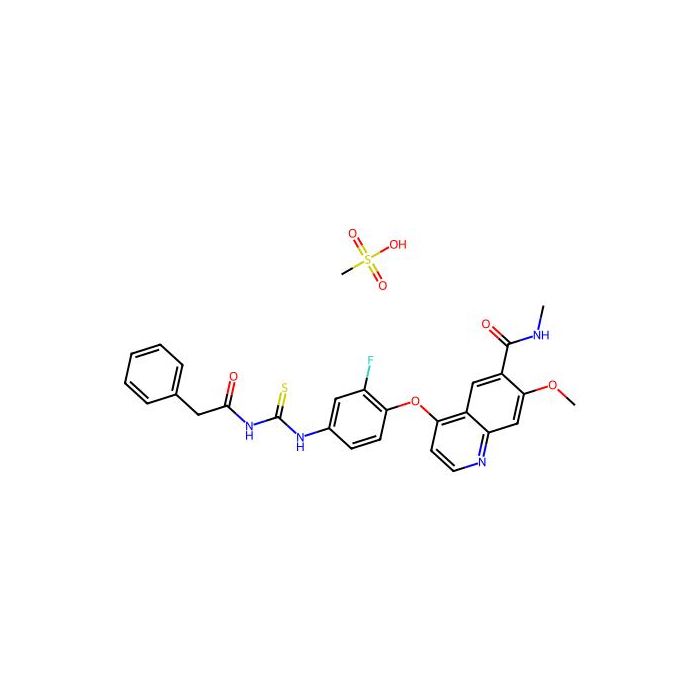
Pamufetinib (TAS-115) mesylate is a potent VEGFR and hepatocyte growth factor receptor ( c-Met/HGFR )-targeted kinase inhibitor, with IC 50 s of 30 and 32 nM for rVEGFR2 and rMET, respectively.
In Vitro
Pamufetinib mesylate powerfully suppresses the VEGF-dependent proliferation of HUVECs (IC 50 =0.019 μM) as a VEGFR-targeted inhibitor and powerfully suppresses the proliferation of MET-amplified cancer cells (GI 50 =0.032-0.362 μM) as a MET-targeted inhibitor. Pamufetinib mesylate has much less toxicity in various normal cell lines when compared with other VEGFR-targeted kinase inhibitors. Crizotinib and Pamufetinib mesylate inhibit Met phosphorylation and reverse erlotinib resistance and VEGF production triggered by HGF in PC-9 and HCC827 cells. MCE has not independently confirmed the accuracy of these methods. They are for reference only.
In Vivo
Pamufetinib mesylate completely suppresses the progression of MET-inactivated tumor by blocking angiogenesis without toxicity when given every day for 6 weeks, even at a serum-saturating dose of Pamufetinib mesylate. Pamufetinib mesylate induces marked tumor shrinkage and prolonges survival in MET-amplified human cancer–bearing mice . MCE has not independently confirmed the accuracy of these methods. They are for reference only.
Cell Assay
Tumor cells (8000 cells/800 mL) with or without TAS-115 (1.0 μM) or erlotinib (0.3 μM) in the lower Transwell collagen–coated chambers are cocultured with MRC-5 (1000 cells/300 μL) cells in the upper chamber for 72 hours. The upper chamber is then removed. Cell viability is measured using the MTT assay. MCE has not independently confirmed the accuracy of these methods. They are for reference only.
Pamufetinib (TAS-115) mesylate is a potent VEGFR and hepatocyte growth factor receptor ( c-Met/HGFR )-targeted kinase inhibitor, with IC 50 s of 30 and 32 nM for rVEGFR2 and rMET, respectively.
Storage
Store at 2-8°C, Desiccated
Shipped In
Wet ice
This product requires cold chain shipping. Ground and other economy services are not available.
We use cookies to ensure the website functions properly and, where permitted, to improve your experience. You can manage your preferences at any time in Settings. Learn more in our Cookie Policy.
Shall we send you a message when we have discounts available?
Remind me later
Thank you! Please check your email inbox to confirm.
Products are supplied to verified businesses, institutions, and qualified professionals for research and development use only. Not for use in humans, animals, diagnosis, or therapy.