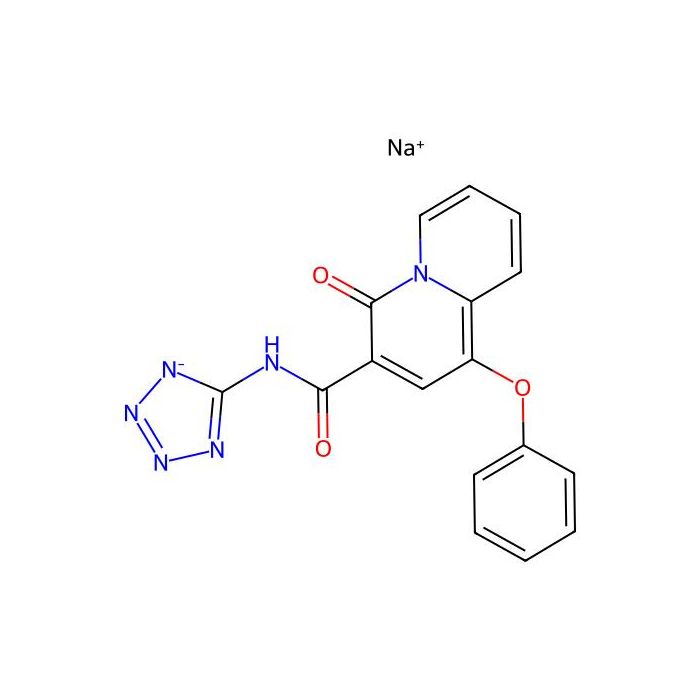
Quinotolast sodium in the concentration range of 1-100 μg/mL inhibits histamine , LTC 4 and PGD 2 release in a concentration-dependent manner.
In Vitro
Quinotolast inhibits the release of histamine and the generation of leukotriene (LT) C 4 and prostaglandin (PG) D 2 from dispersed human lung cells. Quinotolast (100 μg/mL) significantly inhibits PGD 2 and LTC 4 release. Quinotolast inhibits PGD 2 release by 100% and LTC 4 release by 54%. The inhibitory effect of Quinotolast on histamine release from dispersed lung cells is largely independent of the preincubation period, no tachyphylaxis being observed. Quinotolast shows a significant inhibition of inflammatory mediators from human dispersed lung cells. Quinotolast also shows strong inhibitory effects on histamine and peptide leukotrienes release from guinea pig lung fragments or mouse cultured mast cells. Quinotolast concentration-dependently inhibits pLTs release from cultured mast cells. The IC 50 value for Quinotolast is 0.72 μg/mL. MCE has not independently confirmed the accuracy of these methods. They are for reference only.
In Vivo
Quinotolast potently inhibits such type I allergic reactions as passive cutaneous anaphylaxis (PCA) and anaphylactic bronchoconstriction in rats by both intravenous and oral dosing. When Quinotolast is given i.v. to rats, Quinotolast, dose-dependently inhibits PCA. The doses of Quinotolast required to inhibit the reaction by 50% (ED 50 ) is 0.0063 mg/kg. Given p.o., Quinotolast inhibits the reaction. ED 50 value for Quinotolast is 0.0081 mg/kg. Although almost complete inhibition is observed with Quinotolast at a dose of 0.32 mg/kg, its effect is slightly attenuated at a dose of 1 mg/kg. MCE has not independently confirmed the accuracy of these methods. They are for reference only.
Cell Assay
Mast cells are obtained after the culture of bone marrow cells from the femurs of female BDF 1 mice in the presence of conditioned medium from WEHI-3 cells containing interleukin 3. The cells are suspended with Tyrode's buffer (137 mM NaCI, 2.7 mM KC1, 1.8 mM CaCl 2 , 1 mM MgCl 2 , 0.4 mM NaH 2 PO 4 , 11.9 mM NaHCO 3 , 5.6 mM glucose) containing 0.1% gelatin and are sensitized with mouse monoclonal anti-DNP IgE (50 μg/10 6 cells). Then the cells are washed and resuspended with Tyrode's buffer containing 0.25% BSA. The cells (2×10 6 cells) are incubated for 5 min at\n37°C and challenged with TNP-BSA (2 ng BSA/mL). Quinotolast (0.1, 1, 10, 100 ug/mL) is added to the reaction tube simultaneously with the antigen. Ten minutes later, the reaction is stopped by the addition of EDTA (2.7 mM). pLTs in the cell supernatant sre quantified as immunoreactive leukotriene C 4 (iLTC 4 ) with a leukotriene C 4 /D 4 /E 4 [ 3 H] assay system. % Inhibition is calculated in each experiment from the amount of immunoreactive leukotriene C 4 (iLTC 4 ). MCE has not independently confirmed the accuracy of these methods. They are for reference only.
Animal administration
Rats Rats (8 week-old) are used. To study the presence of tachyphylaxis by Quinotolast, Quinotolast (0.001, 0.01, 0.1, 1,10 and 100 mg/kg) is given i.v. in a large dose 30 min before challenge, and again at a smaller dose simultaneously with the antigen challenge. aladdin has not independently confirmed the accuracy of these methods. They are for reference only.
Form:Solid
IC50& Target:Histamine LTC 4