Determine the necessary mass, volume, or concentration for preparing a solution.
≥98% for sensitive chromatographic and analytical workflows requiring minimal baseline interference.
Store at -20°C Ships Ice chest + Ice pads Check lot-specific COA for exact specifications.
SDS, COA, datasheet, and spec sheet available for download. Lot-specific COA accessible via lot number lookup.
Cited in 0 peer-reviewed publications across chromatography, organic synthesis, and cross-coupling reactions.
Information
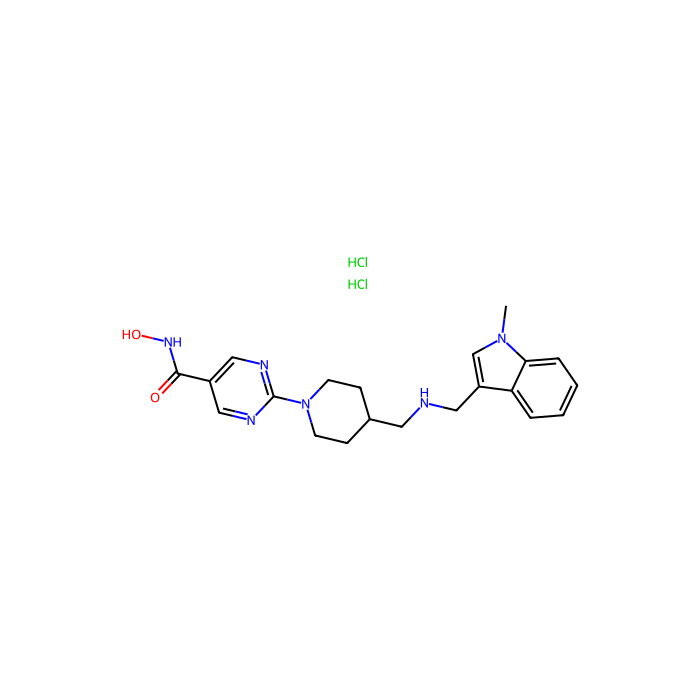
Quisinostat (JNJ-26481585) 2HCl is a novel second-generationHDACinhibitor with highest potency for HDAC1 withIC50of 0.11 nM in a cell-free assay, modest potent to HDACs 2, 4, 10, and 11; greater than 30-fold selectivity against HDACs 3, 5, 8, and 9 and lowest potency to HDACs 6 and 7. Phase 2.
Targets
HDAC1 (Cell-free assay); HDAC2 (Cell-free assay); HDAC11 (Cell-free assay); HDAC10 (Cell-free assay); HDAC4 (Cell-free assay) 97,0.11 nM; 0.33 nM; 0.37 nM; 0.46 nM; 0.64 nM
In vitro
JNJ-26481585 exhibits broad spectrum antiproliferative activity in solid and hematologic cancer cell lines, such as all lung, breast, colon, prostate, brain, and ovarian tumor cell lines, with IC50 ranging from 3.1-246 nM, which is more potent than vorinostat, R306465, panobinostat, CRA-24781, or mocetinostat in various human cancer cell lines tested. A recent study shows that JNJ-26481585 promotes myeloma cell death at low nanomolar concentrations by resulting in Mcl-1 depletion and Hsp72 induction.
In vivo
In an HDAC1-responsive A2780 ovarian tumor screening model, JNJ-26481585 dosing at its maximal tolerated dose (10 mg/kg i.p. and 40 mg/kg p.o.) for 3 days leads to an HDAC1-regulated fluorescence , which predicts tumor growth inhibition. Furthermore, JNJ-26481585 also shows more potent inhibitory effects on the growth of C170HM2 colorectal liver metastases than 5-fluorouracil/Leucovorin.
Cell Research(from reference)
Cell lines:NCL-H2106, Colo699 and LNCAP cells
Concentrations:0-300 nM
Incubation Time:24 hours
| ALogP | 2.749 |
|---|---|
| HBD Count | 2 |
| Rotatable Bond | 6 |
| Pubchem Sid | 504772960 |
|---|---|
| Pubchem Sid Url | https://pubchem.ncbi.nlm.nih.gov/substance/504772960 |
| Canonical Smiles | CN1C=C(C2=CC=CC=C21)CNCC3CCN(CC3)C4=NC=C(C=N4)C(=O)NO.Cl.Cl |
| IUPAC Name | N-hydroxy-2-[4-[[(1-methylindol-3-yl)methylamino]methyl]piperidin-1-yl]pyrimidine-5-carboxamide;dihydrochloride |
| InChIKey | NRUIZESXVMJDKR-UHFFFAOYSA-N |
| INCHI | 1S/C21H26N6O2.2ClH/c1-26-14-17(18-4-2-3-5-19(18)26)11-22-10-15-6-8-27(9-7-15)21-23-12-16(13-24-21)20(28)25-29;;/h2-5,12-15,22,29H,6-11H2,1H3,(H,25,28);2*1H |
| PubChem CID | 122129987 |
| Molecular Weight | 467.39 |
Comprehensive hazard, handling, storage, and regulatory compliance document.
Download SDS →Lot-specific quality data. Enter your lot number to retrieve the exact COA.
Look up COA →Full quality attributes and acceptance criteria for this grade.
View spec sheet →| Solubility | Solubility (25°C) In vitro DMSO: 79 mg/mL (169.02 mM); Water: Insoluble; Ethanol: Insoluble; |
|---|---|
| DMSO(mg / mL) Max Solubility | 79 |
| DMSO(mM) Max Solubility | 169.0237275 |
| Water(mg / mL) Max Solubility | <1 |
| Molecular Weight | 467.400 g/mol |
| XLogP3 | |
| Hydrogen Bond Donor Count | 5 |
| Hydrogen Bond Acceptor Count | 6 |
| Rotatable Bond Count | 6 |
| Exact Mass | 466.165 Da |
| Monoisotopic Mass | 466.165 Da |
| Topological Polar Surface Area | 95.300 Ų |
| Heavy Atom Count | 31 |
| Formal Charge | 0 |
| Complexity | 533.000 |
| Isotope Atom Count | 0 |
| Defined Atom Stereocenter Count | 0 |
| Undefined Atom Stereocenter Count | 0 |
| Defined Bond Stereocenter Count | 0 |
| Undefined Bond Stereocenter Count | 0 |
| The total count of all stereochemical bonds | 0 |
| Covalently-Bonded Unit Count | 3 |