GRADE & PURITYCarrier Free?Carrier-free — supplied without added carrier protein/stabilizer. Use when carriers (e.g. BSA) would interfere with conjugation or sensitive assays.His Tag?His tag grade — recombinant protein bearing a His tag for affinity purification/detection. Use to purify, immobilize, or detect the tagged protein.≥90%(SDS-PAGE)See COA
Carrier Free,His-Tag,≥90%(SDS-PAGE),See COA Carrier Free,His Tag for sensitive chromatographic and analytical workflows requiring minimal baseline interference.
🌡
Storage & shipping
Store at -20°C,Avoid repeated freezing and thawing Ships Ice chest + Ice pads Check lot-specific COA for exact specifications.
📋
Quality documents
SDS, COA, datasheet, and spec sheet available for download. Lot-specific COA accessible via lot number lookup.
📚
Literature proof
Cited in 0 peer-reviewed publications across chromatography, organic synthesis, and cross-coupling reactions.
Specifications
Product Name
Recombinant Human Glutathione Peroxidase 4 Protein
Protects cells against membrane lipid peroxidation and cell death. Required for normal sperm development and male fertility. Could play a major role in protecting mammals from the toxicity of ingested lipid hydroperoxides. Essential for embryonic developm
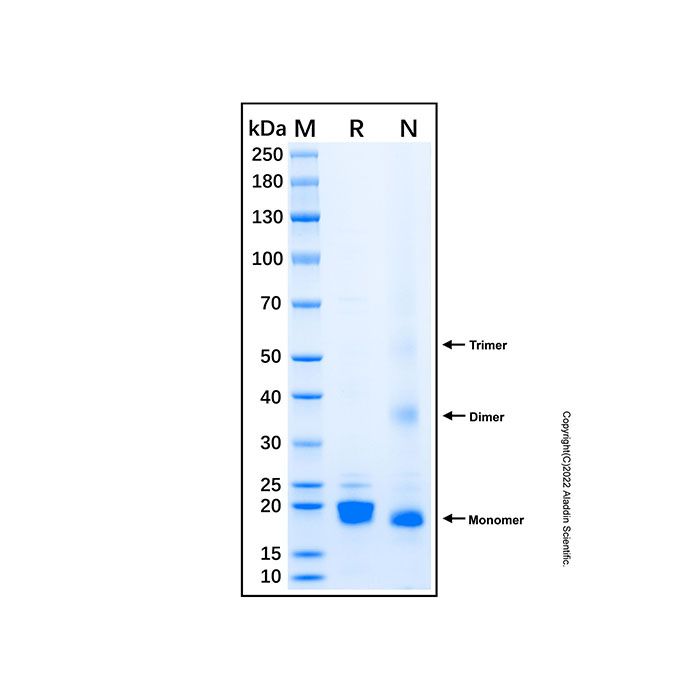
19.6 kDa, under reducing conditions; 18.3 & 36.0 & 53.7 kDa, under non-reducing conditions.
Molecule Type
Protein
Storage and Shipping
Concentration
See COA
Storage
Store at -20°C,Avoid repeated freezing and thawing
Shipped In
Ice chest + Ice pads
Stability And Storage
Store at -20℃ for 6 months. Upon receipt, it is recommended to aliquot. Avoid freeze/thaw cycle.
Images
Recombinant Human Glutathione Peroxidase 4 Protein (rp220388) - SDS-PAGE 3 μg/lane of Recombinant Human Glutathione Peroxidase 4 Protein was resolved with SDS-PAGE under reducing (R) and non-reducing (N) conditions and visualized by Coomassie® Blue staining, showing a band at 19.6 kDa under reducing conditions and 18.3 & 36.0 & 53.7 kDa under non-reducing conditions. The 30-197 amino acid fragment of the GPX4 protein may lack native structural domains, leading to exposure of hydrophobic regions and consequently increasing aggregation propensity. Additionally, substitution of selenocysteine (Sec) with cysteine (Cys) at position 73 (U73C) may enable the introduced Cys residue to form non-native disulfide bonds with adjacent cysteine residues, triggering intermolecular crosslinking and resulting in the formation of dimers or multimers (Uniprot ID: P36969).
Documentation
📋 Safety Data Sheet (SDS)
Comprehensive hazard, handling, storage, and regulatory compliance document.
We use cookies to ensure the website functions properly and, where permitted, to improve your experience. You can manage your preferences at any time in Settings. Learn more in our Cookie Policy.
Shall we send you a message when we have discounts available?
Remind me later
Thank you! Please check your email inbox to confirm.
Products are supplied to verified businesses, institutions, and qualified professionals for research and development use only. Not for use in humans, animals, diagnosis, or therapy.